Kosowska Aleksandra, Cadenas-Fernández Estefanía, Barroso Sandra, Sánchez-Vizcaíno Jose M, Barasona Jose A
VISAVET Health Surveillance Center, Complutense University of Madrid, 28040 Madrid, Spain.
Department of Animal Health, Faculty of Veterinary, Complutense University of Madrid, 28040 Madrid, Spain.
Vaccines (Basel). 2020 Dec 16;8(4):767. doi: 10.3390/vaccines8040767.
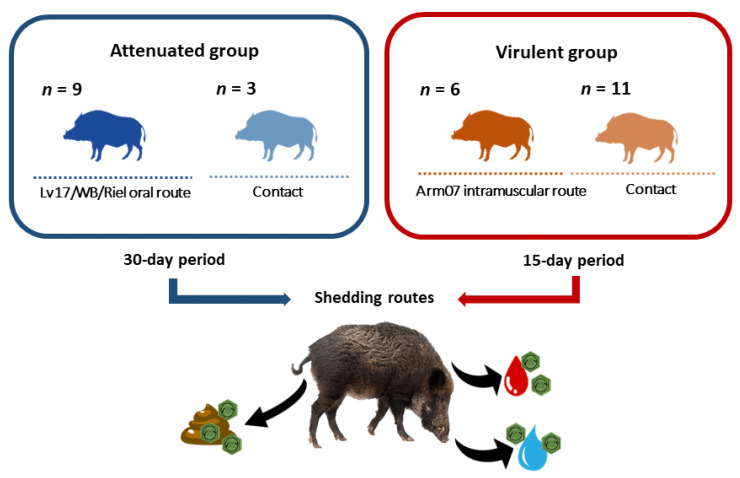
Since the reappearance of African swine fever virus (ASFV), the disease has spread in an unprecedented animal pandemic in Eurasia. ASF currently constitutes the greatest global problem for the swine industry. The wild boar () in which the pathogen has established wild self-sustaining cycles, is a key reservoir for ASFV, signifying that there is an urgent need to develop an effective vaccine against this virus. Current scientific debate addresses whether live attenuated vaccines (LAVs), which have shown promising results in cross-protection of susceptible hosts, may be feasible for vaccinations carried out owing to safety concerns. The objective of this study was, therefore, to compare the ASFV shedding in wild boar infected with virulent and attenuated (LAV) isolates. Different shedding routes (oral fluid and feces) and viremia rates were characterized in wild boar inoculated with Lv17/WB/Rie1 isolate ( = 12) when compared to those inoculated with the virulent Armenia07 isolate ( = 17). In general, fewer animals infected with the Lv17/WB/Rie1 isolate tested positive for ASFV in blood, oral fluid, and feces in comparison to animals infected with the virulent Armenia07 isolate. The shedding patterns were characterized in order to understand the transmission dynamics. This knowledge will help evaluate the shedding of new LAV candidates in wild boar populations, including the comparison with gene deletion mutant LAVs, whose current results are promising.
自非洲猪瘟病毒(ASFV)再度出现以来,该疾病已在欧亚大陆以史无前例的动物大流行形式传播。非洲猪瘟目前是全球养猪业面临的最大问题。野猪( )是该病原体在野外建立自我维持循环的宿主,是ASFV的关键储存宿主,这意味着迫切需要研发一种针对这种病毒的有效疫苗。当前的科学争论聚焦于,鉴于安全问题,在易感宿主交叉保护方面已显示出有前景结果的减毒活疫苗(LAV)用于疫苗接种是否可行。因此,本研究的目的是比较感染强毒株和减毒株(LAV)的野猪体内ASFV的排毒情况。与接种强毒亚美尼亚07株( = 17)的野猪相比,对接种Lv17/WB/Rie1株( = 12)的野猪的不同排毒途径(口腔液和粪便)及病毒血症发生率进行了特征描述。总体而言,与感染强毒亚美尼亚07株的动物相比,感染Lv17/WB/Rie1株的动物在血液、口腔液和粪便中检测出ASFV呈阳性的数量较少。对排毒模式进行特征描述以了解传播动态。这些知识将有助于评估野猪群体中新LAV候选株的排毒情况,包括与基因缺失突变体LAV进行比较,其目前的结果很有前景。