Cosseddu Gian Mario, Magwedere Kudakwashe, Molini Umberto, Pinoni Chiara, Khaiseb Sigfried, Scacchia Massimo, Marcacci Maurilia, Capobianco Dondona Andrea, Valleriani Fabrizia, Polci Andrea, Monaco Federica
Istituto Zooprofilattico Sperimentale dell'Abruzzo e del Molise "G. Caporale"-IZSAM, Campo Boario, 64100 Teramo, Italy.
Central Veterinary Laboratory (CVL), 13187 Windhoek, Namibia.
Viruses. 2020 Dec 16;12(12):1453. doi: 10.3390/v12121453.
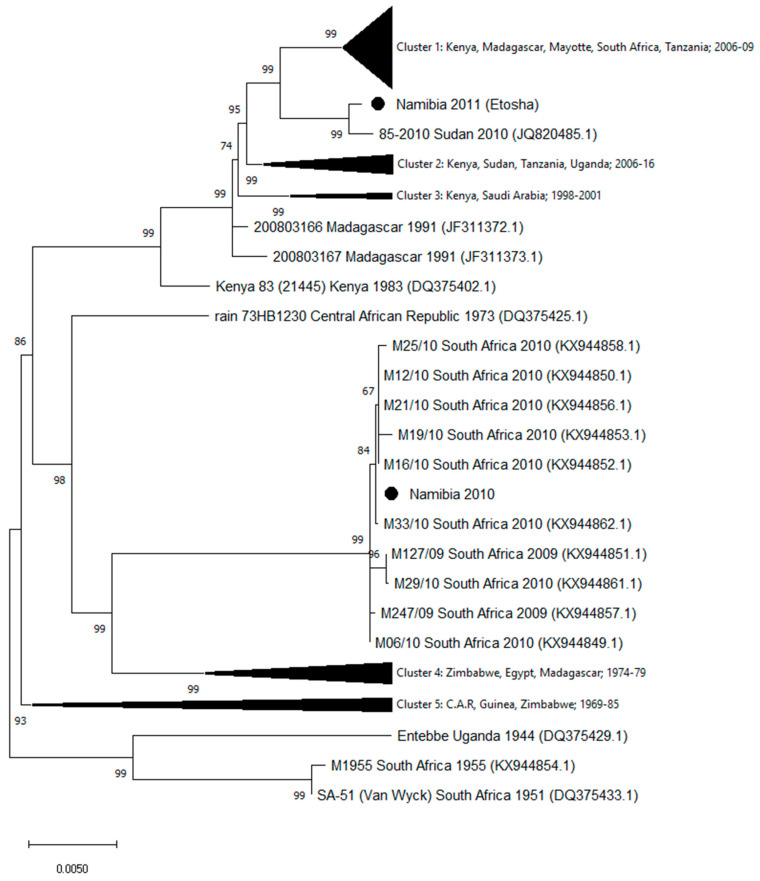
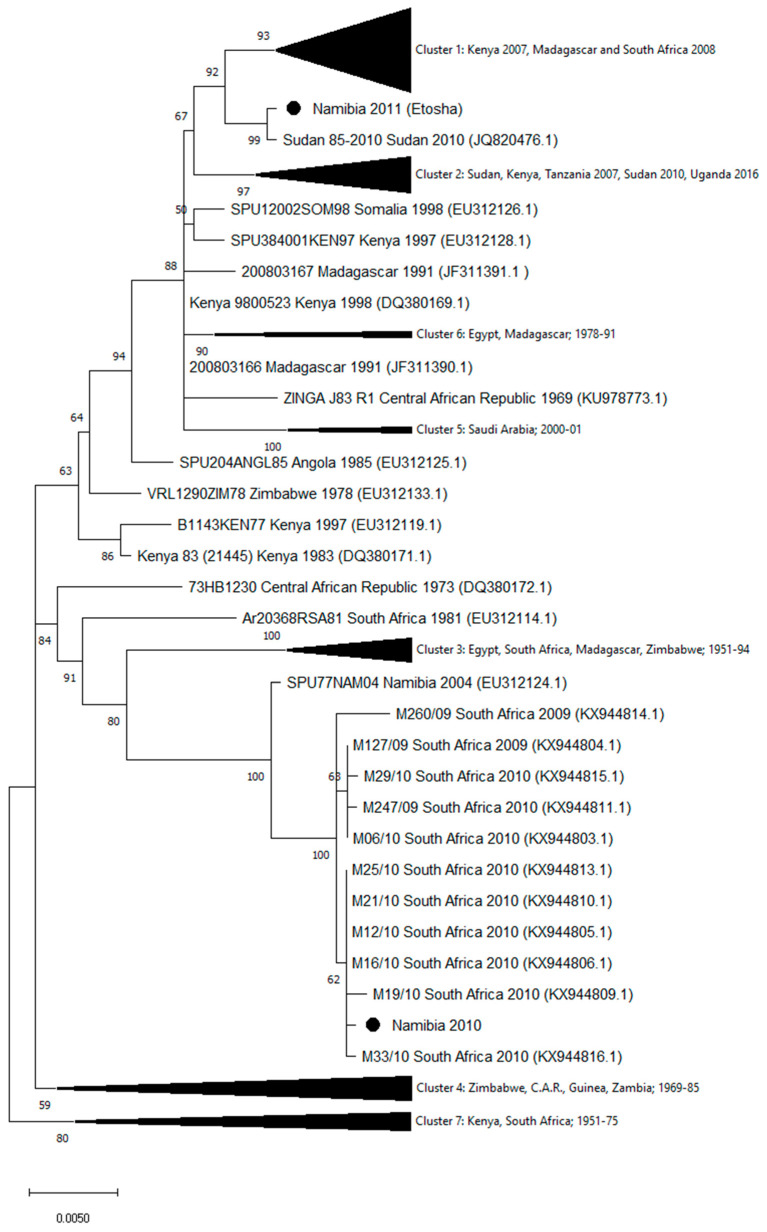
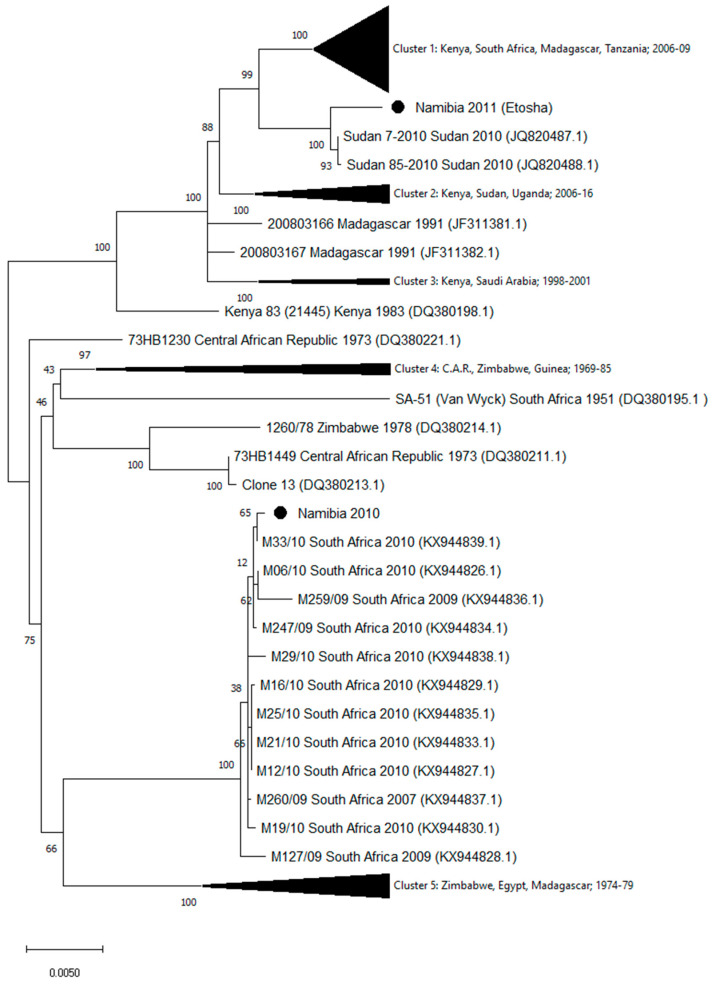
Outbreaks of Rift Valley fever (RVF) occurred in Namibia in 2010 and 2011. Complete genome characterization was obtained from virus isolates collected during disease outbreaks in southern Namibia in 2010 and from wildlife in Etosha National Park in 2011, close to the area where RVF outbreaks occurred in domestic livestock. The virus strains were sequenced using Sanger sequencing (Namibia_2010) or next generation sequencing (Namibia_2011). A sequence-independent, single-primer amplification (SISPA) protocol was used in combination with the Illumina Next 500 sequencer. Phylogenetic analysis of the sequences of the small (S), medium (M), and large (L) genome segments of RVF virus (RVFV) provided evidence that two distinct RVFV strains circulated in the country. The strain collected in Namibia in 2010 is genetically similar to RVFV strains circulating in South Africa in 2009 and 2010, confirming that the outbreaks reported in the southern part of Namibia in 2010 were caused by possible dissemination of the infection from South Africa. Isolates collected in 2011 were close to RVFV isolates from 2010 collected in humans in Sudan and which belong to the large lineage containing RVFV strains that caused an outbreak in 2006-2008 in eastern Africa. This investigation showed that the RVFV strains circulating in Namibia in 2010 and 2011 were from two different introductions and that RVFV has the ability to move across regions. This supports the need for risk-based surveillance and monitoring.
2010年和2011年,纳米比亚爆发了裂谷热(RVF)。对2010年纳米比亚南部疾病爆发期间收集的病毒分离株以及2011年埃托沙国家公园野生动物身上收集的病毒分离株进行了全基因组特征分析,这些野生动物所在区域靠近家畜发生裂谷热疫情的地区。使用桑格测序法(纳米比亚_2010)或新一代测序法(纳米比亚_2011)对病毒株进行测序。采用了一种不依赖序列的单引物扩增(SISPA)方案,并结合Illumina Next 500测序仪。对裂谷热病毒(RVFV)小(S)、中(M)、大(L)基因组片段的序列进行系统发育分析,结果表明该国存在两种不同的RVFV毒株。2010年在纳米比亚收集的毒株在基因上与2009年和2010年在南非传播的RVFV毒株相似,这证实了2010年纳米比亚南部报告的疫情可能是由南非感染传播所致。2011年收集的分离株与2010年在苏丹人类身上收集的RVFV分离株相近,这些苏丹分离株属于包含2006 - 2008年在东非引发疫情的RVFV毒株的大型谱系。这项调查表明,2010年和2011年在纳米比亚传播的RVFV毒株来自两次不同的引入,并且RVFV有跨区域传播的能力。这支持了基于风险的监测和监控的必要性。