Institute for Plant Sciences, University of Cologne, Cologne, Germany.
Department of Plant Sciences, University of California, Davis, Davis, CA.
J Hered. 2020 Dec 31;111(7):606-612. doi: 10.1093/jhered/esaa047.
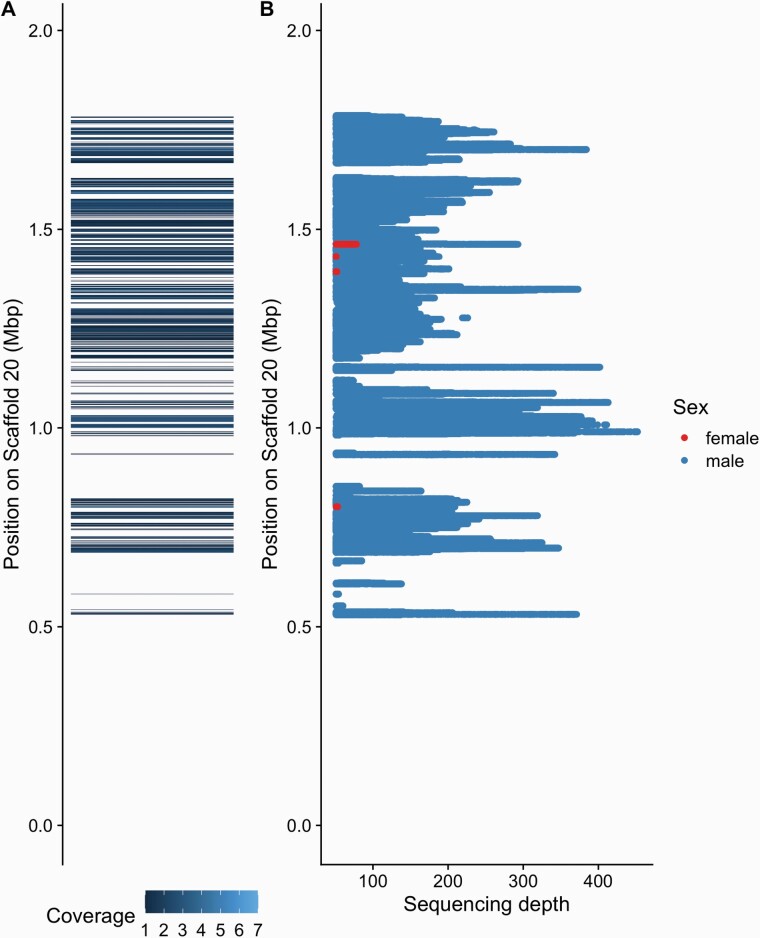
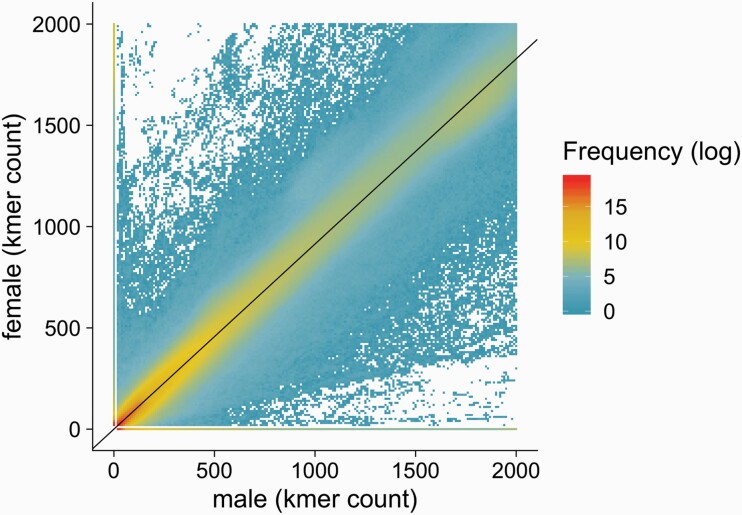
Dioecy, the separation of reproductive organs on different individuals, has evolved repeatedly in different plant families. Several evolutionary paths to dioecy have been suggested, but the mechanisms behind sex determination is not well understood. The diploid dioecious Amaranthus palmeri represents a well-suited model system to study sex determination in plants. Despite the agricultural importance of the species, the genetic control and evolutionary state of dioecy in A. palmeri is currently unknown. Early cytogenetic experiments did not identify heteromorphic chromosomes. Here, we used whole-genome sequencing of male and female pools from 2 independent populations to elucidate the genetic control of dioecy in A. palmeri. Read alignment to a close monoecious relative and allele frequency comparisons between male and female pools did not reveal significant sex-linked genes. Consequently, we employed an alignment-free k-mer comparison which enabled us to identify a large number of male-specific k-mers. We assembled male-specific contigs comprising a total of almost 2 Mb sequence, proposing a XY sex-determination system in the species. We were able to identify the potential Y chromosome in the A. palmeri draft genome sequence as 90% of our male-specific sequence aligned to a single scaffold. Based on our findings, we suggest an intermediate evolutionary state of dioecy with a young Y chromosome in A. palmeri. Our findings give insight into the evolution of sex chromosomes in plants and may help to develop sustainable strategies for weed management.
雌雄异株,即生殖器官在不同个体上的分离,在不同的植物科中多次进化。已经提出了几种向雌雄异株进化的途径,但性别决定的机制尚不清楚。二倍体雌雄异株的苋属植物 Palmeri 代表了研究植物性别决定的一个非常合适的模式系统。尽管该物种具有农业重要性,但 A. palmeri 中的雌雄异株的遗传控制和进化状态目前尚不清楚。早期的细胞遗传学实验未能鉴定出异型染色体。在这里,我们使用来自 2 个独立种群的雄性和雌性群体的全基因组测序来阐明 A. palmeri 中雌雄异株的遗传控制。与单性同株的近缘种的读序列比对和雄性和雌性群体之间的等位基因频率比较没有发现显著的性连锁基因。因此,我们采用了一种无比对的 k-mer 比较方法,该方法使我们能够识别大量的雄性特异性 k-mer。我们组装了雄性特异性的连续体,总共包含近 2 Mb 的序列,提出了该物种中的 XY 性别决定系统。我们能够在 A. palmeri 草图基因组序列中识别潜在的 Y 染色体,因为我们 90%的雄性特异性序列与单个支架对齐。基于我们的发现,我们建议 A. palmeri 中的雌雄异株处于中间进化状态,具有年轻的 Y 染色体。我们的发现深入了解了植物性染色体的进化,并可能有助于制定可持续的杂草管理策略。