Universidade Vale do Rio Doce - Univale, Governador Valadares, MG, Brazil.
Grupo Integrado de Pesquisas em Biomarcadores, Instituto René Rachou, FIOCRUZ-Minas, Belo Horizonte, MG, Brazil.
Infect Dis Poverty. 2020 Dec 20;9(1):167. doi: 10.1186/s40249-020-00763-7.
Leprosy is a chronic infectious disease classified into two subgroups for therapeutic purposes: paucibacillary (PB) and multibacillary (MB), closely related to the host immune responses. In this context it is noteworthy looking for immunological biomarkers applicable as complementary diagnostic tools as well as a laboratorial strategy to follow-up leprosy household contacts.
The cross-sectional study enrolled 49 participants, including 19 patients and 30 healthy controls. Peripheral blood mononuclear cells (PBMC) were isolated and incubated in the presence of Mycobacterium leprae bacilli. The cells were prepared for surface (CD4 and CD8) and intracytoplasmic cytokine staining (IFN-γ, IL-4 and IL-10). Multiple comparisons amongst groups were carried out by ANOVA, Kruskal-Wallis, Student T or Mann-Whitney test. Comparative analysis of categorical variables was performed by Chi-square. Functional biomarker signature analysis was conducted using the global median values for each biomarker index as the cut-off edge to identify the proportion of subjects with high biomarker levels.
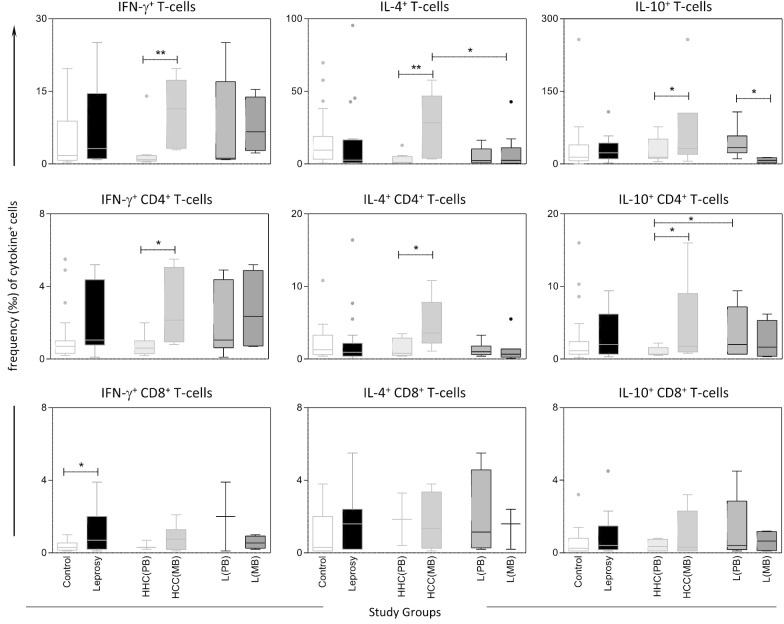
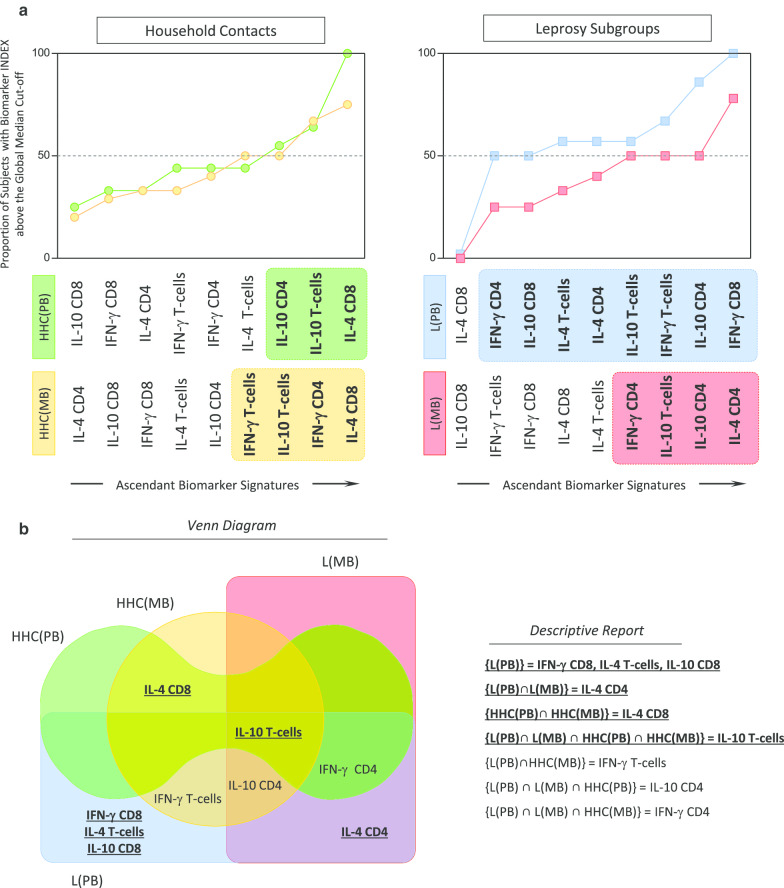
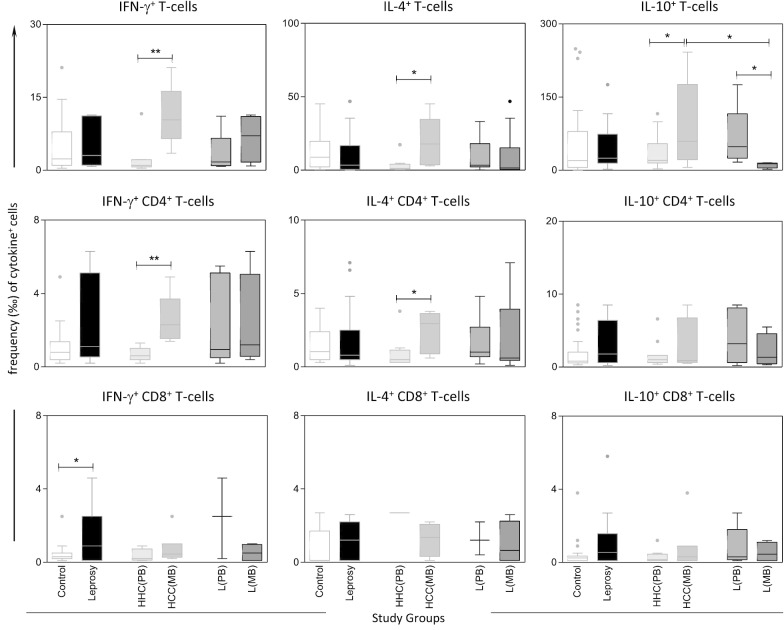
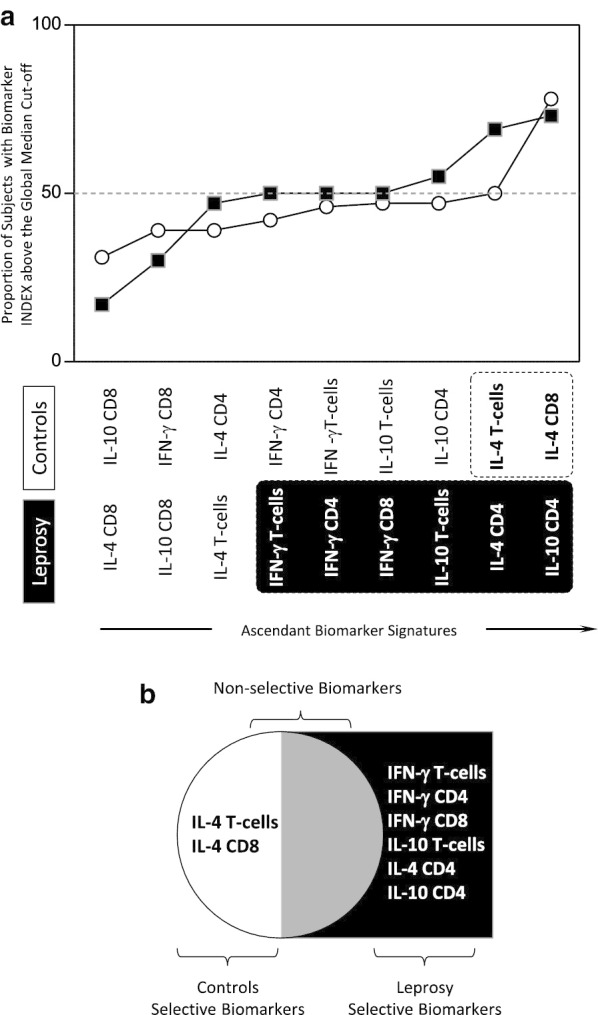
The cytokine signature analysis demonstrated that leprosy patients presented a polyfunctional profile of T-cells subsets, with increased frequency of IFN-γ T-cell subsets along with IL-10 and IL-4 from CD4 T-cells, as compared to health Controls (Venn diagram report). Moreover, statistical analysis was carried out using parametric or non-parametric variance analysis followed by pairwise multiple comparisons, according to the data normality distribution. L(PB) displayed a polyfunctional profile characterized by enhanced percentage of IFN-γ, IL-10 and IL-4 produced by most T-cell subsets, as compared to L(MB) that presented a more restricted cytokine functional profile mediated by IL-10 and IL-4 T-cells with minor contribution of IFN-γ produced by CD4 T-cells. Noteworthy was that HHC(MB) exhibited enhanced frequency of IFN-γ T-cells, contrasting with HHC(PB) that presented a cytokine profile limited to IL-10 and IL-4.
Our data demonstrated that L(PB) displayed enhanced percentage of IFN-γ, IL-10 and IL-4 as compared to L(MB) that presented functional profile mediated by IL-10 and IL-4 T-cells and HHC(MB) exhibited enhanced frequency of IFN-γ T-cells, contrasting with HHC(PB). Together, our findings provide additional immunological features associated with leprosy and household contacts. These data provide evidence that biomarkers of immune response can be useful complementary diagnostic/prognostic tools as well as insights that household contacts should be monitored to access putative subclinical infection.
麻风病是一种慢性传染病,根据宿主免疫反应,分为少菌型(PB)和多菌型(MB)两种亚型,与宿主免疫反应密切相关。在这种情况下,寻找可作为辅助诊断工具的免疫生物标志物以及麻风病家庭接触者的实验室监测策略是值得关注的。
这项横断面研究纳入了 49 名参与者,包括 19 名患者和 30 名健康对照者。分离外周血单核细胞(PBMC),并在麻风分枝杆菌存在的情况下孵育。对细胞进行表面(CD4 和 CD8)和细胞内细胞因子染色(IFN-γ、IL-4 和 IL-10)。采用方差分析、克鲁斯卡尔-沃利斯检验、学生 t 检验或曼-惠特尼检验对各组间进行多重比较。采用卡方检验比较分类变量。使用每个生物标志物指标的全局中位数作为截点值进行功能生物标志物特征分析,以确定高生物标志物水平的受试者比例。
细胞因子特征分析表明,与健康对照组相比,麻风病患者的 T 细胞亚群呈现出多能性特征,CD4 T 细胞中 IFN-γ T 细胞亚群的频率增加,同时伴有 IL-10 和 IL-4。此外,根据数据正态分布,采用参数或非参数方差分析进行统计分析,然后进行两两多重比较。L(PB)表现出多能性特征,与 L(MB)相比,大多数 T 细胞亚群产生的 IFN-γ、IL-10 和 IL-4 百分比增加,而 L(MB)表现出由 IL-10 和 IL-4 T 细胞介导的更受限的细胞因子功能特征,仅由 CD4 T 细胞产生少量 IFN-γ。值得注意的是,HHC(MB)表现出 IFN-γ T 细胞频率增加,而 HHC(PB)则表现出仅局限于 IL-10 和 IL-4 的细胞因子特征。
与 L(MB)相比,L(PB)表现出更高百分比的 IFN-γ、IL-10 和 IL-4,而 L(MB)表现出由 IL-10 和 IL-4 T 细胞介导的功能特征,HHC(MB)表现出更高频率的 IFN-γ T 细胞,而 HHC(PB)则相反。综上所述,我们的研究结果提供了与麻风病和家庭接触者相关的额外免疫特征。这些数据表明,免疫反应的生物标志物可以作为有用的辅助诊断/预后工具,并且家庭接触者应该受到监测,以评估潜在的亚临床感染。