Rohilla Jitendra, Jilowa Charan Singh, Tak Pinki, Hasan Shazia, Upadhyay Nitendra
Department of Psychiatry, All India Institute of Medical Sciences, Rishikesh, Uttarakhand, India.
Department of Psychiatry and JLN Medical College, Ajmer, Rajasthan, India.
Int J Yoga. 2020 Sep-Dec;13(3):227-232. doi: 10.4103/ijoy.IJOY_89_19. Epub 2020 Sep 13.
Premature ejaculation (PME) is a common sexual disorder. Drugs used commonly used for its treatment have various side effects and disadvantages. Yoga is being increasingly studied in a variety of medical disorders with positive results. However, its evidence for patients with PME is very limited.
The aims of this study were to investigate the effect of yoga on ejaculation time in patients with PME and to compare it with paroxetine.
This was a nonrandomized nonblinded comparative study in a tertiary care center.
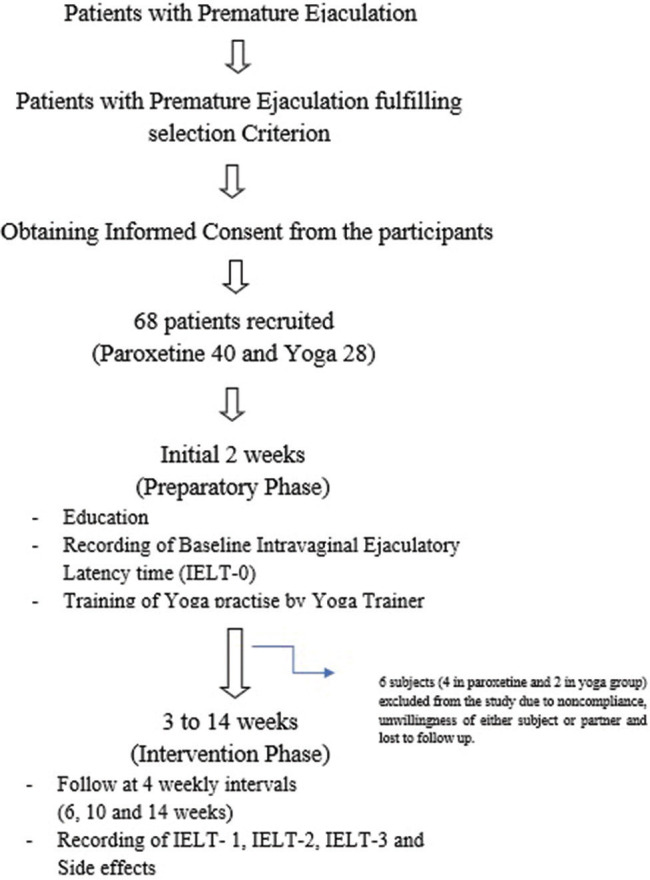
Among patients with PME, 40 selected paroxetine and 28 yoga. Intravaginal ejaculation latency time (IELT) was measured in seconds once before and three times after intervention.
Mean, standard deviation, paired and unpaired t-tests, and repeated measures ANOVA were used for statistical analysis.
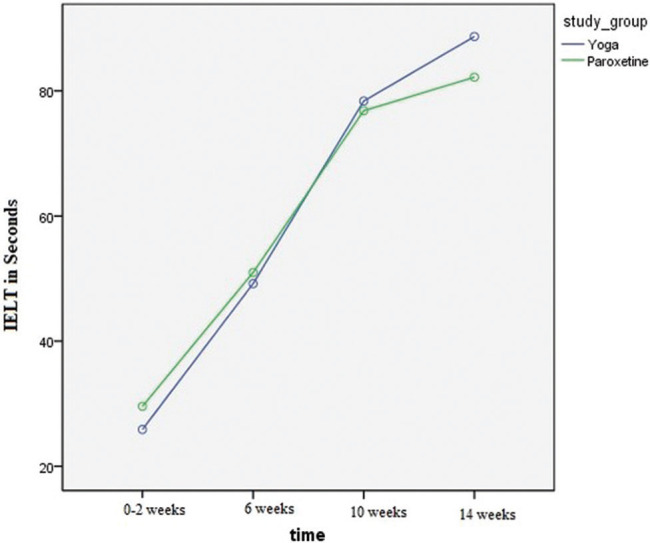
IELT was significantly increased in both groups - paroxetine (from 29.85 ± 11.9 to 82.19 ± 32.9) and yoga (from 25.88 ± 16.1 to 88697 + 26.9). Although the effect of yoga was slightly delayed in onset, its effect size (η = 0.87, < 0.05) was more than paroxetine (η = 0.73, < 0.05). One-fifth of the patients in the paroxetine group (19.5%) and 8% in the yoga group continued to have the problem of PME at the end of the trial.
Yoga caused improvement in both intravaginal ejaculation latency time and subjective sexual experience with minimal side effect. Therefore, yoga could be an easily accessible economical nonpharmacological treatment option for the patient with PME.
早泄(PME)是一种常见的性功能障碍。常用于治疗早泄的药物有各种副作用和缺点。瑜伽在各种医学疾病中的研究越来越多,且取得了积极成果。然而,其对早泄患者的证据非常有限。
本研究的目的是调查瑜伽对早泄患者射精时间的影响,并与帕罗西汀进行比较。
这是一项在三级医疗中心进行的非随机、非盲法的对照研究。
在早泄患者中,40人选择帕罗西汀治疗,28人选择瑜伽治疗。在干预前测量一次阴道内射精潜伏期(IELT),以秒为单位,干预后测量三次。
采用均值、标准差、配对和非配对t检验以及重复测量方差分析进行统计分析。
两组的阴道内射精潜伏期均显著增加——帕罗西汀组(从29.85±11.9增加到82.19±32.9)和瑜伽组(从25.88±16.1增加到88697+26.9)。虽然瑜伽的效果起效稍延迟,但其效应量(η=0.87,P<0.05)大于帕罗西汀(η=0.73,P<0.05)。在试验结束时,帕罗西汀组五分之一的患者(19.5%)和瑜伽组8%的患者仍存在早泄问题。
瑜伽可改善阴道内射精潜伏期和主观性体验,且副作用最小。因此,对于早泄患者,瑜伽可能是一种易于获得的、经济的非药物治疗选择。