Mekonnen Zelalem A, Masavuli Makutiro G, Yu Wenbo, Gummow Jason, Whelan Dawn M, Al-Delfi Zahraa, Torresi Joseph, Gowans Eric J, Grubor-Bauk Branka
Viral Immunology Group, Discipline of Surgery, Basil Hetzel Institute for Translational Medicine, University of Adelaide, Adelaide, SA, Australia.
Centre for Cancer Biology, University of South Australia, Adelaide, SA, Australia.
Front Microbiol. 2020 Nov 24;11:559105. doi: 10.3389/fmicb.2020.559105. eCollection 2020.
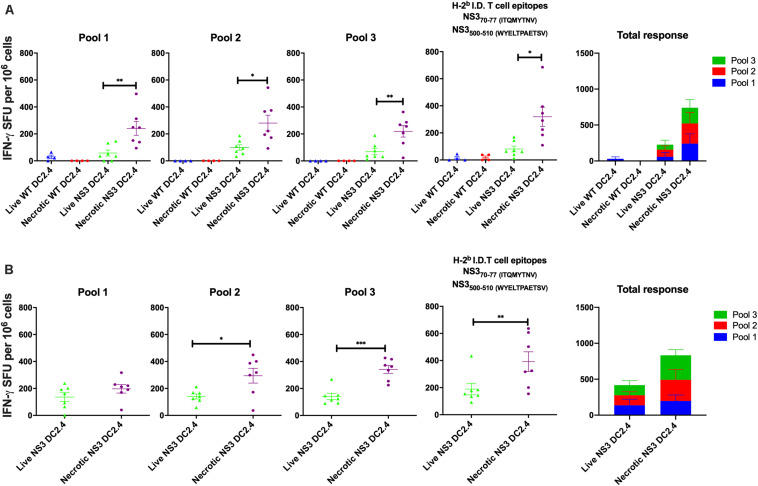
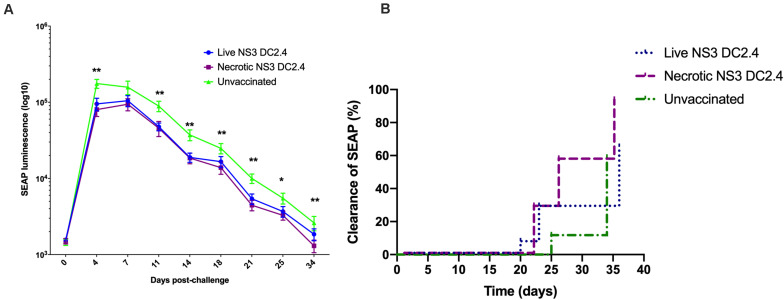
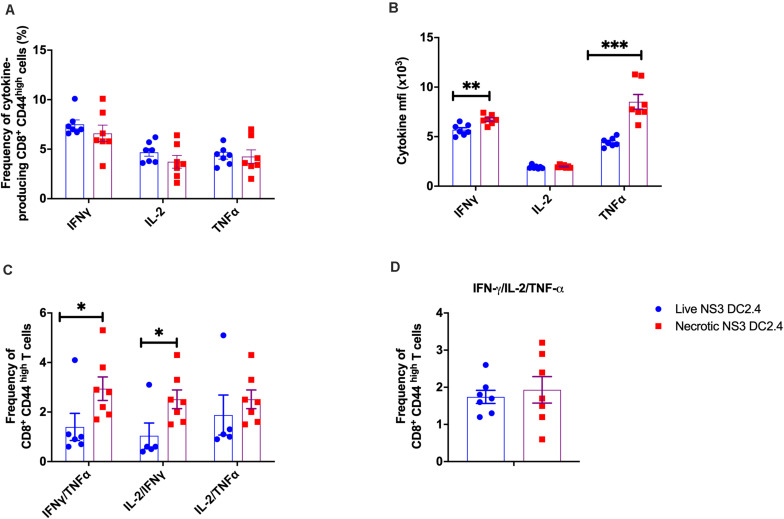
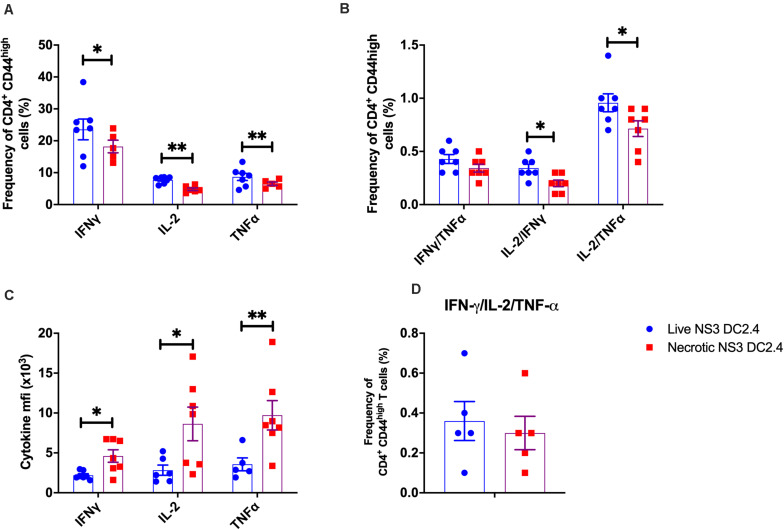
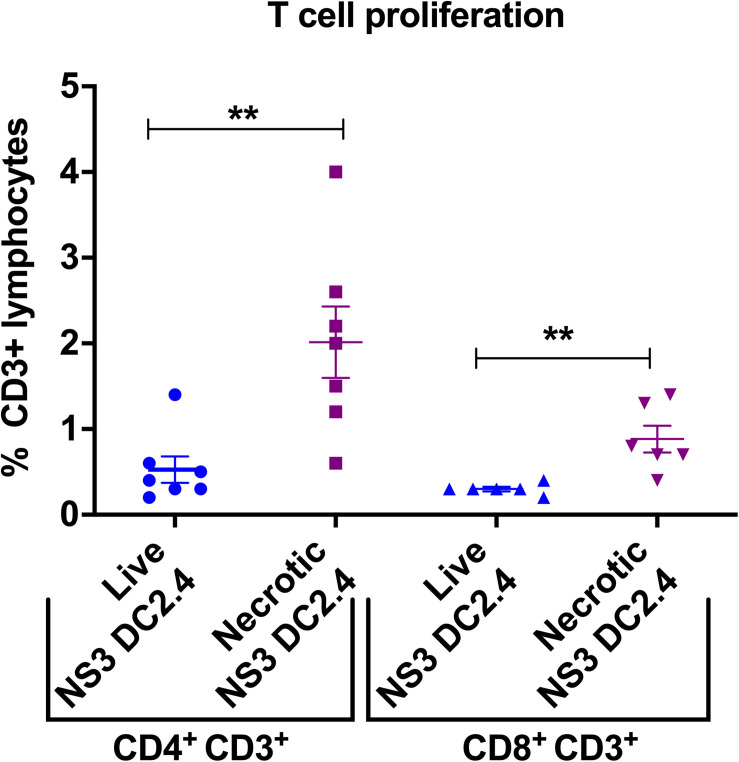
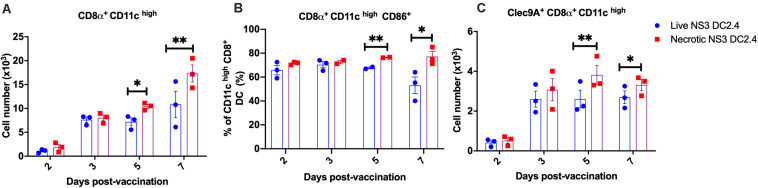
A vaccine that induces potent, broad and sustained cell-mediated immunity, resulting in effective memory has the potential to restrict hepatitis C (HCV) virus infection. Early, multi-functional CD4 and CD8 T cell responses against non-structural protein 3 (NS3) have been associated with HCV clearance. Necrotic cells generate strong immune responses and represent a major antigenic source used by dendritic cells (DC) for processing and presentation, but there is conflicting evidence as to their immunogenicity in vaccination. Immunization with DC loaded with viral antigens has been done in the past, but to date the immunogenicity of live vs. necrotic DC vaccines has not been investigated. We developed a DC2.4 cell line stably expressing HCV NS3, and compared the NS3-specific responses of live vs. necrotic NS3 DC. Vaccination of mice with necrotic NS3 DC increased the breadth of T-cell responses and enhanced the production of IL-2, TNF-α, and IFN-γ by effector memory CD4 and CD8T cells, compared to mice vaccinated with live NS3 DC. A single dose of necrotic NS3 DC vaccine induced a greater influx and activation of cross-presenting CD11c CD8α DC and necrosis-sensing Clec9A DC in the draining lymph nodes. Furthermore, using a hydrodynamic challenge model necrotic NS3 DC vaccination resulted in enhanced clearance of NS3-positive hepatocytes from the livers of vaccinated mice. Taken together, the data demonstrate that necrotic DC represent a novel and exciting vaccination strategy capable of inducing broad and multifunctional T cell memory.
一种能够诱导强大、广泛且持久的细胞介导免疫并产生有效记忆的疫苗,有潜力限制丙型肝炎病毒(HCV)感染。针对非结构蛋白3(NS3)的早期多功能CD4和CD8 T细胞反应与HCV清除有关。坏死细胞会引发强烈的免疫反应,是树突状细胞(DC)用于加工和呈递的主要抗原来源,但关于其在疫苗接种中的免疫原性存在相互矛盾的证据。过去曾用负载病毒抗原的DC进行免疫接种,但迄今为止,活DC疫苗与坏死DC疫苗的免疫原性尚未得到研究。我们构建了一个稳定表达HCV NS3的DC2.4细胞系,并比较了活NS3 DC与坏死NS3 DC的NS3特异性反应。与接种活NS3 DC的小鼠相比,用坏死NS3 DC接种小鼠可增加T细胞反应的广度,并增强效应记忆CD4和CD8 T细胞产生白细胞介素-2、肿瘤坏死因子-α和干扰素-γ的能力。单剂量坏死NS3 DC疫苗可诱导引流淋巴结中交叉呈递的CD11c CD8α DC和坏死感应Clec9A DC有更多的流入和激活。此外,使用流体动力学攻击模型,坏死NS3 DC疫苗接种可增强接种小鼠肝脏中NS3阳性肝细胞的清除。综上所述,数据表明坏死DC代表了一种新型且令人兴奋的疫苗接种策略,能够诱导广泛且多功能的T细胞记忆。