Judson Seth David, Njabo Kevin Yana, Torimiro Judith Ndongo
Department of Medicine, University of Washington, Seattle, USA.
Center for Tropical Research, University of California, Los Angeles, USA.
Pan Afr Med J. 2020 Sep 23;37(Suppl 1):16. doi: 10.11604/pamj.supp.2020.37.16.26167. eCollection 2020.
few studies have assessed risk for coronavirus disease 2019 (COVID-19) within African countries. Here we examine differences in vulnerability to COVID-19 among the ten administrative regions and two major cities of Cameroon based on epidemiological risk factors and access to healthcare resources.
regional epidemiological and healthcare access vulnerability indices were created and compared with cumulative COVID-19 cases, case fatality rates, co-morbidities, and healthcare resources in Cameroon.
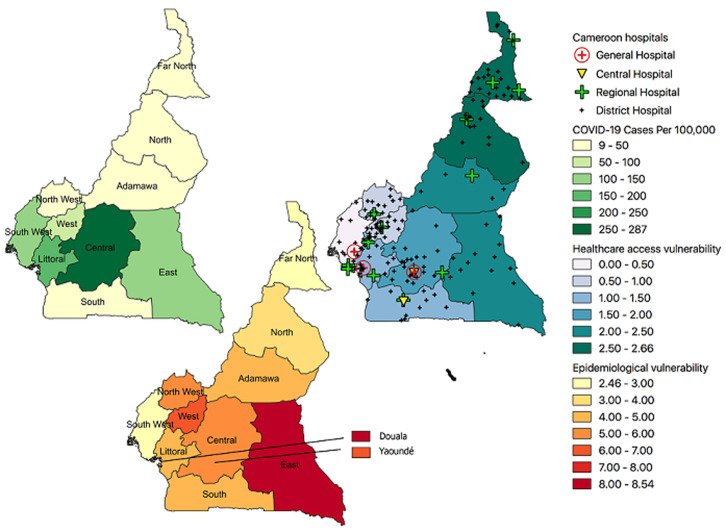
based on epidemiological risk factors, populations in the East Region, Douala (in the Littoral Region), West Region, and Yaoundé (in the Center Region) are at highest risk for COVID-19. Meanwhile, the North, Far North, East, and Adamawa Regions had the most healthcare access vulnerability. COVID-19 cases per population were highest in the Center, Littoral, and East Regions. Case fatality rates were greatest in the North Region. Potential co-morbidities with greater prevalence among COVID-19 patients included male sex, hypertension, and diabetes.
epidemiological risk factors for COVID-19 and access to healthcare varies between the regions of Cameroon. These discrepancies are potentially reflected in regional differences of COVID-19 cases and case fatality rates. In particular, the East Region has high epidemiological risk factors and low healthcare accessibility compared to other regions. Understanding the relationships between epidemiological risk factors, access to healthcare resources, and COVID-19 cases in Cameroon could aid decision-making among national policymakers and inform further research.
在非洲国家中,很少有研究评估2019冠状病毒病(COVID-19)的风险。在此,我们根据流行病学风险因素和获得医疗资源的情况,研究喀麦隆十个行政区和两个主要城市中对COVID-19易感性的差异。
创建区域流行病学和医疗可及性脆弱性指数,并与喀麦隆的COVID-19累计病例、病死率、合并症和医疗资源进行比较。
基于流行病学风险因素,东部地区、杜阿拉(滨海地区)、西部地区和雅温得(中部地区)的人群感染COVID-19的风险最高。同时,北部、极北、东部和阿达马瓦地区的医疗可及性脆弱性最大。人均COVID-19病例数在中部、滨海和东部地区最高。病死率在北部地区最高。COVID-19患者中患病率较高的潜在合并症包括男性、高血压和糖尿病。
喀麦隆各地区之间COVID-19的流行病学风险因素和获得医疗服务的情况各不相同。这些差异可能反映在COVID-19病例和病死率的区域差异上。特别是,与其他地区相比,东部地区的流行病学风险因素较高,医疗可及性较低。了解喀麦隆流行病学风险因素、获得医疗资源的情况与COVID-19病例之间的关系,有助于国家政策制定者进行决策,并为进一步的研究提供信息。