Brown Sherry-Ann, Zaharova Svetlana, Mason Peter, Thompson Jonathan, Thapa Bicky, Ishizawar David, Wilkes Erin, Ahmed Gulrayz, Rubenstein Jason, Sanchez Joyce, Joyce David, Kalyanaraman Balaraman, Widlansky Michael
Cardio-Oncology Program, Division of Cardiovascular Medicine, Medical College of Wisconsin, Milwaukee, WI, United States.
Division of Cardiovascular Medicine, Medical College of Wisconsin, Milwaukee, WI, United States.
Front Cardiovasc Med. 2020 Dec 4;7:568720. doi: 10.3389/fcvm.2020.568720. eCollection 2020.
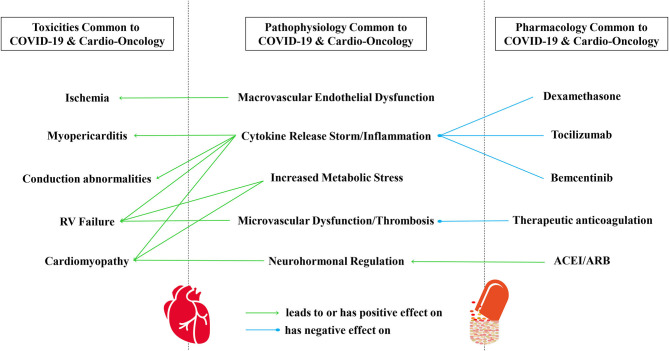
Overlapping commonalities between coronavirus disease of 2019 (COVID-19) and cardio-oncology regarding cardiovascular toxicities (CVT), pathophysiology, and pharmacology are special topics emerging during the pandemic. In this perspective, we consider an array of CVT common to both COVID-19 and cardio-oncology, including cardiomyopathy, ischemia, conduction abnormalities, myopericarditis, and right ventricular (RV) failure. We also emphasize the higher risk of severe COVID-19 illness in patients with cardiovascular disease (CVD) or its risk factors or cancer. We explore commonalities in the underlying pathophysiology observed in COVID-19 and cardio-oncology, including inflammation, cytokine release, the renin-angiotensin-aldosterone-system, coagulopathy, microthrombosis, and endothelial dysfunction. In addition, we examine common pharmacologic management strategies that have been elucidated for CVT from COVID-19 and various cancer therapies. The use of corticosteroids, as well as antibodies and inhibitors of various molecules mediating inflammation and cytokine release syndrome, are discussed. The impact of angiotensin converting enzyme inhibitors (ACEIs) and angiotensin receptor blockers (ARBs) is also addressed, since these drugs are used in cardio-oncology and have received considerable attention during the COVID-19 pandemic, since the culprit virus enters human cells the angiotensin converting enzyme 2 (ACE2) receptor. There are therefore several areas of overlap, similarity, and interaction in the toxicity, pathophysiology, and pharmacology profiles in COVID-19 and cardio-oncology syndromes. Learning more about either will likely provide some level of insight into both. We discuss each of these topics in this viewpoint, as well as what we foresee as evolving future directions to consider in cardio-oncology during the pandemic and beyond. Finally, we highlight commonalities in health disparities in COVID-19 and cardio-oncology and encourage continued development and implementation of innovative solutions to improve equity in health and healing.
2019冠状病毒病(COVID-19)与心脏肿瘤学在心血管毒性(CVT)、病理生理学和药理学方面的重叠共性是疫情期间出现的特殊话题。从这个角度来看,我们考虑了COVID-19和心脏肿瘤学共有的一系列CVT,包括心肌病、缺血、传导异常、心肌心包炎和右心室(RV)衰竭。我们还强调了患有心血管疾病(CVD)或其危险因素或癌症的患者患重症COVID-19疾病的风险更高。我们探讨了在COVID-19和心脏肿瘤学中观察到的潜在病理生理学共性,包括炎症、细胞因子释放、肾素-血管紧张素-醛固酮系统、凝血病、微血栓形成和内皮功能障碍。此外,我们研究了针对COVID-19和各种癌症疗法中CVT已阐明的常见药物管理策略。讨论了皮质类固醇以及介导炎症和细胞因子释放综合征的各种分子的抗体和抑制剂的使用。还讨论了血管紧张素转换酶抑制剂(ACEIs)和血管紧张素受体阻滞剂(ARBs)的影响,因为这些药物用于心脏肿瘤学,并且在COVID-19大流行期间受到了相当多的关注,因为致病病毒通过血管紧张素转换酶2(ACE2)受体进入人体细胞。因此,COVID-19和心脏肿瘤学综合征在毒性、病理生理学和药理学特征方面存在几个重叠、相似和相互作用的领域。更多地了解其中任何一个都可能为两者提供一定程度的见解。我们在本观点中讨论了这些主题中的每一个,以及我们预见的在大流行期间及之后心脏肿瘤学中需要考虑的不断发展的未来方向。最后,我们强调了COVID-19和心脏肿瘤学中健康差异的共性,并鼓励持续开发和实施创新解决方案,以提高健康和治疗的公平性。