Debelle Héloïse, Harkness-Armstrong Carla, Hadwin Kathryn, Maganaris Constantinos N, O'Brien Thomas D
Research Institute for Sport and Exercise Sciences, Liverpool John Moores University, Liverpool, United Kingdom.
Front Sports Act Living. 2020 Jul 21;2:82. doi: 10.3389/fspor.2020.00082. eCollection 2020.
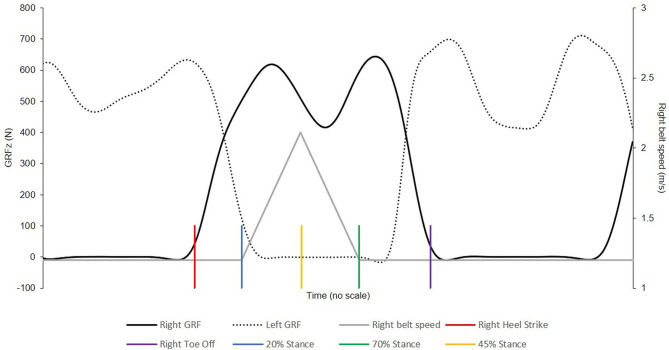
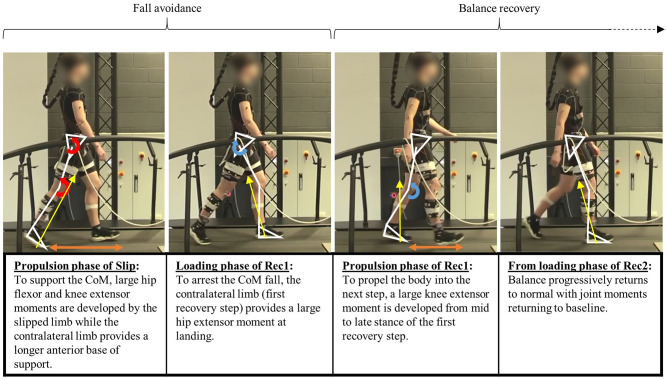
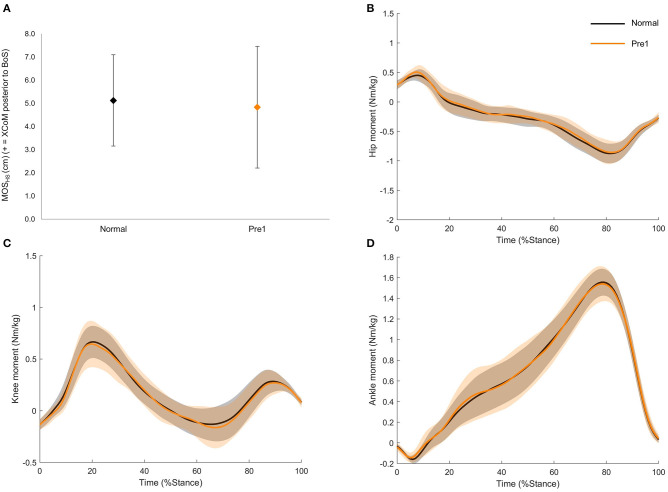
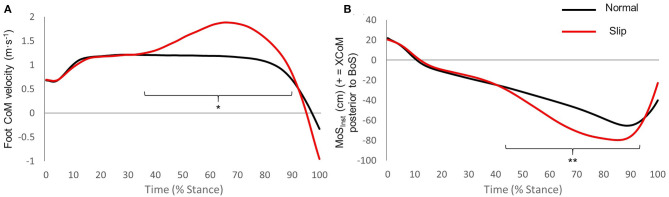
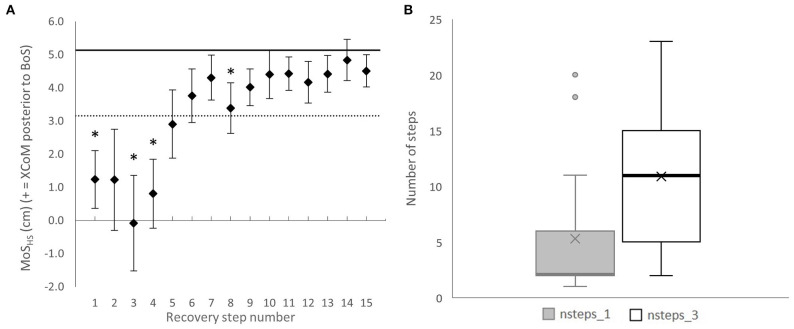
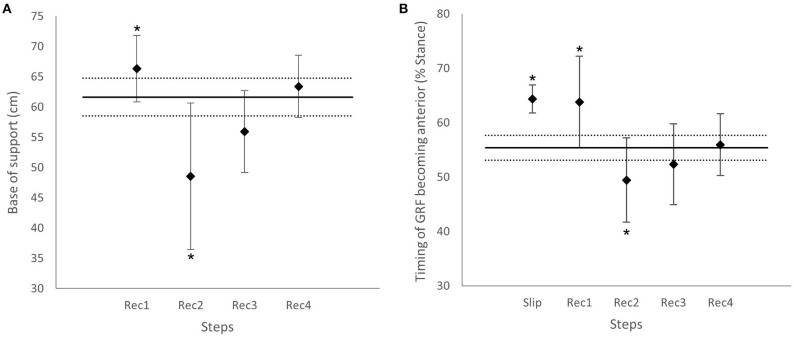
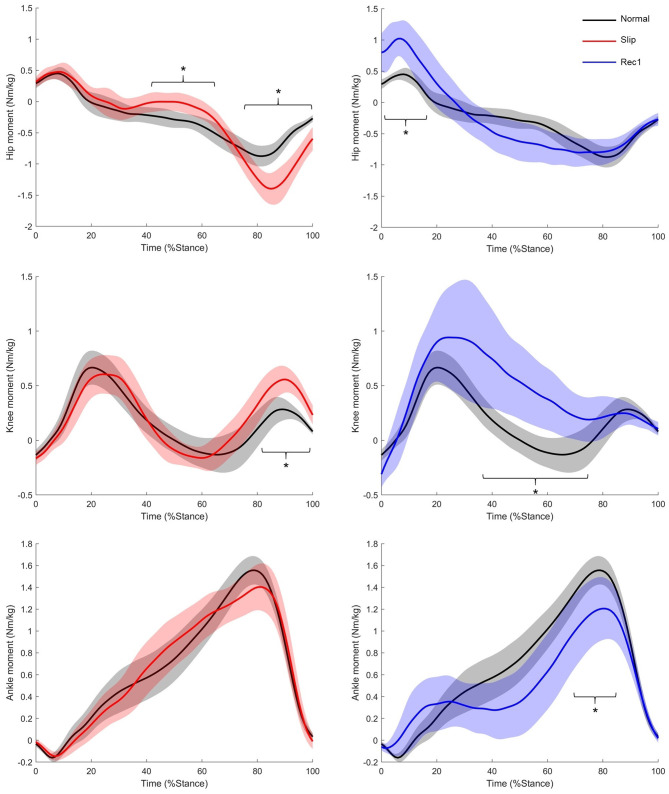
Falls commonly occur from trips and slips while walking. Recovery strategies from trips and backward falling slips have been extensively studied. However, until recently, forward falling slips (FFSs) have been considered less dangerous and have been understudied. This study aimed first to create an application to realistically simulate FFSs using a split-belt instrumented treadmill and then to understand the biomechanical requirements for young adults to recover from an FFS. We developed a semi-automatic custom-made application on D-Flow that triggered FFSs by briefly and unexpectedly increasing the speed ( = 5 m·s) of the right belt during stance. To validate the protocol, we tested against criteria defined for an ecologically and experimentally valid FFS: unexpected occurrence of the slip, increased foot velocity, forward loss of balance during the slip and consistent perturbation timing. We evaluated the recovery strategies of 17 young adults by measuring dynamic stability, joint moments and ground reaction force (GRF) vector angles before, during and on 15 steps following the FFS. The application successfully triggered FFSs, according to the criteria we defined. Participants' balance returned to normal for a minimum of three consecutive steps in 10.9 (7.0) steps. Recovery from the FFSs was characterised by larger hip flexor and knee extensor moments to support the centre of mass during the slip, and a longer first recovery step with large hip extensor moments to arrest the fall followed by large knee extensor moments to raise and advance the centre of mass into the next step ( < 0.001 compared with normal gait). Subsequent steps progressively returned to normal. This is the first study to experimentally simulate FFSs meeting the aforementioned criteria, and to measure their effects on the dynamic balance and kinetic parameters. The split-belt instrumented treadmill proved a promising tool to better study the mechanisms of falls and recovery. The required large hip and knee joint moments generally agree with findings on trips and backward falling slips and provide an indication of the functional capacities that should be targeted in fall-prevention interventions. These findings should be used to better understand and target the mechanisms of balance loss and falls in older adults following FFSs.
跌倒通常发生在行走时的绊倒和滑倒过程中。针对绊倒和向后跌倒滑倒的恢复策略已得到广泛研究。然而,直到最近,向前跌倒滑倒(FFS)一直被认为危险性较小且研究不足。本研究的首要目标是创建一个应用程序,利用分体式皮带测力跑步机逼真地模拟FFS,然后了解年轻人从FFS中恢复所需的生物力学要求。我们在D-Flow上开发了一个半自动定制应用程序,通过在站立期短暂且意外地提高右侧皮带速度(=5米/秒)来触发FFS。为验证该方案,我们对照为生态和实验有效的FFS定义的标准进行测试:滑倒的意外发生、足部速度增加、滑倒时向前失去平衡以及一致的扰动时机。我们通过测量17名年轻人在FFS之前、期间以及之后15步的动态稳定性、关节力矩和地面反作用力(GRF)矢量角度,评估他们的恢复策略。根据我们定义的标准,该应用程序成功触发了FFS。参与者的平衡在10.9(7.0)步内至少连续三步恢复正常。从FFS中恢复的特征是,在滑倒期间有更大的髋屈肌和膝伸肌力矩来支撑重心,以及更长的第一步恢复步,伴有大的髋伸肌力矩来阻止跌倒,随后是大的膝伸肌力矩来将重心提升并推进到下一步(与正常步态相比,P<0.001)。后续步骤逐渐恢复正常。这是第一项通过实验模拟符合上述标准的FFS,并测量其对动态平衡和动力学参数影响的研究。分体式皮带测力跑步机被证明是更好地研究跌倒和恢复机制的有前景的工具。所需的大的髋和膝关节力矩通常与绊倒和向后跌倒滑倒的研究结果一致,并为预防跌倒干预应针对的功能能力提供了指示。这些发现应用于更好地理解和针对老年人在FFS后平衡丧失和跌倒的机制。