Knaus Katherine R, Ebrahimi Anahid, Martin Jack A, Loegering Isaac F, Thelen Darryl G, Blemker Silvia S
Department of Biomedical Engineering, University of Virginia, Charlottesville, VA, United States.
Department of Mechanical Engineering, University of Wisconsin-Madison, Madison, WI, United States.
Front Sports Act Living. 2020 Aug 6;2:88. doi: 10.3389/fspor.2020.00088. eCollection 2020.
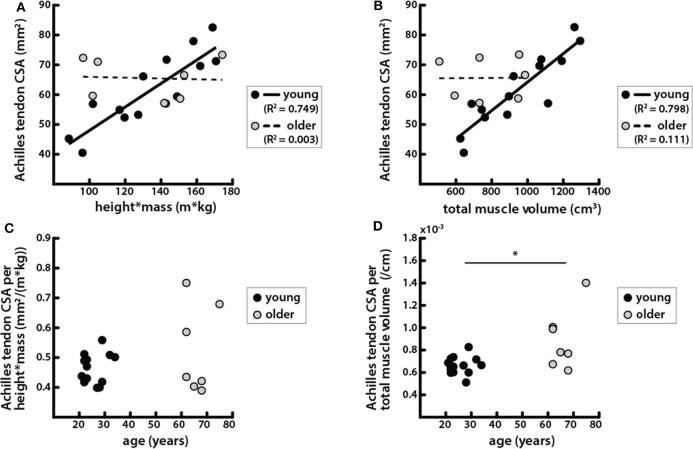
The interaction of the triceps surae muscles and the Achilles tendon is critical in producing the ankle plantarflexion torque required for human walking. Deficits in plantarflexor output are a hallmark of reduced mobility in older adults and are likely associated with changes in the triceps surae muscles that occur with age. Structural differences between young and older adults have been observed in the Achilles tendon and in the triceps surae muscles. However, less is known about how age-related differences in muscle and tendon morphology correspond with each other and, furthermore, how those morphology differences correlate with age-related deficits in function. The goal of this work was to investigate whether there is a correlation between age-related differences in triceps surae muscle size and Achilles tendon cross-sectional area (CSA) and whether either is predictive of ankle plantarflexion torque during walking. We used magnetic resonance imaging (MRI) to measure triceps surae muscle volumes and tendon CSAs in young ( = 14, age: 26 ± 4 years) and older ( = 7, age: 66 ± 5 years) adults, and we determined peak plantarflexion torques during treadmill walking. We found that individual muscle volumes as a percentage of the total triceps surae volume did not differ between young and older adults, though muscle volumes per body size (normalized by the product of height and mass) were smaller in older adults. Achilles tendon CSA was correlated with body size and muscle volumes in young adults but not in older adults. The ratio of tendon CSA to total triceps surae muscle volume was significantly greater in older adults. Peak ankle plantarflexion torque during walking correlated with body size and triceps surae volume in young and older adults but was correlated with tendon CSA only in the young adults. Structure-function relationships that seem to exist between the Achilles tendon and the triceps surae muscles in young adults are no longer evident in all older adults. Understanding mechanisms that determine altered Achilles tendon CSA in older adults may provide insight into age-related changes in function.
小腿三头肌与跟腱的相互作用对于产生人类行走所需的踝关节跖屈扭矩至关重要。跖屈肌输出不足是老年人活动能力下降的一个标志,并且可能与随着年龄增长而发生的小腿三头肌变化有关。在跟腱和小腿三头肌中已观察到年轻人和老年人之间的结构差异。然而,关于肌肉和肌腱形态的年龄相关差异如何相互对应,以及这些形态差异如何与年龄相关的功能缺陷相关联,我们了解得较少。这项工作的目的是研究小腿三头肌大小的年龄相关差异与跟腱横截面积(CSA)之间是否存在相关性,以及两者是否能预测步行过程中的踝关节跖屈扭矩。我们使用磁共振成像(MRI)测量了年轻成年人(n = 14,年龄:26±4岁)和老年人(n = 7,年龄:66±5岁)的小腿三头肌体积和肌腱CSA,并确定了跑步机行走过程中的峰值跖屈扭矩。我们发现,年轻人和老年人之间,单个肌肉体积占小腿三头肌总体积的百分比没有差异,尽管按身体大小计算的肌肉体积(通过身高和体重的乘积进行归一化)在老年人中较小。跟腱CSA与年轻成年人的身体大小和肌肉体积相关,但与老年人无关。老年人的肌腱CSA与小腿三头肌总体积的比值显著更高。步行过程中的峰值踝关节跖屈扭矩与年轻人和老年人的身体大小及小腿三头肌体积相关,但仅与年轻成年人的肌腱CSA相关。年轻人中跟腱和小腿三头肌之间似乎存在的结构 - 功能关系在所有老年人中不再明显。了解决定老年人跟腱CSA改变的机制可能有助于深入了解与年龄相关的功能变化。