Ulstrup Anton, Reinhold Michael, Falster Otto
Department of Orthopaedic Surgery, Holbæk Hospital, Holbæk, Denmark.
JSES Int. 2020 Jul 31;4(4):893-899. doi: 10.1016/j.jseint.2020.06.012. eCollection 2020 Dec.
A prerequisite for a satisfying functional result in the treatment of an irreparable rotator cuff rupture is a significant reduction of shoulder pain and better range of motion with an increase in anatomic glenohumeral joint stability.
Prospective study to examine the outcome after superior capsular reconstruction using a porcine extracellular matrix dermal graft. A special emphasis was primarily on the functional outcome, secondarily on radiographic shoulder changes, that superior capsular reconstruction might yield.
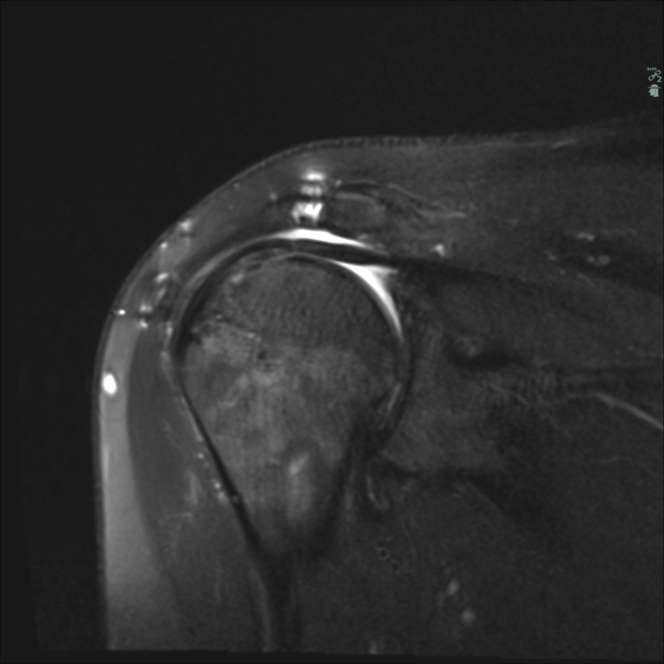
Clinical results were evaluated using the Constant score and Western Ontario Rotator Cuff (WORC) index over a 2-year period. All patients had magnetic resonance imaging (MRI) of the injured shoulder after 1 year. Graft integration and durability were qualitatively estimated as well as any graft deterioration or resorption.
Thirteen patients with 13 superior capsular reconstructions were included over a 3-year period. Mean age was 61 years (range 50-70) at the time of surgery. At final follow-up (mean 24 months, range 23-32), the mean Constant score had improved from an average of 24.9-55.7 points. The mean WORC index had increased from a percentage average of 32.3%-61.9%. Eleven of 13 grafts were intact on follow-up MRI.
Our hypothesis was that successful implantation of a dermal xenograft would correlate with both better functional outcome and stabilized glenohumeral radiographic features. We saw a group of patients with variable but significant increases in functional results and in general with limited pain and with an intact xenograft on an MRI scan. We did not find a positive correlation between functional outcome scores and graft durability nor with single cuff tendon defects vs. larger rotator cuff defects.This study suggests that a superior capsular reconstruction can yield results that are comparable or superior to other known salvage treatment options in patients with large to massive rotator cuff defects without significant cuff tear arthropathy. The hypothesis that superior capsular reconstruction can be a relevant treatment method for irreparable rotator cuff tears could not be refuted despite a fairly low patient inclusion number. With these results, selected patients can be considered for a different treatment than reverse shoulder arthroplasty, débridement, or tendon transfer.
在治疗不可修复的肩袖撕裂时,获得满意功能结果的一个前提条件是显著减轻肩部疼痛,改善活动范围,并增强盂肱关节的解剖稳定性。
进行前瞻性研究,以检查使用猪细胞外基质真皮移植物进行上盂唇重建后的结果。主要特别强调功能结果,其次是上盂唇重建可能产生的肩部影像学变化。
在两年时间内使用Constant评分和西 Ontario 肩袖(WORC)指数评估临床结果。所有患者在1年后对受伤肩部进行磁共振成像(MRI)检查。对移植物的整合和耐久性进行定性评估,以及任何移植物的退变或吸收情况。
在3年期间纳入了13例行上盂唇重建的患者。手术时的平均年龄为61岁(范围50 - 70岁)。在最终随访时(平均24个月,范围23 - 32个月),平均Constant评分从平均24.9分提高到了55.7分。平均WORC指数从平均32.3%提高到了61.9%。13例移植物中有11例在随访MRI时完好无损。
我们的假设是,真皮异种移植物的成功植入将与更好的功能结果和稳定的盂肱关节影像学特征相关。我们观察到一组患者的功能结果有不同程度但显著的改善,总体疼痛有限,且MRI扫描显示异种移植物完好无损。我们未发现功能结果评分与移植物耐久性之间存在正相关,也未发现单根肩袖肌腱缺损与较大肩袖缺损之间存在正相关。本研究表明,对于有大至巨大肩袖缺损且无明显肩袖撕裂性关节病的患者,上盂唇重建可产生与其他已知挽救治疗方案相当或更好的结果。尽管纳入患者数量相当少,但上盂唇重建可作为治疗不可修复肩袖撕裂的一种相关治疗方法这一假设无法被推翻。基于这些结果,对于特定患者可考虑采用不同于反肩关节置换、清创或肌腱转移的治疗方法。