Department of Nephrology, Nagasaki University Hospital, Nagasaki City, Nagasaki, Japan.
Department of Respiratory Medicine, Nagasaki University Graduate School of Biomedical Sciences, Nagasaki City, Nagasaki, Japan.
Med Sci Monit. 2020 Dec 21;26:e928236. doi: 10.12659/MSM.928236.
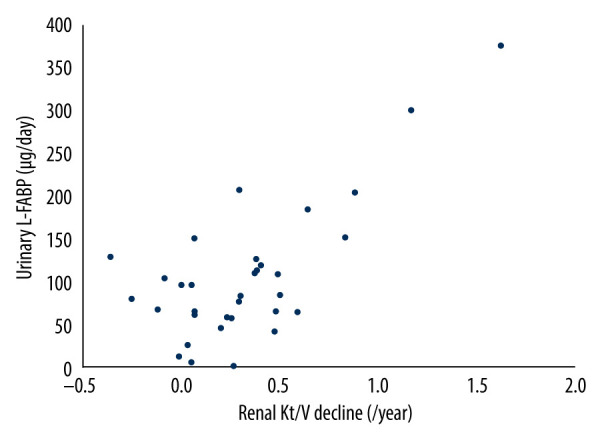
BACKGROUND Liver-type fatty acid-binding protein (L-FABP) is a predictive marker for the early detection of acute kidney injury; however, less is known about how useful it is for predicting residual renal function (RRF) decline in patients on peritoneal dialysis (PD). MATERIAL AND METHODS The study subjects were 35 patients on PD who underwent multiple peritoneal equilibration tests (PETs) between October 2011 and October 2019. Urinary L-FABP levels were analyzed with enzyme-linked immunosorbent assay. The relationship between baseline clinical data, including urinary L-FABP levels and the subsequent annual rate of renal Kt/V decline, was investigated. RESULTS The median follow-up duration was 11 months and the rate of renal Kt/V decline was 0.29/y. Compared with outcomes in the group with renal Kt/V preservation, renal Kt/V decline was associated with both high daily levels of urinary protein excretion (0.60 g/d [range, 0.50-0.87] vs. 0.36 g/d [range, 0.19-0.48]; P=0.01) and high daily levels of urinary L-FABP excretion (111.2 mg/d [range, 76.1-188.6] vs. 61.5 mg/d [range, 35.7-96.0]; P=0.002). Multiple logistic regression analysis showed that only high daily levels of urinary L-FABP excretion were independently associated with renal Kt/V decline (odds ratio 1.03, 95% confidence interval 1.00-1.05; P=0.001). Furthermore, higher daily levels of urinary L-FABP excretion were significantly correlated with the higher annual rate of renal Kt/V decline (r=0.71, P<0.001). CONCLUSIONS We demonstrated that daily levels of urinary L-FABP are associated with RRF decline in patients on PD. The results of the present study indicate that assessment of urinary L-FABP levels may help predict RRF decline in patients on PD.
肝型脂肪酸结合蛋白(L-FABP)是急性肾损伤早期检测的预测标志物;然而,对于它在腹膜透析(PD)患者中预测残余肾功能(RRF)下降的作用知之甚少。
本研究对象为 2011 年 10 月至 2019 年 10 月期间接受多次腹膜平衡试验(PET)的 35 例 PD 患者。采用酶联免疫吸附法分析尿 L-FABP 水平。研究了基线临床数据(包括尿 L-FABP 水平)与随后的年度肾脏 Kt/V 下降率之间的关系。
中位随访时间为 11 个月,肾脏 Kt/V 下降率为 0.29/y。与肾脏 Kt/V 保留组的结果相比,肾脏 Kt/V 下降与每日尿蛋白排泄量较高(0.60 g/d[范围,0.50-0.87] vs. 0.36 g/d[范围,0.19-0.48];P=0.01)和每日尿 L-FABP 排泄量较高(111.2 mg/d[范围,76.1-188.6] vs. 61.5 mg/d[范围,35.7-96.0];P=0.002)有关。多变量逻辑回归分析显示,只有每日尿 L-FABP 排泄量较高与肾脏 Kt/V 下降独立相关(比值比 1.03,95%置信区间 1.00-1.05;P=0.001)。此外,每日尿 L-FABP 排泄量较高与肾脏 Kt/V 下降的年率呈显著正相关(r=0.71,P<0.001)。
我们证明了 PD 患者的每日尿 L-FABP 水平与 RRF 下降相关。本研究结果表明,评估尿 L-FABP 水平可能有助于预测 PD 患者的 RRF 下降。