Division of Hematology, Department. of Internal Medicine, The Ohio State University Comprehensive Cancer Center Columbus, OH, USA.
Division of Cardiology, Department of Internal Medicine, The Ohio State University, Columbus, OH, USA.
Cancer Med. 2021 Feb;10(3):965-973. doi: 10.1002/cam4.3683. Epub 2020 Dec 21.
Systemic light chain (AL) amyloidosis is a clonal plasma-cell neoplasm that carries a poor prognosis. Although AL amyloidosis and Multiple Myeloma (MM) can co-exist and share various cytogenetic chromosomal abnormalities, little is known about Fluorescent in situ hybridization (FISH) and its prognostic relevance in AL amyloidosis.
The study aims to evaluate the most prevalent FISH cytogenetic abnormalities in AL patients as independent prognostic factors, and assess the impact of cytogenetics on the survival of high-risk cardiac AL patients.
MATERIALS & METHODS: This retrospective study reviewed 113 consecutive AL patients treated at The Ohio State University (OSU). Patients were divided into subgroups based on FISH data obtained within 90 days of diagnosis. Hyperdiploidy was defined as trisomies of at least 2 chromosomal loci. Primary endpoints were progression free survival (PFS) and overall survival (OS). Kaplan Meier curves were used to calculate PFS and OS. The log-rank test and Cox proportional hazard models were used to test the equality of survival functions and further evaluate the differences between groups.
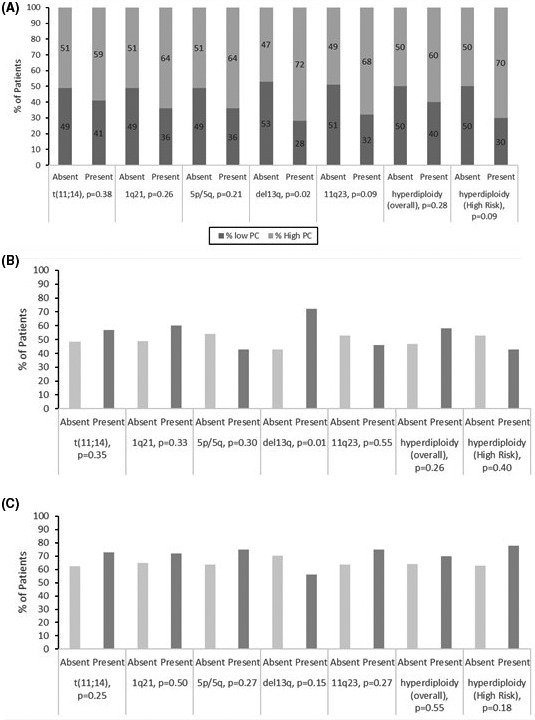
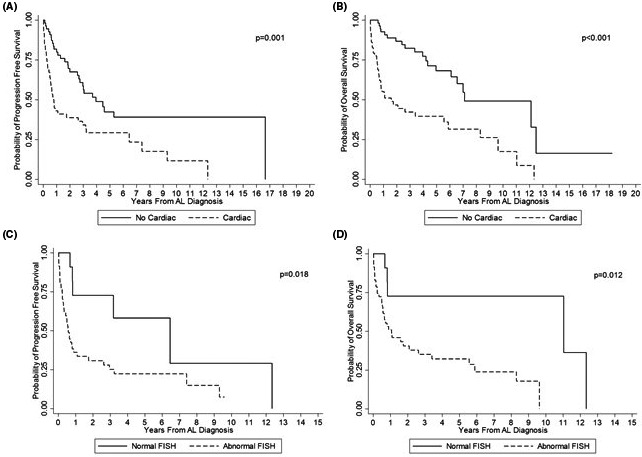
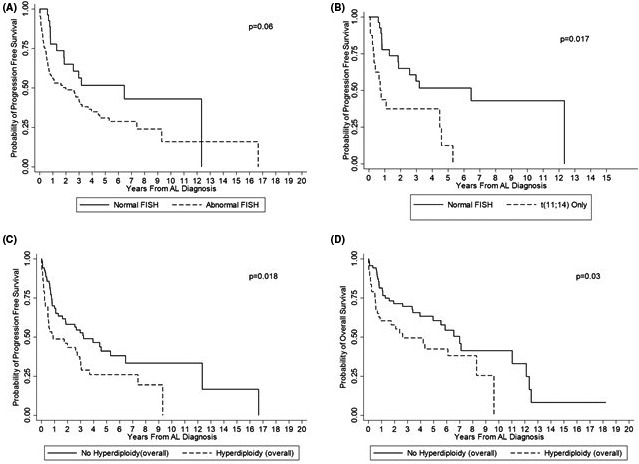
FISH abnormalities were detected in 76% of patients. Patients with abnormal FISH trended toward lower overall survival (OS) (p=0.06) and progression free survival (PFS) (p=0.06). The two most prevalent aberrations were translocation t(11;14) (39%) and hyperdiploidy-overall (38%). Hyperdiploidy-overall was associated with worsening PFS (p=0.018) and OS (p=0.03), confirmed in multivariable analysis. Patients with del 13q most frequently had cardiac involvement (p=0.006) and was associated with increased bone marrow plasmacytosis (p=0.02). Cardiac AL patients with no FISH abnormalities had much improved OS (p=0.012) and PFS (p=0.018) CONCLUSIONS: Our findings ultimately reveal the association of hyperdiploidy on survival in AL amyloidosis patients, including the high-risk cardiac AL population.
系统性轻链(AL)淀粉样变性是一种克隆性浆细胞肿瘤,预后不良。虽然 AL 淀粉样变性和多发性骨髓瘤(MM)可以共存并具有多种细胞遗传学染色体异常,但对于荧光原位杂交(FISH)及其在 AL 淀粉样变性中的预后相关性知之甚少。
本研究旨在评估 AL 患者中最常见的 FISH 细胞遗传学异常作为独立的预后因素,并评估细胞遗传学对高危心脏 AL 患者生存的影响。
本回顾性研究分析了在俄亥俄州立大学(OSU)接受治疗的 113 例连续 AL 患者。根据诊断后 90 天内获得的 FISH 数据将患者分为亚组。超二倍体定义为至少 2 个染色体位点的三体。主要终点是无进展生存期(PFS)和总生存期(OS)。使用 Kaplan-Meier 曲线计算 PFS 和 OS。对数秩检验和 Cox 比例风险模型用于检验生存函数的均等性,并进一步评估组间差异。
76%的患者存在 FISH 异常。FISH 异常患者的总生存期(OS)(p=0.06)和无进展生存期(PFS)(p=0.06)呈下降趋势。两种最常见的异常是易位 t(11;14)(39%)和超二倍体-总体(38%)。超二倍体总体与 PFS 恶化相关(p=0.018)和 OS(p=0.03),在多变量分析中得到证实。del13q 患者最常出现心脏受累(p=0.006),并与骨髓浆细胞瘤增多相关(p=0.02)。无 FISH 异常的心脏 AL 患者的 OS(p=0.012)和 PFS(p=0.018)显著改善。
我们的研究结果最终揭示了 AL 淀粉样变性患者生存与超二倍体之间的关联,包括高危心脏 AL 人群。