Nyerges Ádám, Zöldy Máté
Department of Automotive Technologies, Faculty of Transportation Engineering and Vehicle Engineering, Budapest University of Technology and Economics, H-1521 Budapest, P.O.B. 91, Hungary.
Sensors (Basel). 2020 Dec 18;20(24):7291. doi: 10.3390/s20247291.
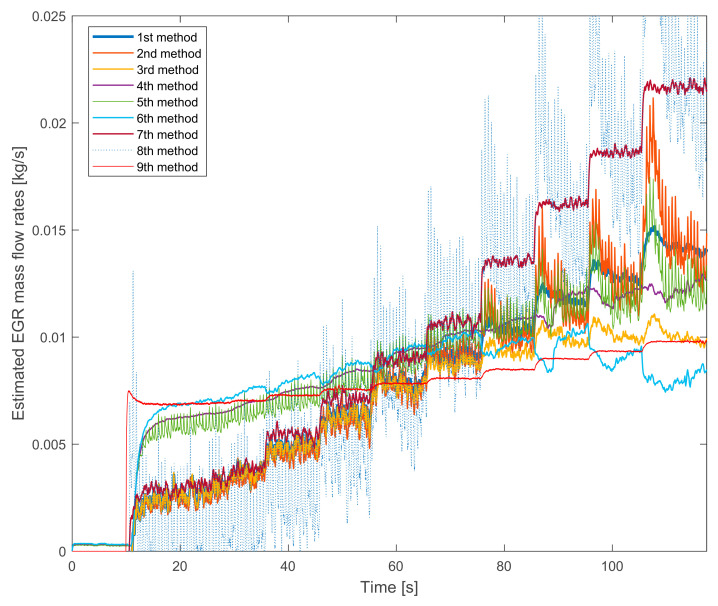
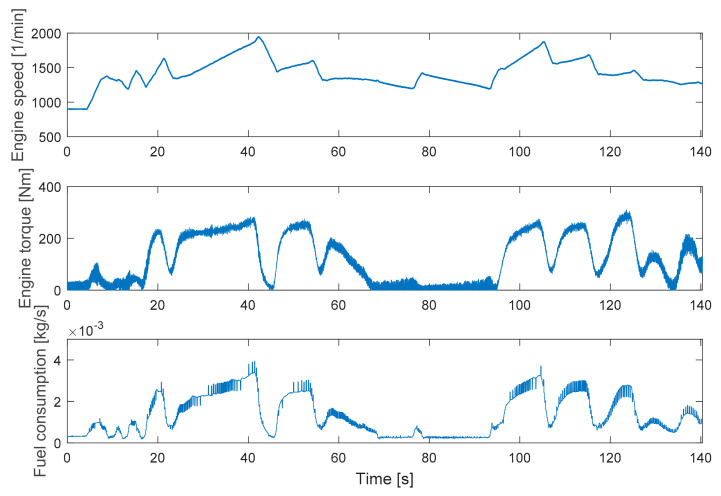
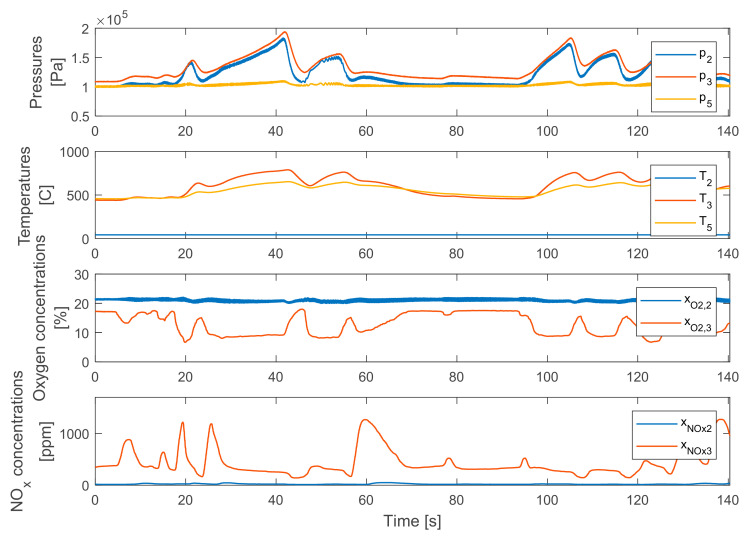
Modern Diesel engines have complex exhaust gas recirculation (EGR) systems. Due to the high temperatures, it is a typical issue to measure EGR mass flow rates in these complex control systems. Therefore, it is expedient to estimate it. Several sensed values can help the estimation: the fresh air mass flow rate, the fuel consumption, pressures, temperatures and mass fractions in the air path system. In most of the articles, the EGR mass flow rate estimation is done by the pressures. However, gas composition based models usually would be better for control aims. In this paper, nine EGR estimation methods will be presented: an important outcome is to present the required sensor architectures and estimation challenges. The comparison will be made by measurement results both in stationary operation points and transient cycles. The estimated EGR mass flow rates will be evaluated by verification conditions. The results will prove that the intake and exhaust side oxygen sensors can give verifiable signals for EGR mass flow rate estimation. In contrast, the applied fresh air mass flow rate and the nitrogen-oxide signals are not accurate enough to provide verifiable EGR mass flow rates in every operating condition. The effects of sensor inaccuracies will also be considered.
现代柴油发动机具有复杂的废气再循环(EGR)系统。由于温度较高,在这些复杂的控制系统中测量EGR质量流量是一个典型问题。因此,对其进行估算很有必要。几个传感值有助于进行估算:新鲜空气质量流量、燃油消耗、空气路径系统中的压力、温度和质量分数。在大多数文章中,EGR质量流量估算通过压力来完成。然而,基于气体成分的模型通常对控制目标更有利。本文将介绍九种EGR估算方法:一个重要成果是展示所需的传感器架构和估算挑战。将通过稳态运行点和瞬态循环的测量结果进行比较。估算的EGR质量流量将通过验证条件进行评估。结果将证明,进气侧和排气侧氧传感器能够为EGR质量流量估算提供可验证的信号。相比之下,所应用的新鲜空气质量流量和氮氧化物信号不够准确,无法在每个运行条件下提供可验证的EGR质量流量。还将考虑传感器不准确的影响。