Schulte Jessica D, Buerki Robin A, Lapointe Sarah, Molinaro Annette M, Zhang Yalan, Villanueva-Meyer Javier E, Perry Arie, Phillips Joanna J, Tihan Tarik, Bollen Andrew W, Pekmezci Melike, Butowski Nicholas, Oberheim Bush Nancy Ann, Taylor Jennie W, Chang Susan M, Theodosopoulos Philip, Aghi Manish K, Hervey-Jumper Shawn L, Berger Mitchel S, Solomon David A, Clarke Jennifer L
Department of Neurological Surgery, University of California, San Francisco, San Francisco, California, USA.
Department of Neurology, University of California, San Francisco, San Francisco, California, USA.
Neurooncol Adv. 2020 Oct 22;2(1):vdaa142. doi: 10.1093/noajnl/vdaa142. eCollection 2020 Jan-Dec.
"Diffuse midline glioma (DMG), H3 K27M-mutant" is a new tumor entity established in the 2016 WHO classification of Tumors of the Central Nervous System that comprises a set of diffuse gliomas arising in midline structures and is molecularly defined by a K27M mutation in genes encoding the histone 3 variants H3.3 or H3.1. While this tumor entity is associated with poor prognosis in children, clinical experience in adults remains limited.
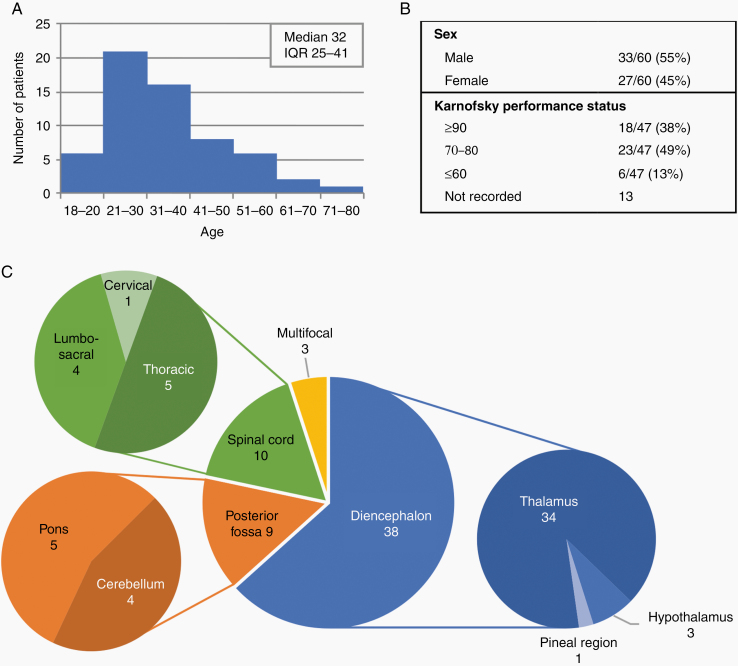
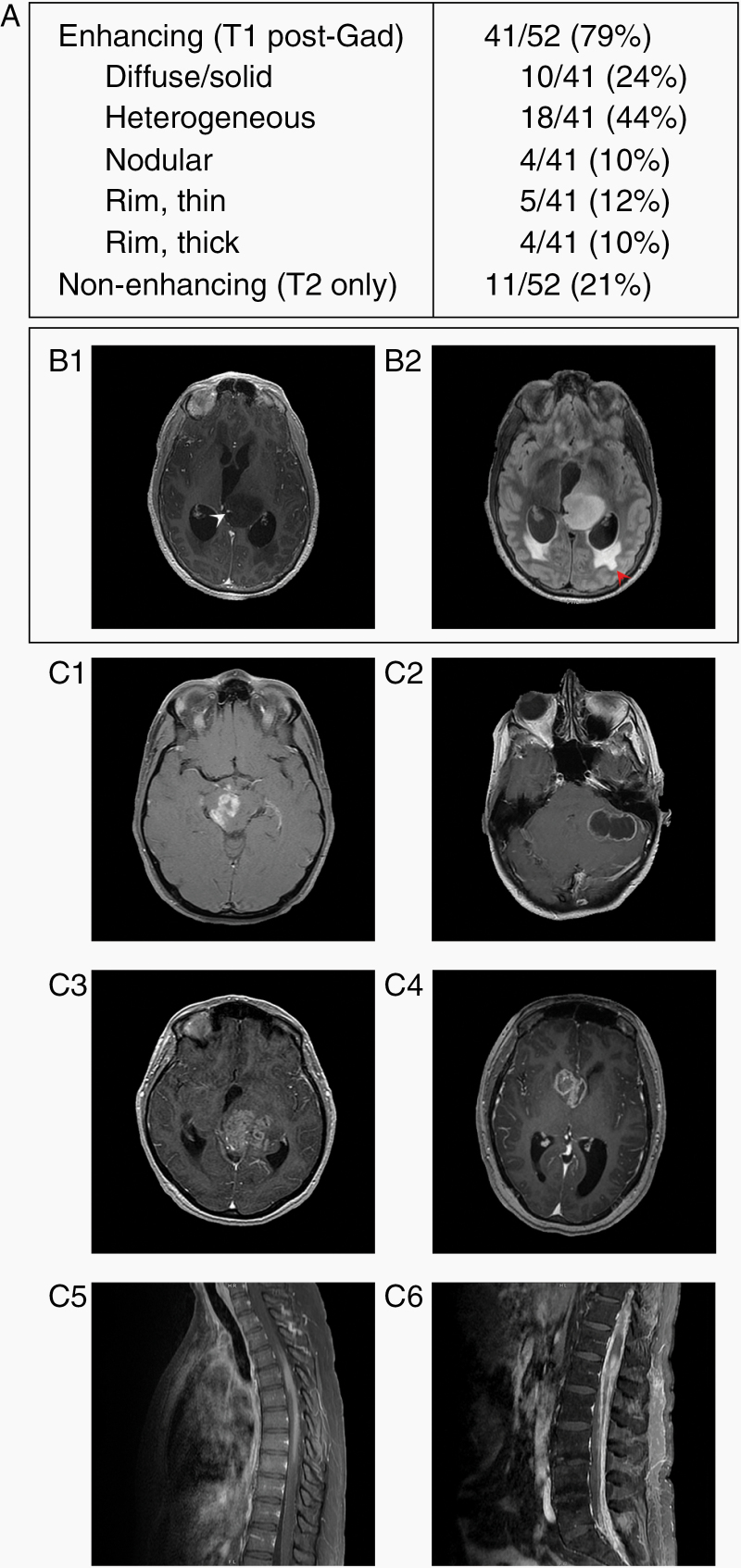
Patient demographics, radiologic and pathologic characteristics, treatment course, progression, and patient survival were collected for 60 adult patients with DMG, H3 K27M-mutant. A subset of tumors also underwent next-generation sequencing. Analysis of progression-free survival and overall survival was conducted using Kaplan-Meier modeling, and univariate and multivariate analysis.
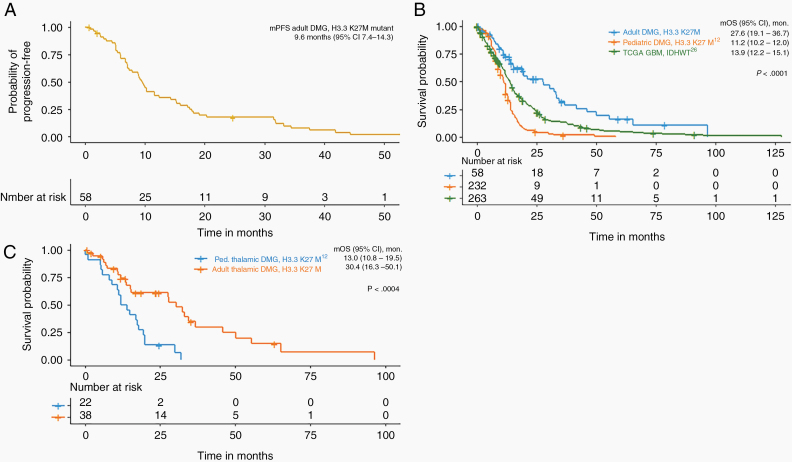
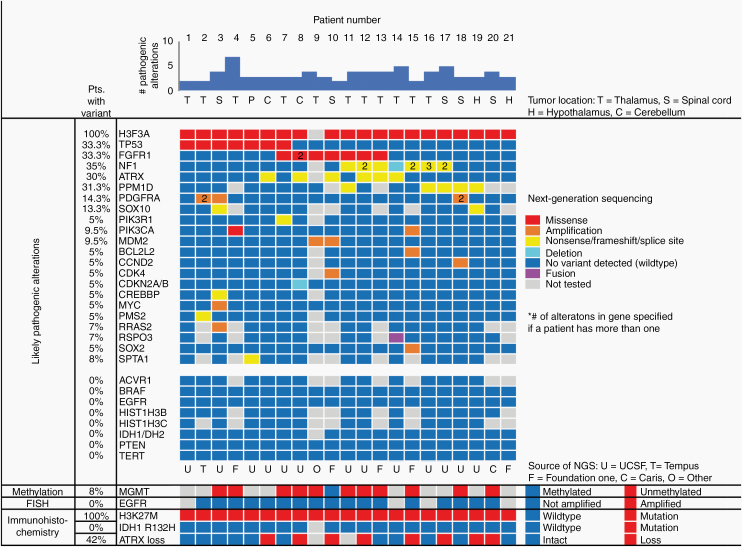
Median patient age was 32 years (range 18-71 years). Tumors were centered in the thalamus ( = 34), spinal cord (10), brainstem (5), cerebellum (4), or other midline sites (4), or were multifocal (3). Genomic profiling revealed p.K27M mutations exclusively in the gene and an absence of mutations in , which are present in approximately one-third of pediatric DMGs. Accompanying mutations in , , , , and were frequently found. The overall survival of this adult cohort was 27.6 months, longer than historical averages for both H3 K27M-mutant DMG in children and IDH-wildtype glioblastoma in adults.
Together, these findings indicate that H3 K27M-mutant DMG represents a heterogeneous disease with regard to outcomes, sites of origin, and molecular pathogenesis in adults versus children.
“弥漫性中线胶质瘤(DMG),H3 K27M突变型”是2016年世界卫生组织中枢神经系统肿瘤分类中确立的一种新的肿瘤实体,它包括一组起源于中线结构的弥漫性胶质瘤,在分子水平上由编码组蛋白3变体H3.3或H3.1的基因中的K27M突变所定义。虽然这种肿瘤实体与儿童预后不良相关,但成人的临床经验仍然有限。
收集了60例H3 K27M突变型成人DMG患者的人口统计学资料、放射学和病理学特征、治疗过程、病情进展及患者生存情况。一部分肿瘤还进行了二代测序。采用Kaplan-Meier模型以及单因素和多因素分析对无进展生存期和总生存期进行分析。
患者中位年龄为32岁(范围18 - 71岁)。肿瘤主要位于丘脑(n = 34)、脊髓(10例)、脑干(5例)、小脑(4例)或其他中线部位(4例),或为多灶性(3例)。基因组分析显示仅在 基因中有p.K27M突变,而 基因无突变,约三分之一儿童DMG存在 基因突变。经常发现 、 、 、 和 基因的伴随突变。该成人队列的总生存期为27.6个月,长于儿童H3 K27M突变型DMG和成人异柠檬酸脱氢酶(IDH)野生型胶质母细胞瘤的历史平均生存期。
总之,这些发现表明,H3 K27M突变型DMG在成人和儿童中的预后、起源部位及分子发病机制方面均表现为一种异质性疾病。