Leibniz-Institute for Food Systems Biology at the Technical University of Munich, Freising, Germany.
Department of Molecular Genetics, German Institute of Human Nutrition Potsdam-Rehbruecke, Nuthetal, Germany.
Genome Biol Evol. 2021 Jan 7;13(1). doi: 10.1093/gbe/evaa264.
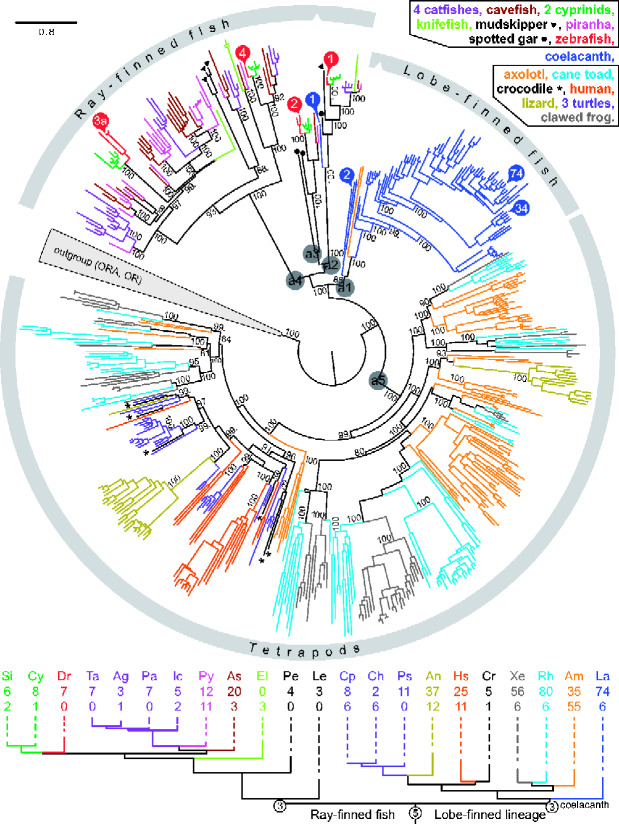
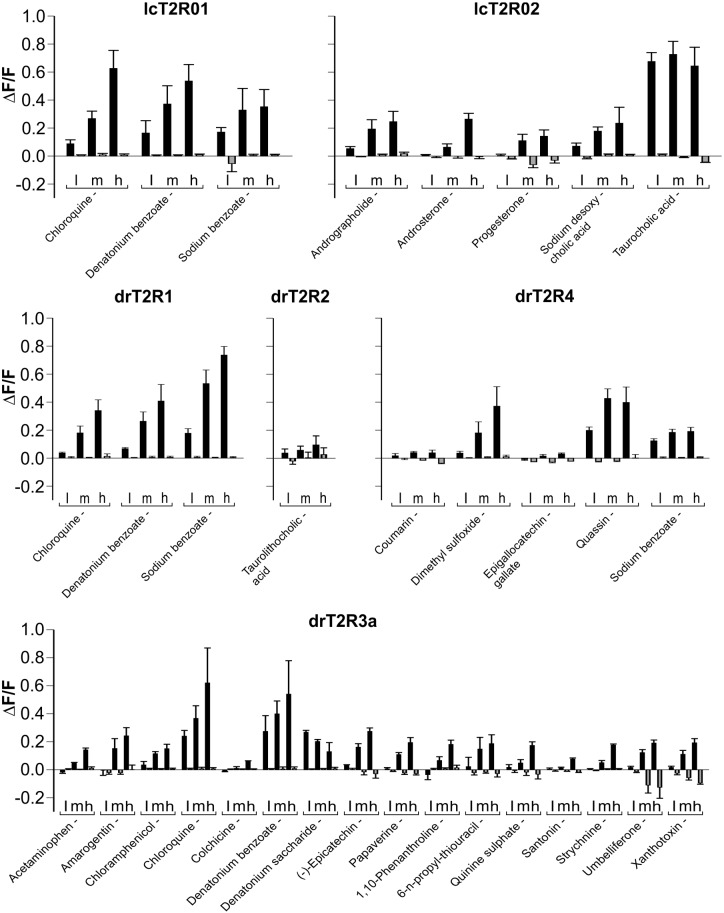
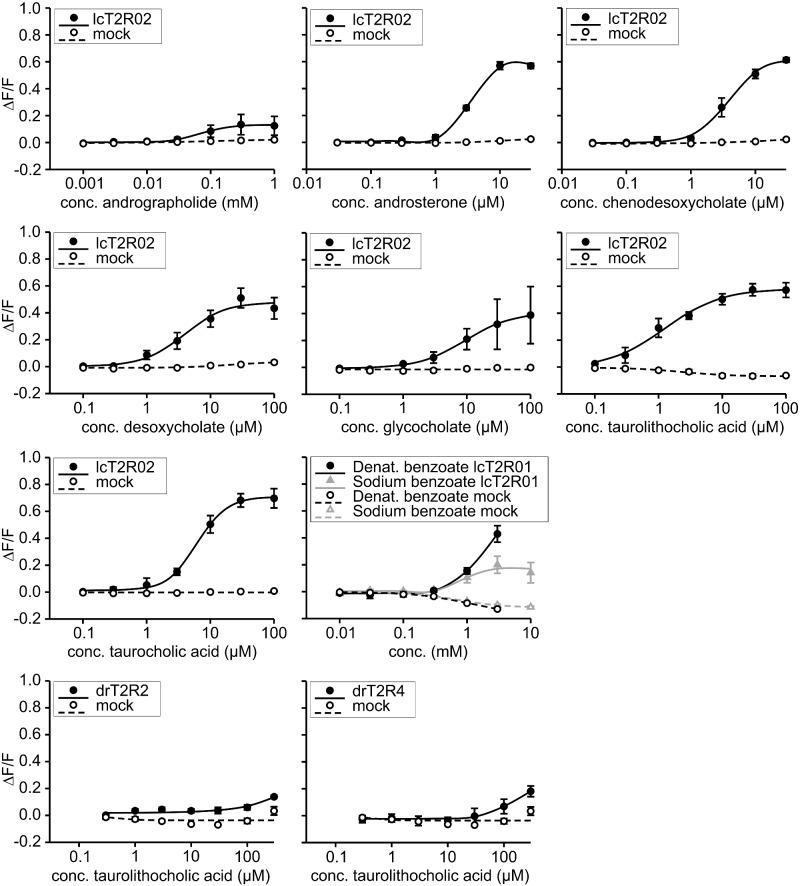
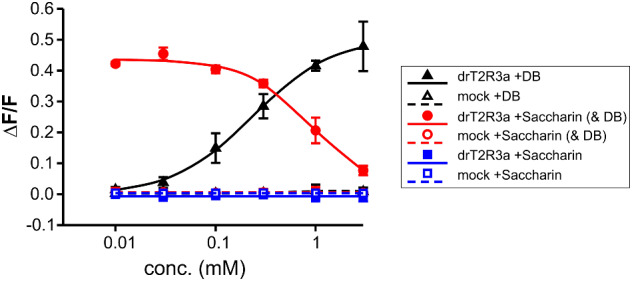
The careful evaluation of food is important for survival throughout the animal kingdom, and specialized chemoreceptors have evolved to recognize nutrients, minerals, acids, and many toxins. Vertebrate bitter taste, mediated by the taste receptor type 2 (T2R) family, warns against potentially toxic compounds. During evolution T2R receptors appear first in bony fish, but the functional properties of bony fish T2R receptors are mostly unknown. We performed a phylogenetic analysis showing the "living fossil" coelacanth (Latimeria chalumnae) and zebrafish (Danio rerio) to possess T2R repertoires typical for early-diverged species in the lobe-finned and the ray-finned clade, respectively. Receptors from these two species were selected for heterologous expression assays using a diverse panel of bitter substances. Remarkably, the ligand profile of the most basal coelacanth receptor, T2R01, is identical to that of its ortholog in zebrafish, consistent with functional conservation across >400 Myr of separate evolution. The second coelacanth receptor deorphaned, T2R02, is activated by steroid hormones and bile acids, evolutionary old molecules that are potentially endogenously synthesized agonists for extraoral T2Rs. For zebrafish, we report the presence of both specialized and promiscuous T2R receptors. Moreover, we identified an antagonist for one of the zebrafish receptors suggesting that bitter antagonism contributed to shape this receptor family throughout evolution.
动物王国中,对食物的仔细评估对于生存至关重要,因此进化出了专门的化学感受器来识别营养物质、矿物质、酸和许多毒素。脊椎动物的苦味感知由味觉受体类型 2(T2R)家族介导,可预警潜在的有毒化合物。在进化过程中,T2R 受体首先出现在硬骨鱼中,但硬骨鱼 T2R 受体的功能特性在很大程度上尚不清楚。我们进行了系统发育分析,结果表明“活化石”腔棘鱼(Latimeria chalumnae)和斑马鱼(Danio rerio)分别拥有与早期分异的肉鳍鱼和辐鳍鱼支系中典型的 T2R 基因库。我们选择了来自这两个物种的受体,并用多样化的苦味物质进行了异源表达测定。值得注意的是,最基础的腔棘鱼受体 T2R01 的配体谱与其在斑马鱼中的同源物相同,这表明在 >400 Myr 的独立进化过程中存在功能保守性。第二个被鉴定的腔棘鱼受体 T2R02 被类固醇激素和胆酸激活,这些是古老的进化分子,可能是口腔外 T2R 的内源性合成激动剂。对于斑马鱼,我们报告了存在专门和混杂的 T2R 受体。此外,我们鉴定出了一种斑马鱼受体的拮抗剂,这表明苦味拮抗作用在整个进化过程中促成了该受体家族的形成。