National Institute of Neoplastic Diseases, Lima, Peru.
Peruvian Group of Clinical Studies in Oncology, Lima, Peru.
Thorac Cancer. 2021 Feb;12(4):420-425. doi: 10.1111/1759-7714.13760. Epub 2020 Dec 23.
To assess the correlation of WHO histological classification and Masaoka-Koga staging system of thymic epithelial tumors (TETs) with prognosis.
We retrospectively analyzed 83 patients with TETs in the Instituto Nacional de Enfermedades Neoplasicas between 1996 to 2018. We analyzed the clinical stages, histological types and treatment modalities and attempted to determine the impact on overall survival. The data was retrieved from clinical files and reviewed by a pathologist who reclassificated according to the 2004 WHO classification system. The staging was performed with the Masaoka-Koga staging system. Survival curves were constructed with Kaplan-Meir method.
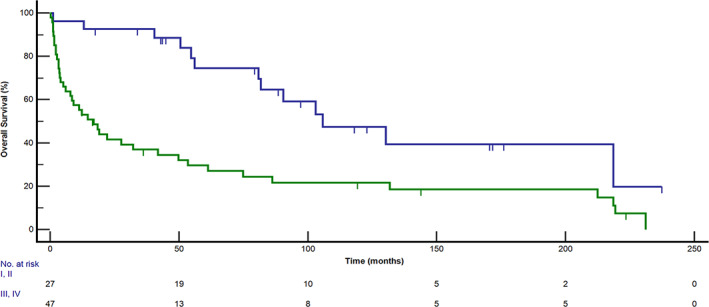
There was a total of 83 patients with a median age of 55 years old included in the study. The histological type corresponded to thymoma (T) in 63.8% (n = 53) and to thymic carcinoma (TC) in 36.1%. T were type A, AB, B1, B2 and B3 in 14.4%, 18%, 12%, 3.6%, 7.4% of cases, respectively. The proportion of advanced disease (Masaoka stage III-IV) was high (65%). With a median follow-up of 88.4 months, median overall survival (OS) was 81.6 months for T and 12.3 months for TC (P = 0.01). Univariate analysis showed that sex, histological type, clinical stage and surgery (P = 0.01) were significant independent prognostic factors. On multivariate analysis, histology type and Masaoka-Koga staging had an effect on survival.
The results indicates a clear association between the WHO histological classification and Masaoka-Koga staging system with survival. We found a higher proportion of TETs with advanced disease at diagnosis. Further research are required and collaboration is important to foster knowledge focused on classification and treatment.
SIGNIFICANT FINDINGS OF THE STUDY: The WHO histological classification, the Masaoka-Koga system and surgery treatment were associated with overall survival.
To determine prognosis factors in TETs.
评估世界卫生组织(WHO)组织学分型与胸腺癌(TET)Masaoka-Koga 分期系统与预后的相关性。
我们回顾性分析了 1996 年至 2018 年期间 INEN 研究所 83 例 TET 患者的临床资料。我们分析了临床分期、组织学类型和治疗方式,并试图确定其对总生存率的影响。数据从临床档案中检索,由病理学家进行回顾性分析,并根据 2004 年 WHO 分类系统重新分类。分期采用 Masaoka-Koga 分期系统。生存曲线采用 Kaplan-Meier 法构建。
本研究共纳入 83 例患者,中位年龄 55 岁。组织学类型为胸腺瘤(T)占 63.8%(n=53),胸腺癌(TC)占 36.1%。T 型分别为 A、AB、B1、B2 和 B3,占比分别为 14.4%、18%、12%、3.6%和 7.4%。晚期疾病(Masaoka 分期 III-IV 期)比例较高(65%)。中位随访 88.4 个月,T 组中位总生存期(OS)为 81.6 个月,TC 组为 12.3 个月(P=0.01)。单因素分析显示,性别、组织学类型、临床分期和手术(P=0.01)是显著的独立预后因素。多因素分析显示,组织学类型和 Masaoka-Koga 分期对生存有影响。
结果表明,WHO 组织学分型与 Masaoka-Koga 分期系统与生存密切相关。我们发现诊断时 TET 患者晚期疾病的比例较高。需要进一步研究,合作对于关注分类和治疗的知识的发展很重要。
WHO 组织学分型、Masaoka-Koga 系统和手术治疗与总生存率相关。
确定 TET 的预后因素。