Lu Tao, Li Qiang, Li Lan, Yang Kaizhen, Zhou Danfei, Gao Jie, Chen Minjiang, Xu Yan, Zhong Wei, Wang Mengzhao, Liang Zhiyong, Zhao Jing
Department of Pathology, Peking Union Medical College Hospital, Peking Union Medical College, Chinese Academy of Medical Sciences, Beijing 100730, China.
Department of Respiratory Medicine, Beijing No.6 Hospital, Beijing 100007, China.
Zhongguo Fei Ai Za Zhi. 2020 Dec 20;23(12):1059-1065. doi: 10.3779/j.issn.1009-3419.2020.104.23.
The lack of pathological quality control standard in detecting epidermal growth factor receptor (EGFR) gene mutation in malignant pleural effusion leads to confusion in the interpretation of detection results and the clinical use of EGFR-tyrosine kinase inhibitor (TKI). Therefore, it is very important to propose quality control standards and guide the detection of EGFR mutation in pleural effusion. The aim of this study is to retrospectively analyze the results of EGFR gene mutation in pleural effusion sediment section according to strict pathological quality control standards, and the therapeutic effect of EGFR-TKIs guided by this detection results.
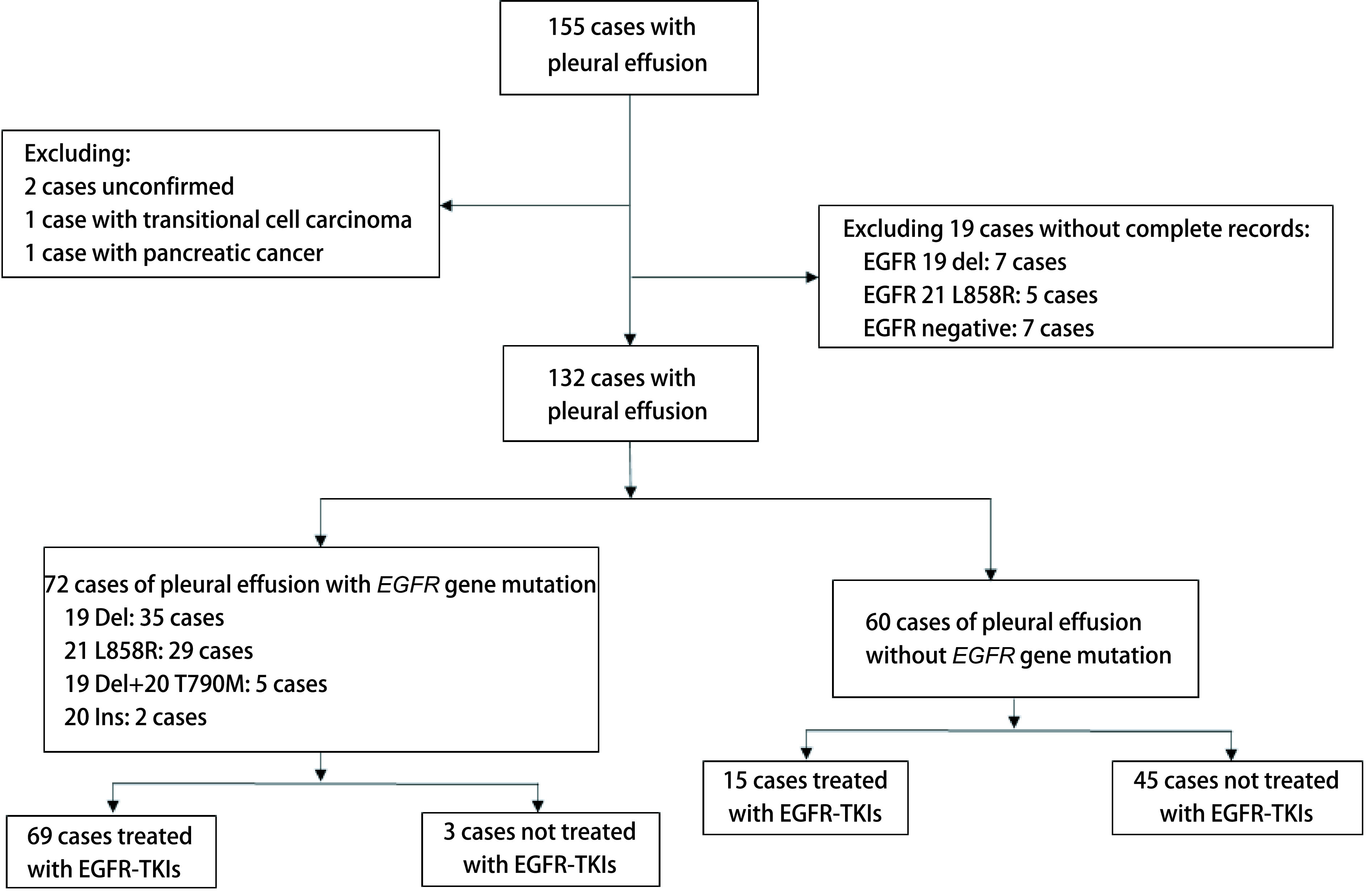
From January 2012 to June 2018, the clinical data of patients with pleural effusion collected from Department of Pathology of Peking Union Medical College Hospital were analyzed retrospectively. Among them, 132 patients with relatively complete clinical data and with EGFR gene mutation detection of paraffin-embedded pleural effusion sediment section according to the established quality control standard were included. According to the results of EGFR gene mutation, it was divided into positive group and negative group, and the efficacy of EGFR-TKIs in different groups was compared.
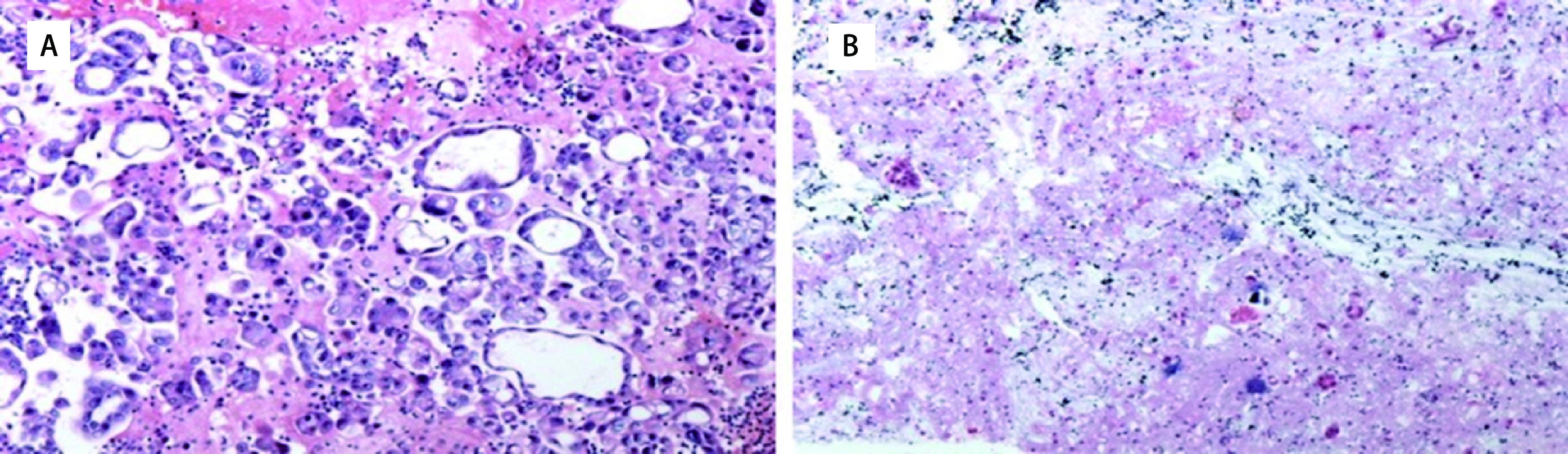
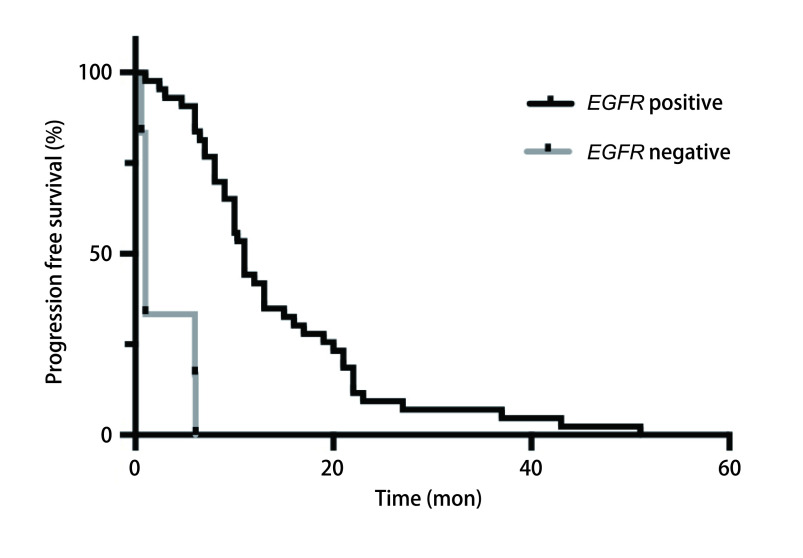
After the centrifugation of pleural effusion, the sediment was embedded in paraffin, sectioned, and observed under the microscope after HE staining. If the number of tumor cells ≥100, it met the pathological quality control standard, and it could be used for subsequent EGFR gene mutation detection. EGFR gene mutations were detected in 72 (54.5%) of 132 patients. EGFR-TKIs were used in 69 of 72 mutation positive patients. Of 60 EGFR mutation negative patients, only 15 used EGFR-TKIs. In EGFR mutation positive group, the disease control rate (DCR) was 95.8%, and the median progression-free survival (PFS) was 11 months. In EGFR mutation negative group, the DCR was 0%, and the median PFS was 1 month. The DCR and PFS were significantly different between the two groups (P<0.05).
According to the pathological quality control standards, the embedded section of pleural fluid sediment can be used to detect EGFR gene mutation, and the results can be used to guide the clinical use of EGFR-TKIs.
恶性胸腔积液中表皮生长因子受体(EGFR)基因突变检测缺乏病理质量控制标准,导致检测结果解读及EGFR酪氨酸激酶抑制剂(TKI)临床应用存在困惑。因此,提出质量控制标准并指导胸腔积液中EGFR突变检测非常重要。本研究旨在依据严格的病理质量控制标准,回顾性分析胸腔积液沉淀物切片中EGFR基因突变结果,以及以此检测结果为指导的EGFR-TKIs治疗效果。
回顾性分析2012年1月至2018年6月北京协和医院病理科收集的胸腔积液患者临床资料。其中,纳入132例临床资料相对完整且按照既定质量控制标准对石蜡包埋胸腔积液沉淀物切片进行EGFR基因突变检测的患者。根据EGFR基因突变结果分为阳性组和阴性组,比较不同组EGFR-TKIs的疗效。
胸腔积液离心后,沉淀物石蜡包埋、切片,HE染色后显微镜下观察。若肿瘤细胞数≥100,则符合病理质量控制标准,可用于后续EGFR基因突变检测。132例患者中,72例(54.5%)检测到EGFR基因突变。72例突变阳性患者中69例使用了EGFR-TKIs。60例EGFR突变阴性患者中,仅15例使用了EGFR-TKIs。EGFR突变阳性组疾病控制率(DCR)为95.8%,中位无进展生存期(PFS)为11个月。EGFR突变阴性组DCR为0%,中位PFS为1个月。两组DCR和PFS差异有统计学意义(P<0.05)。
按照病理质量控制标准,胸腔积液沉淀物包埋切片可用于检测EGFR基因突变,其结果可指导EGFR-TKIs的临床应用。