Clinical Nursing Teaching and Research Section, Xiangya Hospital, Central South University, Changsha, Hunan, China; Department of Emergency Medicine, Xiangya Hospital, Central South University, Changsha, Hunan, China; Department of Nursing, Medical College, Hunan Normal University, Changsha, Hunan, China.
Department of Emergency Medicine, Xiangya Hospital, Central South University, Changsha, Hunan, China.
Public Health. 2021 Jan;190:82-88. doi: 10.1016/j.puhe.2020.11.004. Epub 2020 Dec 23.
With the epidemic of coronavirus disease 2019 (COVID-19), the healthcare workers (HCWs) require proper respiratory personal protective equipment (rPPE) against viral respiratory infectious diseases (VRIDs). It is necessary to evaluate which type of mask and manner of wearing is the best suitable rPPE for preventing the VRID.
A Bayesian network meta-analysis was performed to comprehensively analyze the protective efficacy of various rPPE.
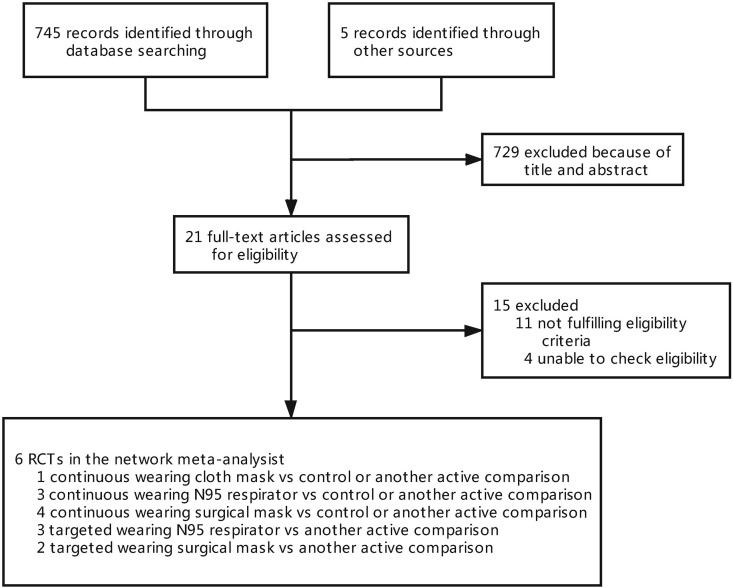
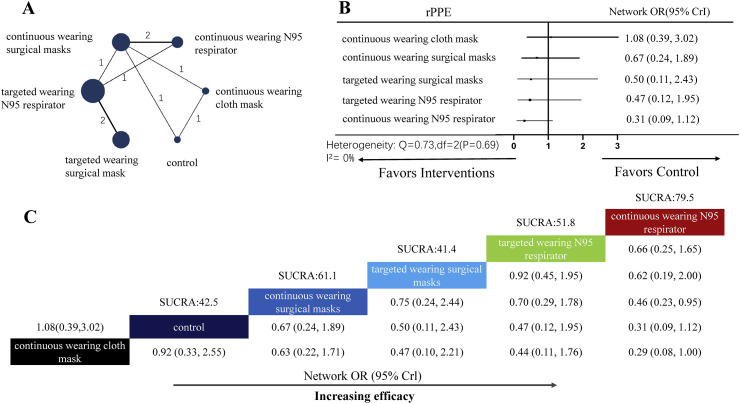
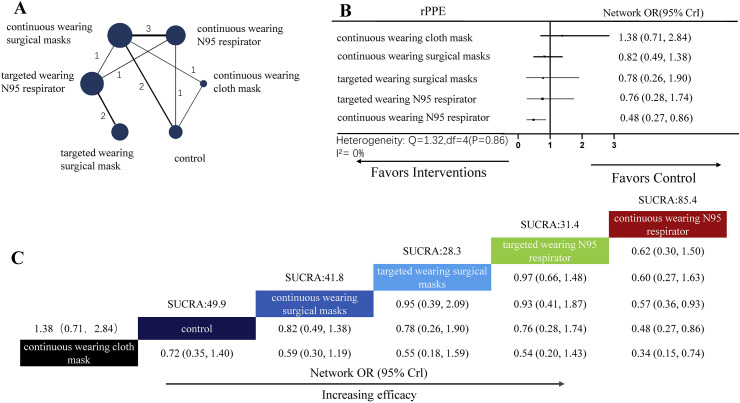
This network meta-analysis protocol was registered in an international prospective register of systematic reviews (CRD42020179489). Electronic databases were searched for cluster randomized control trials (RCTs) of comparing the effectiveness of rPPE and wearing manner in preventing HCWs from VRID. The primary outcome was the incidence of laboratory-confirmed viral respiratory infection reported as an odds ratio (OR) with the associated 95% credibility interval (CrI). The secondary outcome was the incidence of clinical respiratory illness (CRI) reported as an OR with the associated 95% CrI. Surface under the cumulative ranking curve analysis (SUCRA) provided a ranking of each rPPE according to the primary outcome and the secondary outcome as data supplement.
Six studies encompassing 12,265 HCWs were included. In terms of the incidence of laboratory-confirmed viral respiratory infection, the continuous wearing of N95 respirators (network OR, 0.48; 95% CrI: 0.27 to 0.86; SUCRA score, 85.4) showed more effective than the control group. However, in terms of reducing the incidence of CRI, there was no rPPE showing superior protective effectiveness.
There are significant differences in preventive efficacy among current rPPE. Our result suggests that continuous wearing of N95 respirators on the whole shift can serve as the best preventive rPPE for HCWs from the VRID.
随着 2019 年冠状病毒病(COVID-19)的流行,医护人员(HCWs)需要适当的呼吸道个人防护设备(rPPE)来预防病毒性呼吸道传染病(VRIDs)。有必要评估哪种类型的口罩和佩戴方式最适合预防 VRID。
采用贝叶斯网络荟萃分析综合分析各种 rPPE 的保护效果。
本网络荟萃分析方案已在国际前瞻性系统评价注册中心(CRD42020179489)注册。电子数据库检索了比较 rPPE 效果和佩戴方式对预防 HCWs 感染 VRID 的有效性的簇随机对照试验(RCT)。主要结局为实验室确诊的病毒呼吸道感染发病率,报告为比值比(OR)及其相关 95%可信度区间(CrI)。次要结局为临床呼吸道疾病(CRI)发病率,报告为 OR 及其相关 95%CrI。累积排序曲线分析(SUCRA)下的表面分析根据主要结局和次要结局为每个 rPPE 提供排名作为数据补充。
纳入了 6 项共纳入 12265 名 HCWs 的研究。就实验室确诊的病毒呼吸道感染发病率而言,连续佩戴 N95 口罩(网络 OR,0.48;95%CrI:0.27 至 0.86;SUCRA 评分,85.4)的效果优于对照组。然而,在降低 CRI 发病率方面,没有 rPPE 显示出优越的保护效果。
目前的 rPPE 在预防效果上存在显著差异。我们的结果表明,在整个轮班期间连续佩戴 N95 口罩可以作为 HCWs 预防 VRID 的最佳预防 rPPE。