
人类受试者闭眼和困倦会降低基线皮肤电反应及主动手掌出汗:皮肤电反应与手掌出汗反应之间的关系。
Eyes Closing and Drowsiness in Human Subjects Decrease Baseline Galvanic Skin Response and Active Palmar Sweating: Relationship Between Galvanic Skin and Palmar Perspiration Responses.
作者信息
Momose Hideya, Morimitsu Norimasa, Ikeda Eiji, Kanai Shigeki, Sakaguchi Masao, Ohhashi Toshio
机构信息
Department of Innovation of Medical and Health Sciences Research, Shinshu University School of Medicine, Matsumoto, Japan.
出版信息
Front Physiol. 2020 Dec 10;11:558047. doi: 10.3389/fphys.2020.558047. eCollection 2020.
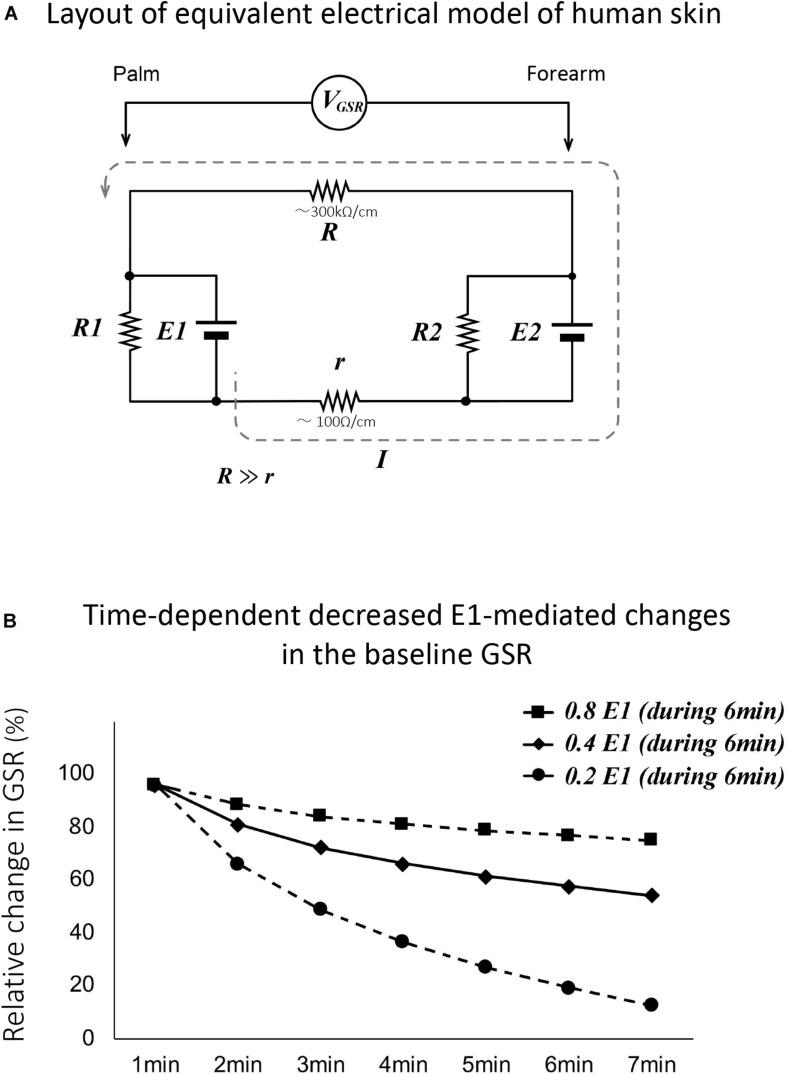
We previously constructed a perspiration ratemeter for the measurement of palmar sweating in human subjects. Although galvanic skin response (GSR) has been used to evaluate emotional responses in human subjects, little is known about the relationships between the phasic and baseline components in GSR and active palmar sweating. From the aforementioned, we aimed to investigate the relationships in human subjects with handgrip exercise and eyes closing or opening. Fifteen healthy volunteers (mean age: 26.9 ± 8.7 years) participated in the present experiments. We investigated the effects of maximal handgrip exercise, eyes closing or opening, and self-awareness of drowsy on the GSR, active palmar sweating, R-R interval in electrocardiograph (ECG), and percentage of α wave in EEG. The faster phasic component in GSR completely agreed with the starting point of active palmar sweating. Handgrip exercise induced significantly faster spike in GSR, active palmar sweating, and decrease in R-R interval in ECG. Eyes closing produced significant decreases in baseline GSR and active palmar sweating in all human subjects. The percentage of α wave in electroencephalograph (EEG) also increased. In contrast, eyes opening increased significantly the baseline GSR and active palmar sweating. In the equivalent electrical model of human skin, the eyes closing-mediated time-dependent decrease in the baseline GSR completely agreed with the hypothesis that the palmar skin voltage only in the model decreased time dependently to 0.4 of the control during 6 min. The self-awareness of drowsy in mid-night working with computer produced similar decreases in baseline GSR and active palmar sweating to the responses with eyes closing in all human subjects. In conclusion, the faster spike in GSR completely agreed with the starting point of active palmar sweating. Eyes closing and opening or self-awareness of drowsy significantly produced changes in baseline GSR and active palmar sweating, which may become useful tools for evaluating clearness or drowsiness in human subjects.
我们之前构建了一种排汗率计,用于测量人类受试者的手掌出汗情况。尽管皮肤电反应(GSR)已被用于评估人类受试者的情绪反应,但对于GSR的相位和基线成分与主动手掌出汗之间的关系却知之甚少。基于上述情况,我们旨在研究人类受试者在进行握力运动以及闭眼或睁眼时的这些关系。15名健康志愿者(平均年龄:26.9±8.7岁)参与了本实验。我们研究了最大握力运动、闭眼或睁眼以及困倦的自我意识对GSR、主动手掌出汗、心电图(ECG)中的R-R间期以及脑电图(EEG)中α波百分比的影响。GSR中较快的相位成分与主动手掌出汗的起始点完全一致。握力运动导致GSR、主动手掌出汗显著更快地出现峰值,且心电图中的R-R间期缩短。闭眼使所有人类受试者的基线GSR和主动手掌出汗显著减少。脑电图(EEG)中α波的百分比也增加。相反,睁眼使基线GSR和主动手掌出汗显著增加。在人体皮肤的等效电模型中,闭眼介导的基线GSR随时间的下降完全符合以下假设:仅模型中的手掌皮肤电压在6分钟内随时间下降至对照值的0.4。午夜使用电脑工作时的困倦自我意识在所有人类受试者中导致基线GSR和主动手掌出汗出现与闭眼反应类似的下降。总之,GSR中较快的峰值与主动手掌出汗的起始点完全一致。闭眼、睁眼或困倦的自我意识显著导致基线GSR和主动手掌出汗发生变化,这可能成为评估人类受试者清醒程度或困倦程度的有用工具。


 Zotero 插件