Guan Liming
Department of Obstetrics and Gynaecology, Zhabei Central Hospital, Jing'an District, Shanghai, 200070, People's Republic of China.
Onco Targets Ther. 2020 Dec 14;13:12811-12827. doi: 10.2147/OTT.S277644. eCollection 2020.
The incidence rate of cervical cancer is the highest in the reproductive tract and is not sensitive to chemotherapy. An appropriate amount of anti-angiogenic agents can reconstruct tumor blood vessels in a short period of time and form vascular homeostasis, increase the function of blood vessel perfusion and reverse the multidrug resistance of chemotherapy, which is also called "vascular normalization." Endostar (a recombinant human endostatin) was developed by China and as a multi-target anti-angiogenesis agent. Many reports about endostar involved the treatment of non-small cell lung cancer, fewer reports are on cervical cancer.
To determine whether endostar can rebuild tumor vascular homeostasis and enhance chemotherapy effects for patients with cervical cancer.
In this study, the patients with cervical cancer within stage IIB2 were selected, endostar combined with cisplatin+paclitaxel neoadjuvant chemotherapy (NACT) before radical surgical operation was adopted, patients outcome and adverse reaction were followed up. The changes of tumor vascular structure and perfusion function before and after endostar given were evaluated by histopathology and dynamic contrast-enhanced magnetic resonance imaging (DEC-MRI). VEGF-Notch signal pathway was detected for the regulating mechanism of vascular proliferation in different groups. GraphPad Prism 6 software was used for statistical analysis of the study results.
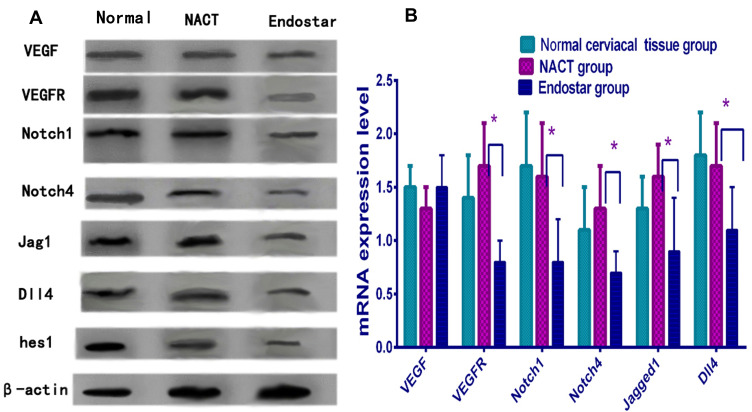
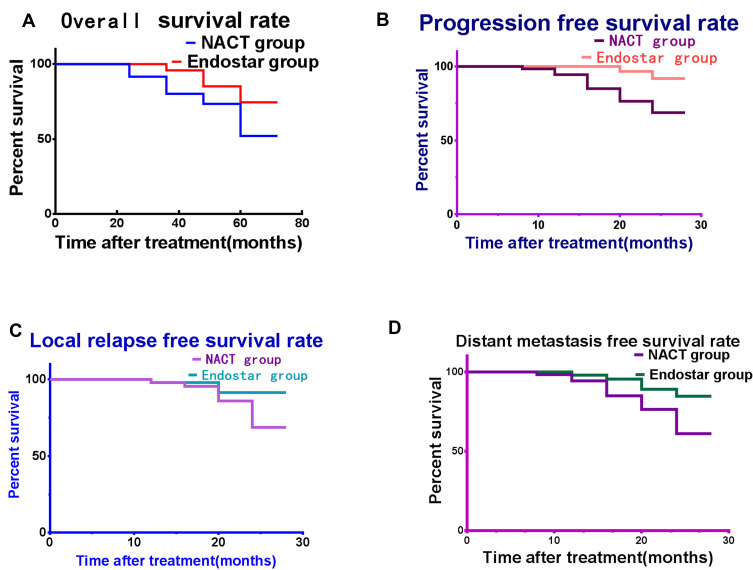
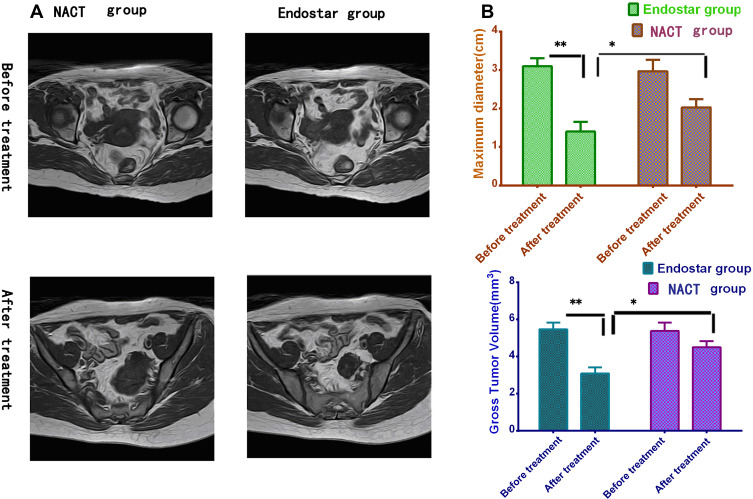
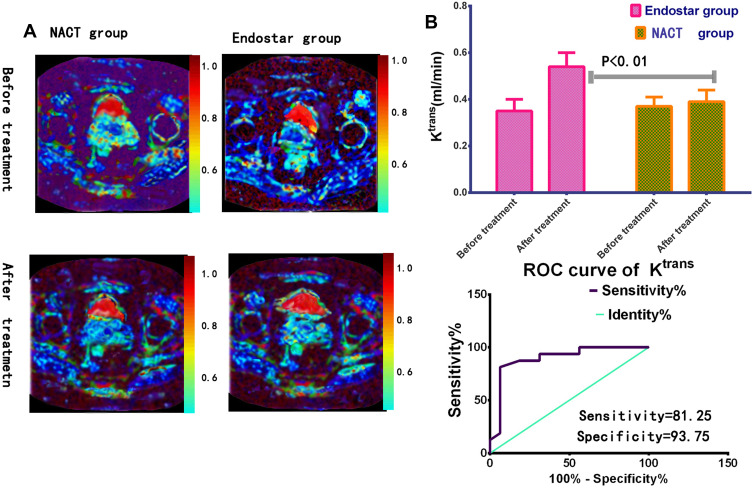
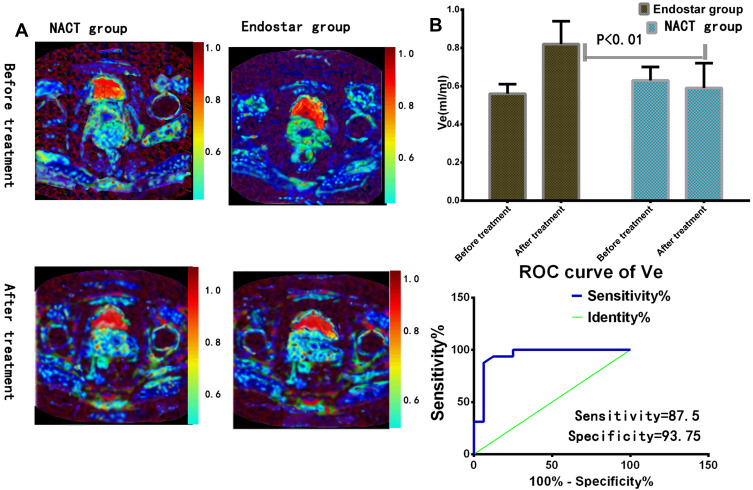
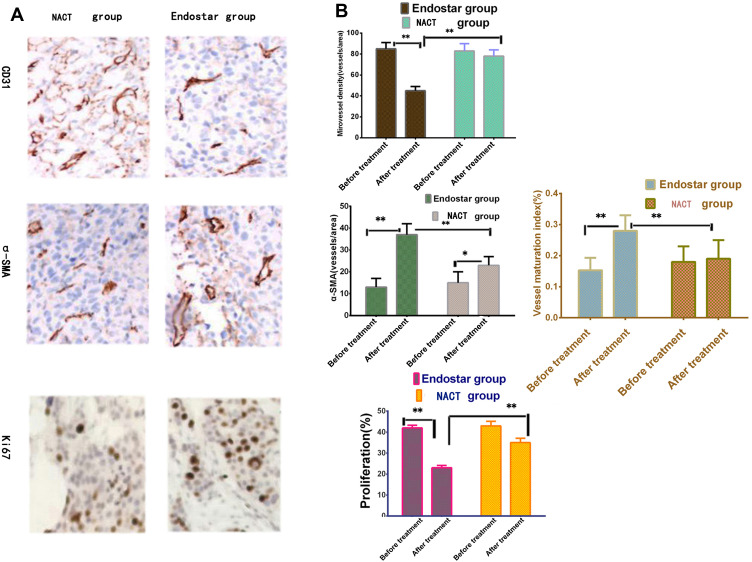
Endostar enhanced the short-term (2 year) overall survival (OS), progression-free survival (PFS) rates for cervical cancer patients. All the same, endostar increased long-term (5 year) OS for cervical cancer patients. Endostar therapy exhibited with mild adverse reaction. MRI showed endostar+NACT further reduce tumor volume than NACT alone. The parameters of Ktrans, Ve for DEC-MRI in endostar group exhibited obviously increase than NACT group. Tumor vascular maturation index α-SMA/CD31 in endostar group increased obviously than NACT group, correspondingly Ki67 staining for tumor proliferative rates, lymphovascular space invasion in endostar group further declined than NACT group. The genes and proteins expression of , , were obviously downregulated in endostar group comparing to NACT group.
Endostar restored vascular homeostasis in cervical cancer temporarily, enhanced chemotherapeutic agents effects in cervical cancer, increased patient OS ratio. Endostar+NACT treatment may provide a new target therapy for cervical cancer.
宫颈癌发病率在生殖道肿瘤中居首位,且对化疗不敏感。适量的抗血管生成药物可在短时间内重塑肿瘤血管,形成血管稳态,增强血管灌注功能并逆转化疗多药耐药性,即“血管正常化”。恩度(重组人血管内皮抑制素)由我国自主研发,是一种多靶点抗血管生成药物。目前关于恩度的报道多涉及非小细胞肺癌治疗,用于宫颈癌治疗的报道较少。
探讨恩度能否重建宫颈癌患者肿瘤血管稳态并增强化疗效果。
选取IIB2期宫颈癌患者,采用恩度联合顺铂+紫杉醇新辅助化疗(NACT)后行根治性手术,随访患者预后及不良反应。通过组织病理学和动态对比增强磁共振成像(DEC-MRI)评估恩度给药前后肿瘤血管结构及灌注功能变化。检测VEGF-Notch信号通路以探讨不同组血管增殖的调控机制。采用GraphPad Prism 6软件对研究结果进行统计分析。
恩度提高了宫颈癌患者的短期(2年)总生存(OS)率、无进展生存(PFS)率。同样,恩度提高了宫颈癌患者的长期(5年)OS率。恩度治疗不良反应轻微。MRI显示恩度+NACT组较单纯NACT组进一步缩小肿瘤体积。恩度组DEC-MRI的Ktrans、Ve参数较NACT组明显升高。恩度组肿瘤血管成熟指数α-SMA/CD31较NACT组明显升高,相应地恩度组肿瘤增殖率Ki67染色、脉管间隙浸润较NACT组进一步下降。与NACT组相比,恩度组中 、 、 的基因和蛋白表达明显下调。
恩度可暂时恢复宫颈癌血管稳态,增强宫颈癌化疗药物疗效,提高患者OS率。恩度+NACT治疗可能为宫颈癌提供一种新的靶向治疗方法。