van de Donk Tine, van Cosburgh Jurjan, van Dasselaar Tom, van Velzen Monique, Drewes Asbjørn Mohr, Dahan Albert, Niesters Marieke
Department of Anesthesiology, Leiden University Medical Center, Leiden, the Netherlands.
Department of Anesthesiology, Reinier de Graaf Gasthuis, Leiden, the Netherlands.
Pain Rep. 2020 Dec 17;5(6):e877. doi: 10.1097/PR9.0000000000000877. eCollection 2020 Nov-Dec.
Chronic low back pain (CLBP) is one of the most common chronic pain conditions in pain practice.
In the current study, we describe phenotypes of patients with CLBP based on the status of their endogenous pain modulatory system.
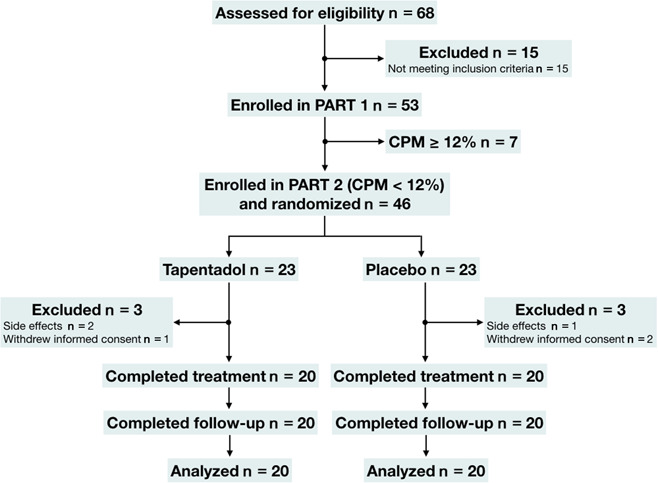
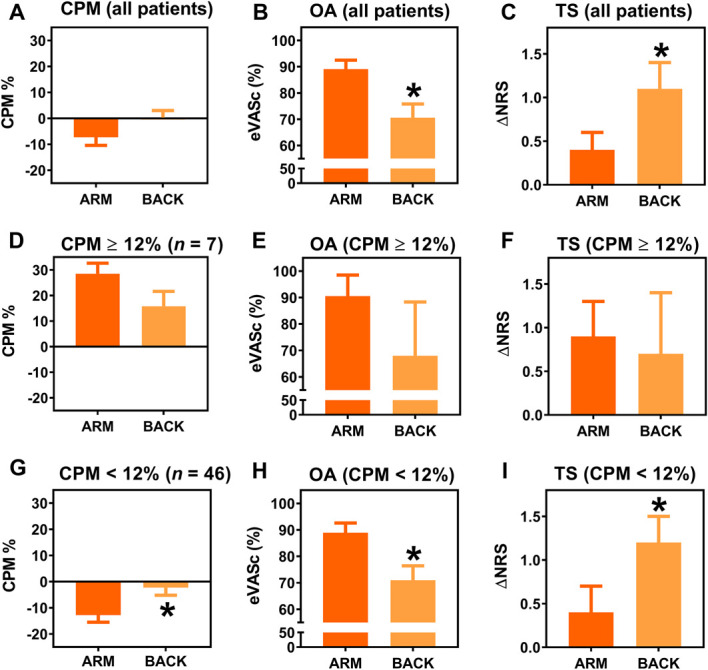
Conditioned pain modulation (a measure of central pain inhibition), temporal summation (TS, a measure of pain facilitation), and offset analgesia (a measure of temporal filtering of nociception) were evaluated in 53 patients with CLBP at painful and nonpainful sites. Next, in a double-blind, randomized, placebo-controlled trial, 40 patients with defective conditioned pain modulation responses received treatment with tapentadol prolonged-release or placebo for 3 months.
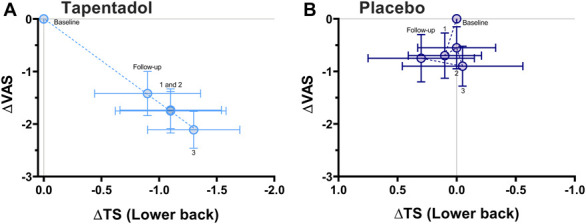
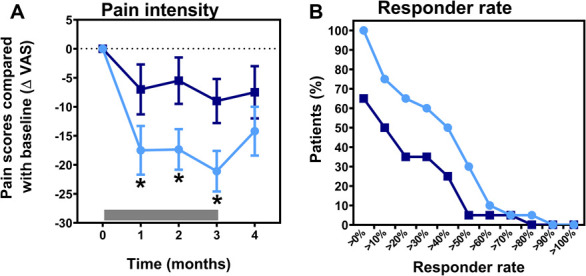
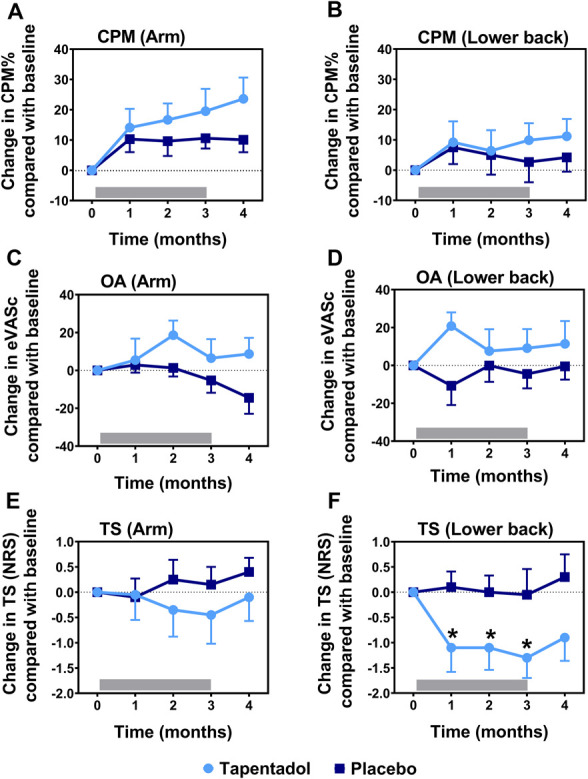
The majority of patients (87%) demonstrated loss of central pain inhibition combined with segmentally increased TS and reduced offset analgesia at the lower back region. During treatment, tapentadol reduced pain intensity more than placebo (tapentadol -19.5 ± 2.1 mm versus placebo -7.1 ± 1.8 mm, = 0.025). Furthermore, tapentadol significantly decreased pain facilitation by reduction of TS responses at the lower back (tapentadol -0.94 ± 1.9 versus placebo 0.01 ± 1.5, = 0.020), which correlated with pain reduction ( < 0.001).
Patients with CLBP demonstrated different phenotypes of endogenous pain modulation. In patients with reduced conditioned pain modulation, tapentadol produced long-term pain relief that coincided with reduction of signs of pain facilitation. These data indicate that the endogenous pain system may be used as a biomarker in the pharmacological treatment of CLBP, enabling an individualized, mechanism-based treatment approach.
慢性下腰痛(CLBP)是疼痛治疗中最常见的慢性疼痛病症之一。
在本研究中,我们根据内源性疼痛调节系统的状态描述CLBP患者的表型。
对53例CLBP患者的疼痛部位和非疼痛部位进行条件性疼痛调制(一种中枢性疼痛抑制的测量方法)、时间总和(TS,一种疼痛易化的测量方法)和抵消性镇痛(一种伤害性感受的时间滤波测量方法)评估。接下来,在一项双盲、随机、安慰剂对照试验中,40例条件性疼痛调制反应缺陷的患者接受了3个月的缓释他喷他多或安慰剂治疗。
大多数患者(87%)表现出中枢性疼痛抑制丧失,同时下背部区域的TS节段性增加和抵消性镇痛减少。治疗期间,他喷他多比安慰剂更能降低疼痛强度(他喷他多-19.5±2.1mm,安慰剂-7.1±1.8mm,P=0.025)。此外,他喷他多通过降低下背部的TS反应显著降低了疼痛易化(他喷他多-0.94±1.9,安慰剂0.01±1.5,P=0.020),这与疼痛减轻相关(P<0.001)。
CLBP患者表现出不同的内源性疼痛调节表型。在条件性疼痛调制降低的患者中,他喷他多产生了长期的疼痛缓解,这与疼痛易化迹象的减少相一致。这些数据表明,内源性疼痛系统可作为CLBP药物治疗的生物标志物,从而实现个体化的、基于机制的治疗方法。