Division of Hematological Malignancies, Department of Medical Oncology, and.
Department of Data Sciences, Dana-Farber Cancer Institute, Boston MA.
Blood. 2020 Dec 24;136(26):3070-3081. doi: 10.1182/blood.2020005397.
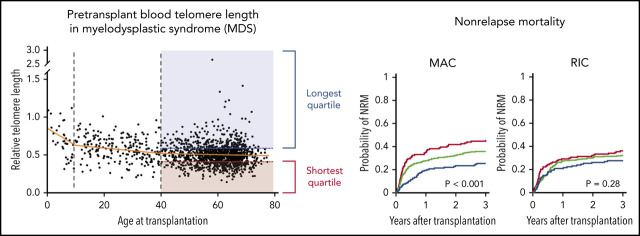
Allogeneic hematopoietic stem cell transplantation is the only potentially curative treatment for patients with myelodysplastic syndrome (MDS), but long-term survival is limited by the risk of transplant-related complications. Short telomere length, mediated by inherited or acquired factors, impairs cellular response to genotoxic and replicative stress and could identify patients at higher risk for toxicity after transplantation. We measured relative telomere length in pretransplant recipient blood samples in 1514 MDS patients and evaluated the association of telomere length with MDS disease characteristics and transplantation outcomes. Shorter telomere length was significantly associated with older age, male sex, somatic mutations that impair the DNA damage response, and more severe pretransplant cytopenias, but not with bone marrow blast count, MDS treatment history, or history of prior cancer therapy. Among 1267 patients ≥40 years old, telomere length in the shortest quartile was associated with inferior survival (P < .001) because of a high risk of nonrelapse mortality (NRM; P = .001) after adjusting for significant clinical and genetic variables. The adverse impact of shorter telomeres on NRM was independent of recipient comorbidities and was observed selectively among patients receiving more intensive conditioning, including myeloablative regimens and higher dose melphalan-based reduced-intensity regimens. The effect of shorter telomeres on NRM was prominent among patients who developed severe acute graft-versus-host disease, suggesting that short telomere length may limit regenerative potential of mucosal tissues after acute injury. MDS patients with shorter telomere length, who have inferior survival driven by excess toxicity, could be considered for strategies focused on minimizing toxic effects of transplantation.
异基因造血干细胞移植是治疗骨髓增生异常综合征(MDS)患者的唯一潜在根治方法,但长期生存受到移植相关并发症风险的限制。由遗传或获得性因素介导的短端粒长度会损害细胞对遗传毒性和复制应激的反应能力,并且可能会识别出移植后毒性风险更高的患者。我们在 1514 例 MDS 患者的移植前受者血液样本中测量了相对端粒长度,并评估了端粒长度与 MDS 疾病特征和移植结果的关联。较短的端粒长度与年龄较大、男性、损害 DNA 损伤反应的体细胞突变以及更严重的移植前细胞减少症显著相关,但与骨髓原始细胞计数、MDS 治疗史或既往癌症治疗史无关。在 1267 例年龄≥40 岁的患者中,最短四分位数的端粒长度与较差的生存相关(P<0.001),因为在调整了重要的临床和遗传变量后,非复发死亡率(NRM;P=0.001)的风险很高。较短的端粒对 NRM 的不利影响独立于受者合并症,并且仅在接受更强化预处理的患者中观察到,包括清髓性方案和更高剂量基于美法仑的减低强度方案。较短的端粒对 NRM 的影响在发生严重急性移植物抗宿主病的患者中尤为明显,表明短端粒长度可能限制急性损伤后黏膜组织的再生潜力。由于过度毒性导致生存较差的 MDS 患者,可能会考虑采用侧重于最小化移植毒性作用的策略。