Endocrinology Unit, Department of Medical, Surgical and Neurological Sciences, University Hospital of Siena, Siena, 53100, Italy.
Center for Immuno-Oncology, Medical Oncology and Immunotherapy, Department of Oncology, University Hospital of Siena, 53100, Siena, Italy.
J Endocrinol Invest. 2021 Aug;44(8):1719-1726. doi: 10.1007/s40618-020-01480-6. Epub 2020 Dec 26.
Immunotherapy against immune checkpoints has significantly improved survival both in metastatic and adjuvant setting in several types of cancers. Thyroid dysfunction is the most common endocrine adverse event reported. Patients who are at risk of developing thyroid dysfunction remain to be defined. We aimed to identify predictive factors for the development of thyroid dysfunction during immunotherapy.
This is a retrospective study including a total of 68 patients who were treated with immune checkpoint inhibitors (ICIs) for metastatic or unresectable advanced cancers. The majority of patients were treated with anti-PD1 drugs in monotherapy or in combination with anti-CTLA4 inhibitors. Thyroid function and anti-thyroid antibodies, before starting immunotherapy and during treatment, were evaluated. Thyroid ultrasound was also performed in a subgroup of patients at the time of enrolment in the study.
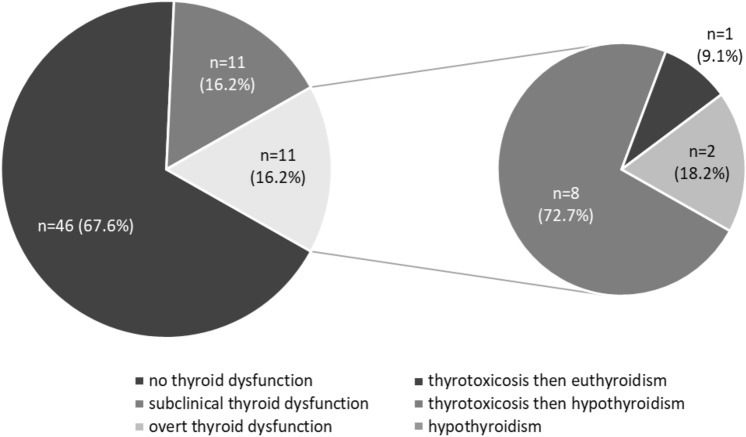
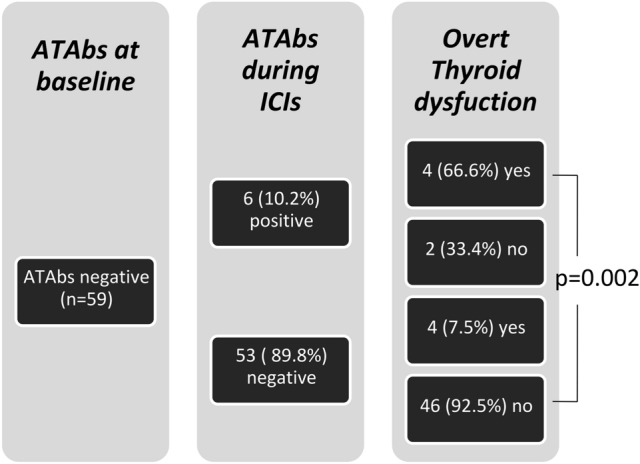
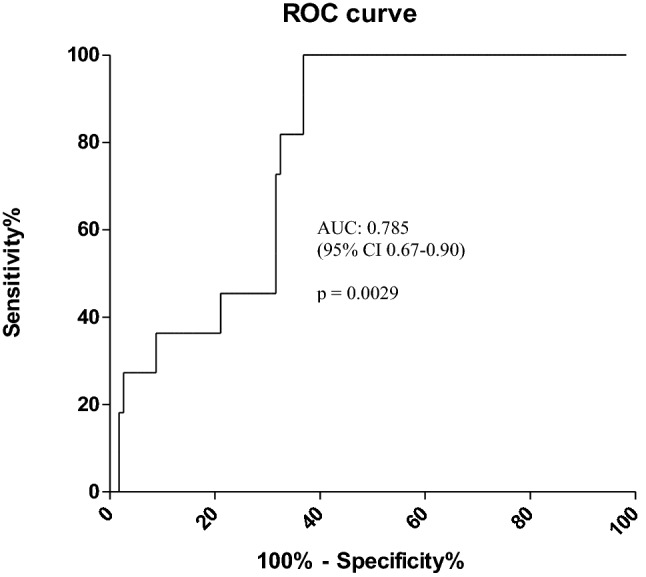
Eleven out of 68 patients (16.1%) developed immune-related overt thyroid dysfunction. By ROC curve analysis, we found that a serum TSH cut-off of 1.72 mUI/l, at baseline, had a good diagnostic accuracy in identifying patients without overt thyroid dysfunction (NPV = 100%, p = 0.0029). At multivariate analysis, both TSH and positive anti-thyroid antibodies (ATAbs) levels, before ICIs treatment, were independently associated with the development of overt thyroid dysfunction during immunotherapy (p = 0.0001 and p = 0.009, respectively).
Pre-treatment serum TSH and ATAbs levels may help to identify patients at high risk for primary thyroid dysfunction. Our study suggests guidance for an appropriate timely screening and for a tailored management of thyroid dysfunctions in patients treated with ICIs.
免疫检查点抑制剂(ICI)在多种癌症的转移性和辅助治疗环境中显著提高了生存率,其中甲状腺功能障碍是最常见的内分泌不良事件。但哪些患者有发生甲状腺功能障碍的风险仍有待确定。本研究旨在确定免疫治疗期间甲状腺功能障碍发生的预测因素。
这是一项回顾性研究,共纳入 68 例接受免疫检查点抑制剂(ICI)治疗转移性或不可切除晚期癌症的患者。大多数患者接受抗 PD-1 药物单药或联合抗 CTLA-4 抑制剂治疗。在开始免疫治疗前和治疗期间评估甲状腺功能和甲状腺自身抗体。在研究入组时,还对部分患者进行了甲状腺超声检查。
68 例患者中有 11 例(16.1%)发生免疫相关显性甲状腺功能障碍。通过 ROC 曲线分析,我们发现基线时血清 TSH 截断值为 1.72 mIU/L 时,对无显性甲状腺功能障碍的患者具有良好的诊断准确性(NPV=100%,p=0.0029)。多变量分析显示,ICI 治疗前 TSH 和抗甲状腺自身抗体(ATAbs)水平均与免疫治疗期间显性甲状腺功能障碍的发生独立相关(p=0.0001 和 p=0.009)。
治疗前血清 TSH 和 ATAbs 水平有助于识别高风险的原发性甲状腺功能障碍患者。本研究为接受 ICI 治疗的患者进行适当的及时筛查和甲状腺功能障碍的个体化管理提供了依据。