Chandler-Bostock Rebecca, Mata Carlos P, Bingham Richard J, Dykeman Eric C, Meng Bo, Tuthill Tobias J, Rowlands David J, Ranson Neil A, Twarock Reidun, Stockley Peter G
Astbury Centre for Structural Molecular Biology, Faculty of Biological Sciences, University of Leeds, Leeds, United Kingdom.
Department of Mathematics, University of York, York, United Kingdom.
PLoS Pathog. 2020 Dec 28;16(12):e1009146. doi: 10.1371/journal.ppat.1009146. eCollection 2020 Dec.
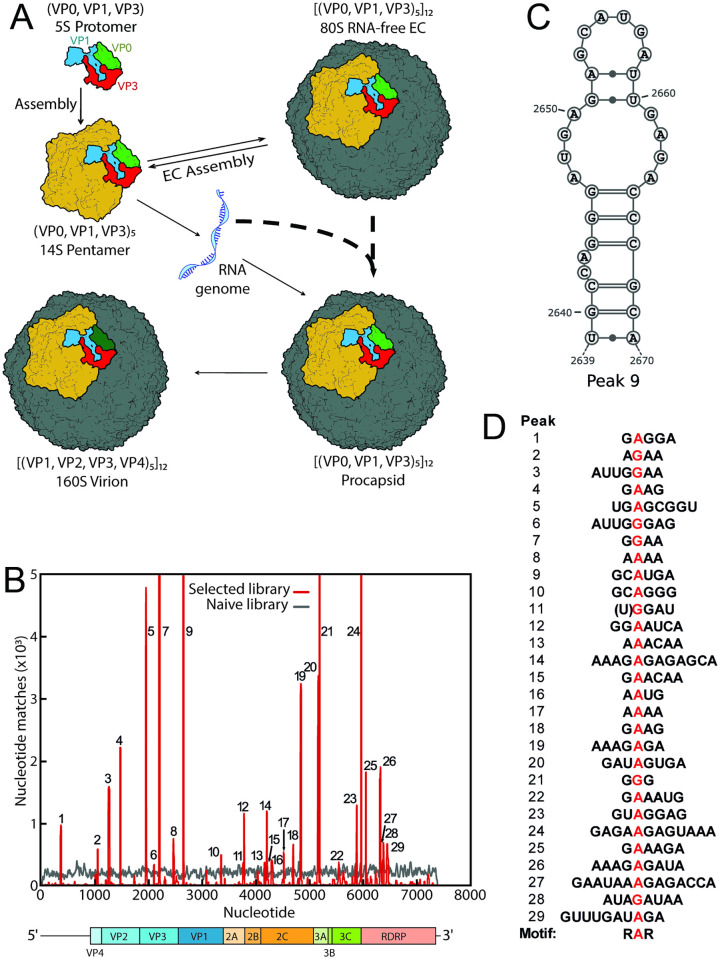
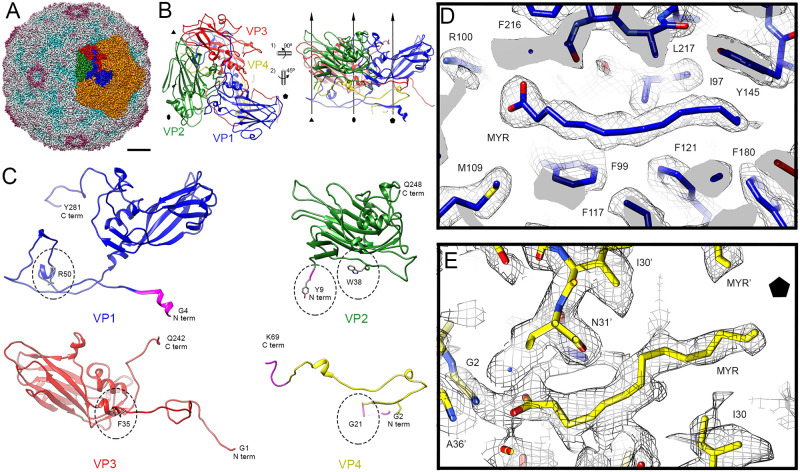
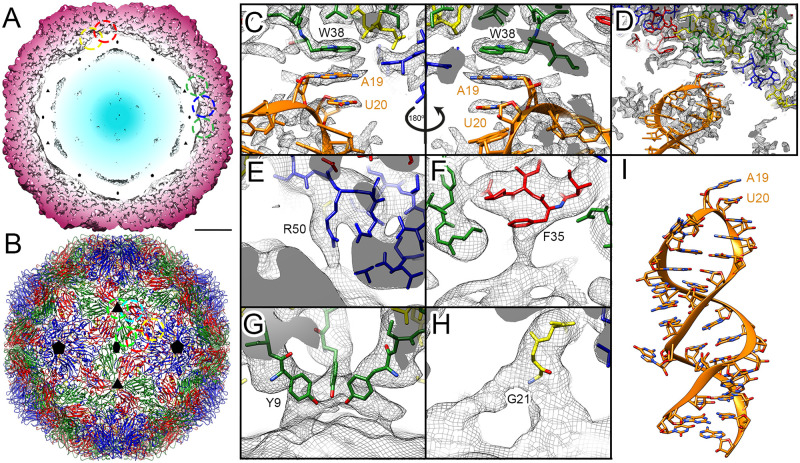
Picornaviruses are important viral pathogens, but despite extensive study, the assembly process of their infectious virions is still incompletely understood, preventing the development of anti-viral strategies targeting this essential part of the life cycle. We report the identification, via RNA SELEX and bioinformatics, of multiple RNA sites across the genome of a typical enterovirus, enterovirus-E (EV-E), that each have affinity for the cognate viral capsid protein (CP) capsomer. Many of these sites are evolutionarily conserved across known EV-E variants, suggesting they play essential functional roles. Cryo-electron microscopy was used to reconstruct the EV-E particle at ~2.2 Å resolution, revealing extensive density for the genomic RNA. Relaxing the imposed symmetry within the reconstructed particles reveals multiple RNA-CP contacts, a first for any picornavirus. Conservative mutagenesis of the individual RNA-contacting amino acid side chains in EV-E, many of which are conserved across the enterovirus family including poliovirus, is lethal but does not interfere with replication or translation. Anti-EV-E and anti-poliovirus aptamers share sequence similarities with sites distributed across the poliovirus genome. These data are consistent with the hypothesis that these RNA-CP contacts are RNA Packaging Signals (PSs) that play vital roles in assembly and suggest that the RNA PSs are evolutionarily conserved between pathogens within the family, augmenting the current protein-only assembly paradigm for this family of viruses.
小核糖核酸病毒是重要的病毒病原体,但尽管进行了广泛研究,其感染性病毒粒子的组装过程仍未完全了解,这阻碍了针对这一生命周期关键部分的抗病毒策略的开发。我们报告了通过RNA SELEX和生物信息学,在典型肠道病毒肠道病毒-E(EV-E)的基因组中鉴定出多个RNA位点,每个位点都与同源病毒衣壳蛋白(CP)衣壳粒具有亲和力。这些位点中的许多在已知的EV-E变体中是进化保守的,表明它们发挥着重要的功能作用。利用冷冻电子显微镜以约2.2埃的分辨率重建了EV-E颗粒,揭示了基因组RNA的广泛密度。在重建颗粒中放宽所施加的对称性,揭示了多个RNA-CP接触,这在任何小核糖核酸病毒中都是首次发现。对EV-E中单个与RNA接触的氨基酸侧链进行保守诱变,其中许多在包括脊髓灰质炎病毒在内的肠道病毒家族中是保守的,是致命的,但不干扰复制或翻译。抗EV-E和抗脊髓灰质炎病毒适体与分布在脊髓灰质炎病毒基因组中的位点具有序列相似性。这些数据与以下假设一致,即这些RNA-CP接触是在组装中起重要作用的RNA包装信号(PSs),并表明RNA PSs在该病毒家族的病原体之间是进化保守的,扩展了目前该病毒家族仅基于蛋白质的组装模式。