Future medicine division, Korea Institute of Oriental Medicine, Daejeon 34504, Korea.
Department of Internal Medicine and Neuroscience, College of Korean Medicine, Wonkwang University, Iksan 54538, Korea.
Sensors (Basel). 2020 Dec 21;20(24):7338. doi: 10.3390/s20247338.
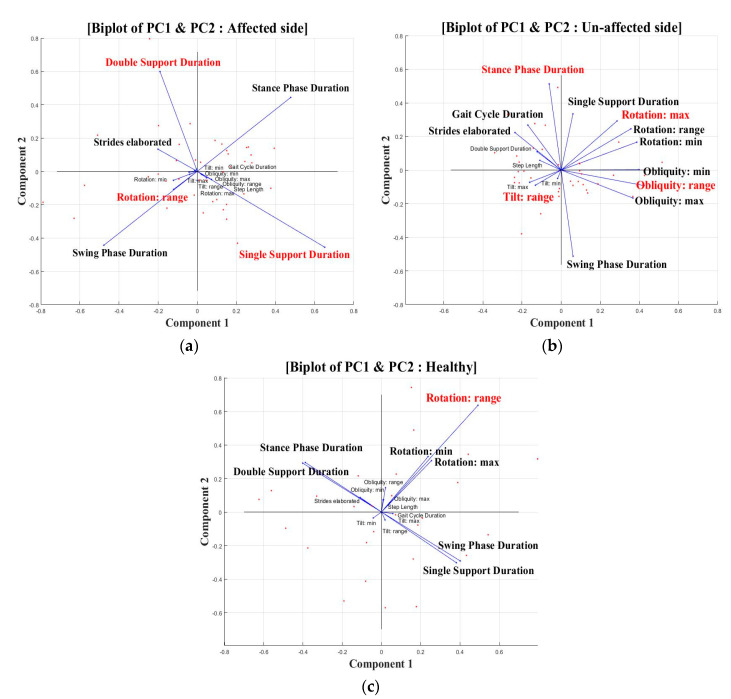
This study describe the characteristics of hemiplegic stroke gait with principal component analysis (PCA) of trunk movement (TM) and gait event (GE) parameters by the inertial measurement unit (IMU) sensors: (1) Background: This process can determine dominant variables through multivariate examination to identify the affected, unaffected, and healthy lower-limb sides; (2) Methods: The study monitored forty patients with stroke and twenty-eight healthy individuals comprising the control group for comparison. The IMU sensors were attached to each subject while performing a 6 m walking test. Sixteen variables extracted from the measured data were divided into 7 GE and 9 TM variables explaining pelvis tilt, oblique, and rotation. (3) Results: The tilt range variables of the trunk movement on the affected and unaffected sides were lower than those of the healthy side; this showed between-group differences in various GE variables. For the healthy and affected sides, 80% of variances were explained with 2 or 3 PCs involving only a few dominant variables; and (4) Conclusions: The difference between each side leg should be considered during the development of a diagnosis method. This research can be utilized to develop functional assessment tools for personalized treatment and to design appropriate training protocols.
本研究通过惯性测量单元(IMU)传感器对躯干运动(TM)和步态事件(GE)参数进行主成分分析(PCA),描述偏瘫步态的特征:(1)背景:通过多变量检查确定主导变量,以识别患侧、健侧和健康下肢;(2)方法:研究监测了 40 名脑卒中患者和 28 名健康对照者。在进行 6 m 步行测试时,将 IMU 传感器附着在每个受试者上。从测量数据中提取的 16 个变量分为 7 个 GE 和 9 个 TM 变量,用于解释骨盆倾斜、倾斜和旋转。(3)结果:患侧和健侧躯干运动的倾斜范围变量低于健康侧;这表明在各种 GE 变量中存在组间差异。对于健康侧和患侧,80%的方差可以用仅涉及少数主导变量的 2 或 3 个 PCs 来解释;(4)结论:在开发诊断方法时,应考虑每侧腿之间的差异。本研究可用于开发个性化治疗的功能评估工具,并设计适当的训练方案。