Lin Hsiang-Yu, Chen Ming-Ren, Lee Chung-Lin, Lin Shan-Miao, Hung Chung-Lieh, Niu Dau-Ming, Chang Tung-Ming, Chuang Chih-Kuang, Lin Shuan-Pei
Department of Medicine, MacKay Medical College, New Taipei City 25245, Taiwan.
Department of Pediatrics, MacKay Memorial Hospital, Taipei 10449, Taiwan.
Diagnostics (Basel). 2020 Dec 23;11(1):16. doi: 10.3390/diagnostics11010016.
Cardiovascular abnormalities have been observed in patients with mucopolysaccharidosis (MPS) of any type, with the most documented abnormalities being valvular regurgitation and stenosis and cardiac hypertrophy. Only a few studies have focused on aortic root dilatation and the long-term effects of enzyme replacement therapy (ERT) in these patients.
We reviewed echocardiograms of 125 Taiwanese MPS patients (age range, 0.1 to 19.1 years; 11 with MPS I, 49 with MPS II, 25 with MPS III, 29 with MPS IVA, and 11 with MPS VI). The aortic root diameter was measured at the sinus of Valsalva.
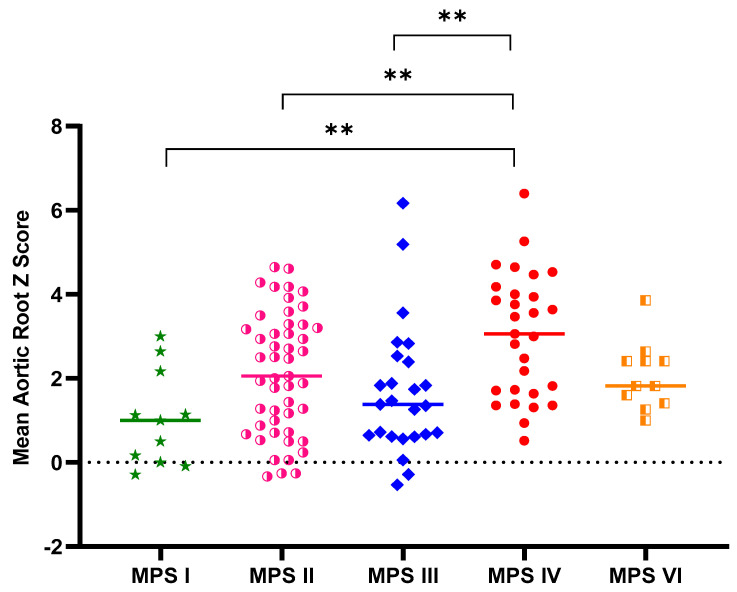
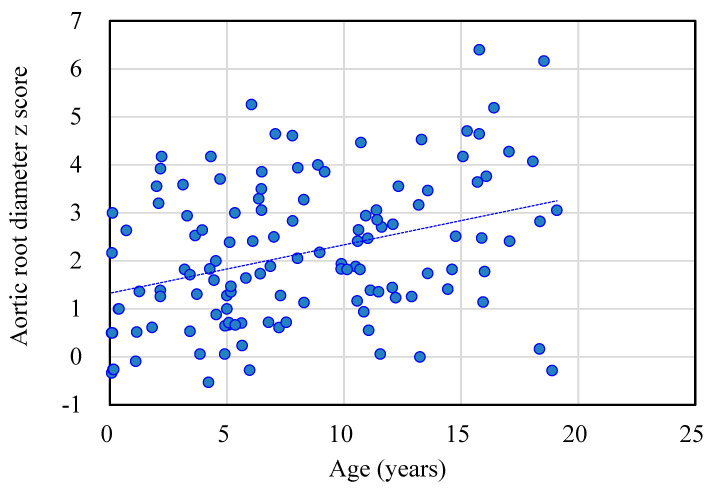
Aortic root dilatation ( score >2) was observed in 47% of the MPS patients, including 66% of MPS IV, 51% of MPS II, 45% of MPS VI, 28% of MPS III, and 27% of MPS I patients. The mean aortic root diameter score was 2.14 ( = 125). The patients with MPS IV had the most severe aortic root dilatation with a mean aortic root diameter score of 3.03, followed by MPS II (2.12), MPS VI (2.06), MPS III (1.68), and MPS I (1.03). The aortic root diameter score was positively correlated with increasing age ( = 125, < 0.01). For the patients with MPS II, III, and IV, aortic root diameter score was also positively correlated with increasing age ( < 0.01). For 16 patients who had received ERT and had follow-up echocardiographic data (range 2.0-16.2 years), the mean aortic root diameter score change was -0.46 compared to baseline (baseline 2.49 versus follow-up 2.03, = 0.490).
Aortic root dilatation was common in the patients with all types of MPS, with the most severe aortic root dilatation observed in those with MPS IV. The severity of aortic root dilatation worsened with increasing age, reinforcing the concept of the progressive nature of this disease. ERT for MPS appears to stabilize the progression of aortic root dilatation.
在任何类型的黏多糖贮积症(MPS)患者中均观察到心血管异常,其中记录最多的异常为瓣膜反流、狭窄及心脏肥大。仅有少数研究关注这些患者的主动脉根部扩张及酶替代疗法(ERT)的长期影响。
我们回顾了125例台湾MPS患者的超声心动图(年龄范围0.1至19.1岁;11例MPS I型、49例MPS II型、25例MPS III型、29例MPS IVA型及11例MPS VI型)。在主动脉瓣窦处测量主动脉根部直径。
47%的MPS患者观察到主动脉根部扩张(评分>2),包括66%的MPS IV型、51%的MPS II型、45%的MPS VI型、28%的MPS III型及27%的MPS I型患者。主动脉根部直径平均评分为2.14(n = 125)。MPS IV型患者的主动脉根部扩张最为严重,主动脉根部直径平均评分为3.03,其次为MPS II型(2.12)、MPS VI型(2.06)、MPS III型(1.68)及MPS I型(1.03)。主动脉根部直径评分与年龄增长呈正相关(n = 125,P < 0.01)。对于MPS II型、III型及IV型患者,主动脉根部直径评分也与年龄增长呈正相关(P < 0.01)。对于16例接受ERT且有超声心动图随访数据的患者(随访时间2.0至16.2年),与基线相比,主动脉根部直径平均评分变化为-0.46(基线2.49对比随访2.03,P = 0.490)。
主动脉根部扩张在所有类型的MPS患者中均很常见,MPS IV型患者的主动脉根部扩张最为严重。主动脉根部扩张的严重程度随年龄增长而加重,强化了该病具有进展性的概念。MPS的ERT似乎可稳定主动脉根部扩张的进展。