Lee Wing-Hin, Loo Ching-Yee, Traini Daniela, Young Paul M
Faculty of Pharmacy and Health Sciences, Royal College of Medicine Perak, Universiti Kuala Lumpur (RCMP UniKL), Ipoh 30450, Perak, Malaysia.
Respiratory Technology, Woolcock Institute of Medical Research, Discipline of Pharmacology, Faculty of Medicine and Health, University of Sydney, NSW 2037, Australia.
Pharmaceutics. 2020 Dec 22;13(1):9. doi: 10.3390/pharmaceutics13010009.
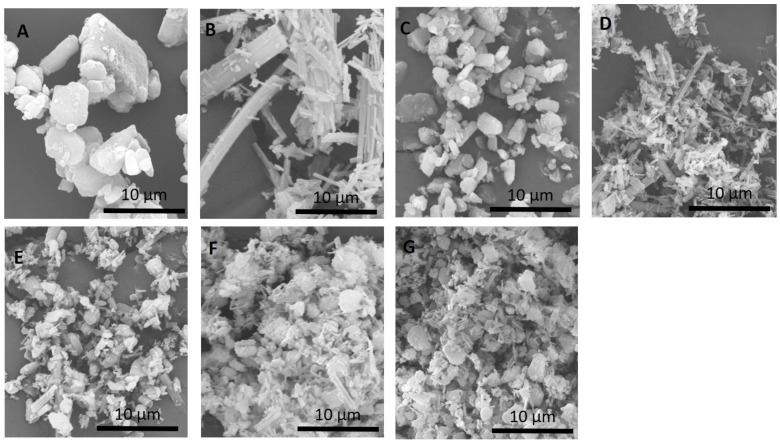
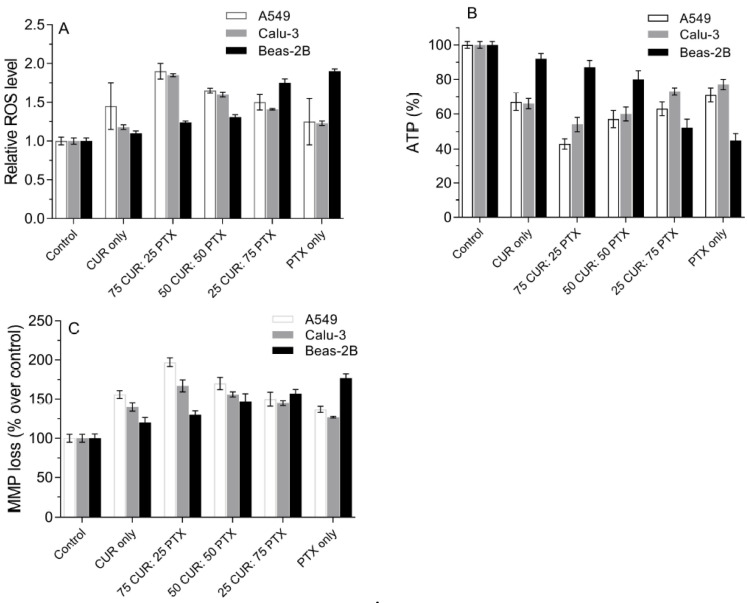
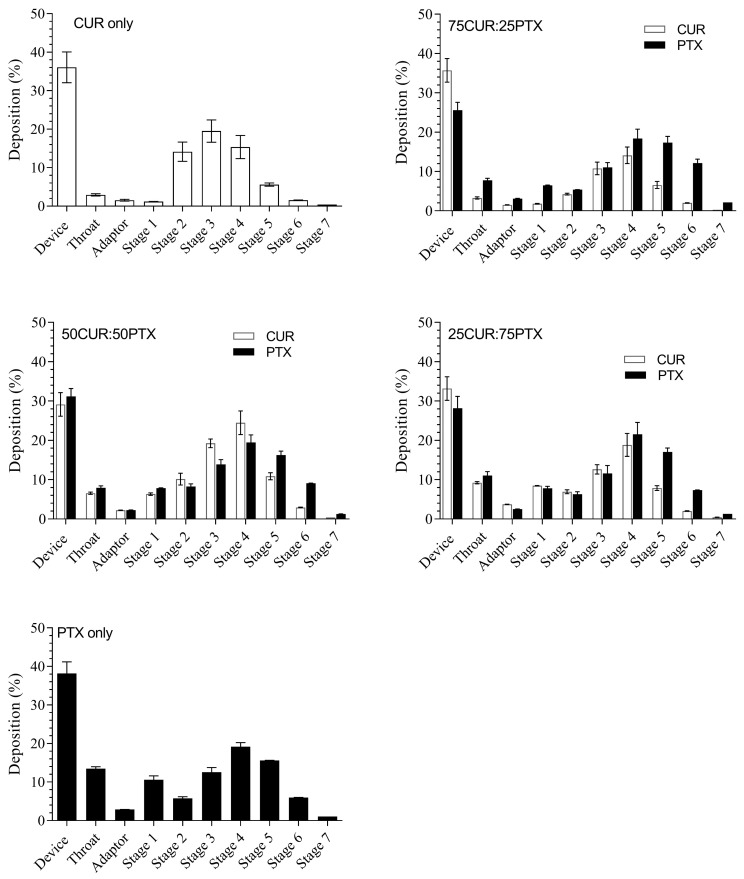
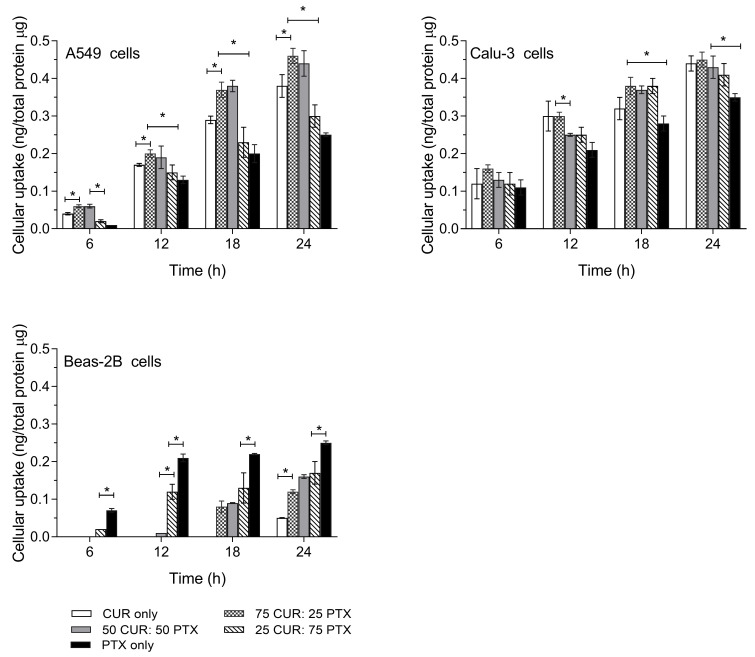
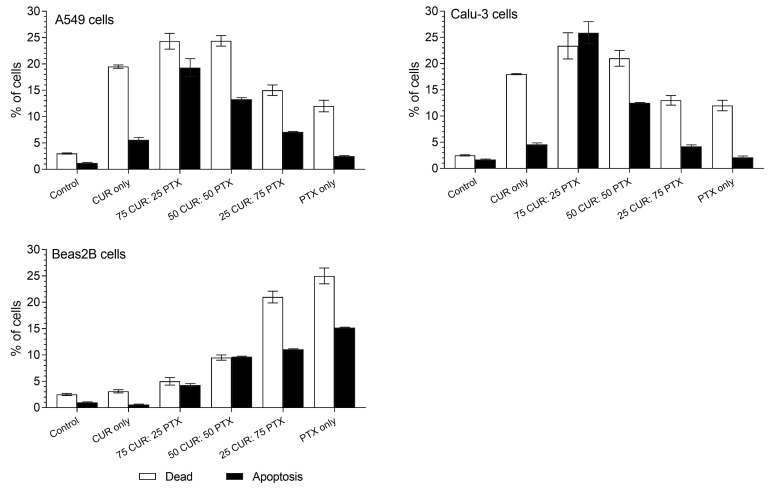
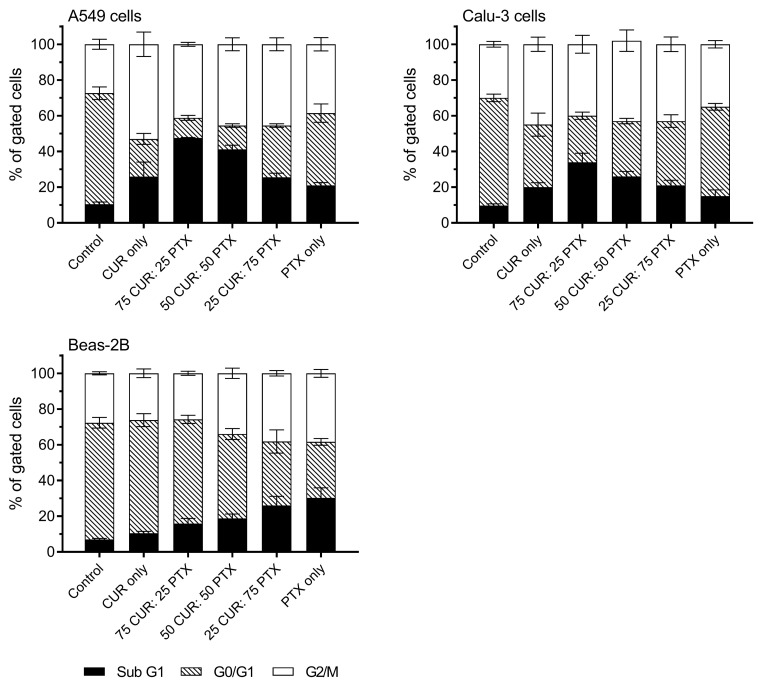
Despite the effort to develop efficient targeted drug delivery for lung cancer treatment, the outcome remains unsatisfactory with a survival rate of 15% after 5 years of diagnosis. Inhalation formulation is an ideal alternative that could ensure the direct deposition of chemotherapeutics to the lungs. However, the design of an inhalable formulation that could simultaneously achieve a high local chemotherapeutic dose to the solid tumor and exert low pulmonary toxicities is a challenge, as the presence of 10-30% of chemotherapeutics in the lung is sufficient to induce toxicity. Therefore, this study aimed to develop a simple dry powder inhalation (DPI) formulation containing a model chemotherapeutic agent (paclitaxel, PTX) and a natural antioxidant (curcumin, CUR) that acts to protect healthy lung cells from injury during direct lung delivery. The co-jet-milling of CUR and PTX resulted in formulations with suitable aerosol performance, as indicated in the high fine particle fractions (FPF) (>60%) and adequate mass median aerodynamic diameter (MMAD). The CUR/PTX combination showed a more potent cytotoxic effect against lung cancer cells. This is evident from the induction of apoptosis/necrotic cell death and G2/M cell cycle arrests in both A549 and Calu-3 cells. The increased intracellular ROS, mitochondrial depolarization and reduced ATP content in A549 and Calu-3 cells indicated that the actions of CUR and PTX were associated with mitochondrial oxidative stress. Interestingly, the presence of CUR is crucial to neutralize the cytotoxic effects of PTX against healthy cells (Beas-2B), and this is dose-dependent. This study presents a simple approach to formulating an effective DPI formulation with preferential cytotoxicity towards lung cancer.
尽管人们努力开发用于肺癌治疗的高效靶向药物递送系统,但诊断后5年的生存率仍为15%,治疗效果仍不尽人意。吸入制剂是一种理想的替代方案,可确保化疗药物直接沉积到肺部。然而,设计一种可吸入制剂,使其既能同时对实体瘤实现高局部化疗剂量,又能降低肺部毒性,是一项挑战,因为肺部存在10%-30%的化疗药物就足以引发毒性。因此,本研究旨在开发一种简单的干粉吸入(DPI)制剂,该制剂含有一种模型化疗药物(紫杉醇,PTX)和一种天然抗氧化剂(姜黄素,CUR),在直接肺部给药过程中,后者可保护健康肺细胞免受损伤。CUR和PTX的共气流粉碎产生了具有合适气溶胶性能的制剂,高细颗粒分数(FPF)(>60%)和足够的质量中值空气动力学直径(MMAD)表明了这一点。CUR/PTX组合对肺癌细胞显示出更强的细胞毒性作用。这在A549和Calu-3细胞中诱导凋亡/坏死性细胞死亡以及G2/M细胞周期阻滞中很明显。A549和Calu-3细胞中细胞内活性氧增加、线粒体去极化和ATP含量降低表明,CUR和PTX的作用与线粒体氧化应激有关。有趣的是,CUR的存在对于中和PTX对健康细胞(Beas-2B)的细胞毒性作用至关重要,且这具有剂量依赖性。本研究提出了一种简单的方法来制备对肺癌具有优先细胞毒性的有效DPI制剂。