Kong Ziyan, Liu Xuemei, Li Chenxi, Cheng Siyun, Xu Fei, Gu Bing
Medical Technology School, Xuzhou Medical University, Xuzhou, Jiangsu Province, People's Republic of China.
Department of Laboratory Medicine, The First People's Hospital of Lianyungang, Lianyungang, Jiangsu Province, People's Republic of China.
Infect Drug Resist. 2020 Dec 22;13:4627-4635. doi: 10.2147/IDR.S293206. eCollection 2020.
The continuous emergence of carbapenem-resistant (CRKP) has become a serious public health problem globally, especially for children, but data on CRKP infection in pediatric patients are limited. This study aimed to identify epidemiological and molecular patterns of CRKP among pediatric patients in Jiangsu province, China.
CRKP were consecutively collected from the Children's Hospital of Nanjing Medical University in China from July 2018 to May 2019. Then, CRKP strains were performed for further study: antimicrobial susceptibility testing, drug-resistance determinants screening and homology analysis.
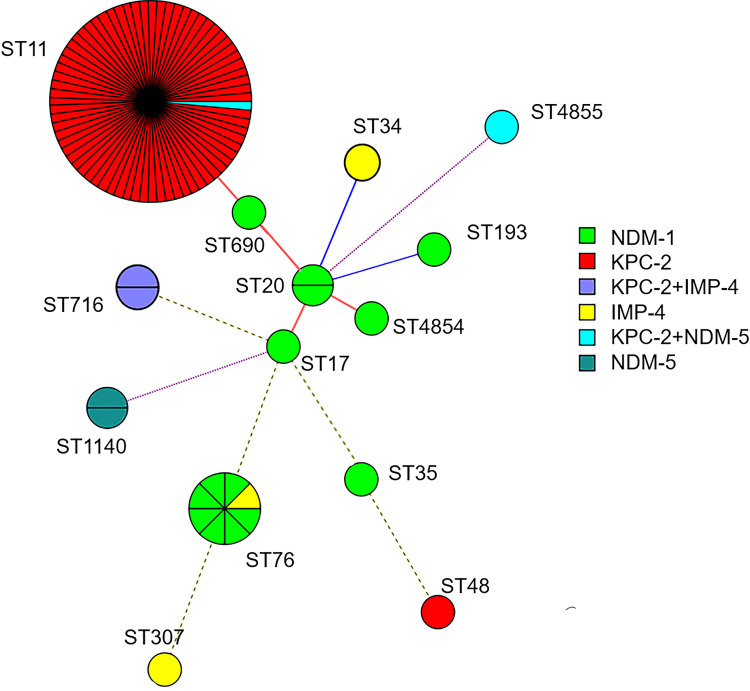
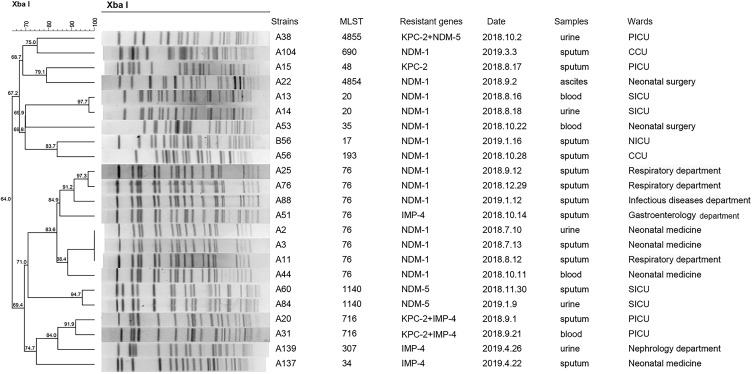
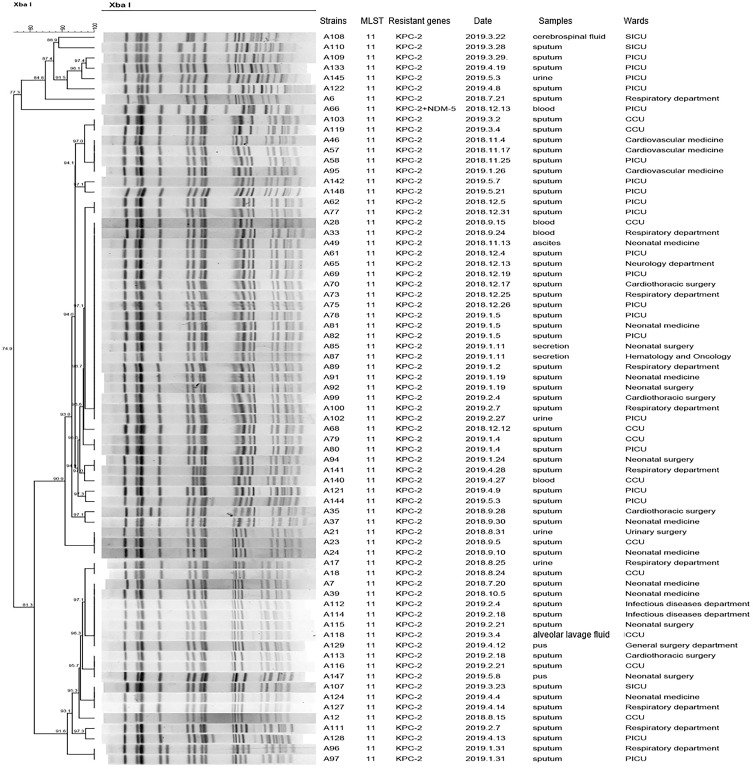
We collected 94 CRKP from 94 children. Overall, (79.8%) was the predominant carbapenemase gene, followed by (14.9%), (5.3%) and (4.3%). Notably, two isolates coharbored and , and two isolates coharbored and . MLST analysis revealed that 14 distinct sequence types (STs) were identified, of which ST11 was the most common sequence type identified. Moreover, two novel STs, ST4854 and ST4855, were detected in this study. PFGE revealed that a predominant cluster consisting of KPC-2-producing CRKP ST11 clone isolates was identified and was distributed mainly in the pediatric intensive care unit (PICU) and cardiac intensive care unit (CCU). Moreover, this is the first report to identify the dissemination of ST716 CRKP coproducing KPC-2 and IMP-4 clones.
Clonal dissemination of KPC-2-producing CRKP ST11 was observed in multiple departments. Moreover, two novel STs (ST4854 and ST4855) were identified, which indicates an increased diversity of CRKP strains. To our knowledge, this is the first report that identified the dissemination of coproducing KPC-2 and IMP-4 clones among children, which represents a significant health risk to pediatric patients. Active surveillance and effective control measures are urgently needed to prevent further transmission of these strains among children.
耐碳青霉烯类肺炎克雷伯菌(CRKP)的不断出现已成为全球严重的公共卫生问题,尤其是对儿童而言,但儿科患者CRKP感染的数据有限。本研究旨在确定中国江苏省儿科患者中CRKP的流行病学和分子特征。
2018年7月至2019年5月期间,从中国南京医科大学附属儿童医院连续收集CRKP。然后,对CRKP菌株进行进一步研究:抗菌药物敏感性试验、耐药决定因素筛查和同源性分析。
我们从94名儿童中收集了94株CRKP。总体而言,blaKPC(79.8%)是主要的碳青霉烯酶基因,其次是blaNDM(14.9%)、blaIMP(5.3%)和blaVIM(4.3%)。值得注意的是,有两株分离株同时携带blaKPC和blaNDM,两株分离株同时携带blaKPC和blaIMP。多位点序列分型(MLST)分析显示,共鉴定出14种不同的序列类型(STs),其中ST11是最常见的序列类型。此外,本研究还检测到两种新的STs,即ST4854和ST4855。脉冲场凝胶电泳(PFGE)显示,鉴定出一个由产KPC-2的CRKP ST11克隆分离株组成的主要聚类,主要分布在儿科重症监护病房(PICU)和心脏重症监护病房(CCU)。此外,这是首次报道鉴定出同时产KPC-2和IMP-4克隆的ST716 CRKP的传播情况。
观察到产KPC-2的CRKP ST11在多个科室的克隆传播。此外,鉴定出两种新的STs(ST4854和ST4855),这表明CRKP菌株的多样性增加。据我们所知,这是首次报道在儿童中鉴定出同时产KPC-2和IMP-4克隆的传播情况,这对儿科患者构成了重大健康风险。迫切需要进行主动监测并采取有效的控制措施,以防止这些菌株在儿童中进一步传播。