Yitayew Moges Yinges, Adem Mohammed Hussien, Tibebu Nigusie Selomon
Ethiopian Red Cross Society South Gondar Branch, Debre Tabor, Ethiopia.
Department of Health Systems Management and Health Economics, School of Public Health, Bahir Dar University, Bahir Dar, Ethiopia.
Risk Manag Healthc Policy. 2020 Dec 15;13:3031-3038. doi: 10.2147/RMHP.S280685. eCollection 2020.
Community-based health insurance is a not-for-profit type of health insurance that has been used by poor people to protect themselves against the high costs of seeking medical care and treatment for illness. This study aimed to assess communities' willingness to enroll for community-based health insurance (CBHI) and its associated factors in Simada district, Northwest, Ethiopia.
A community-based mixed cross-sectional study design was conducted. Multistage simple random and purposive sampling techniques were used for quantitative and qualitative studies, respectively. Data were coded and entered into Epi info version 7.2.0.1 and exported to SPSS 20.0 for data analysis. Inferential statistics were done to determine an association between the outcome and independent variables. Statistically significant variables in binary logistic regression analysis with p-value <0.2 were entered for multivariable binary logistic regression analysis and P-value ≤0.05 was considered as statistically significant. Hosmer and Lemeshow's goodness of fitness test was fitted and qualitative data were analyzed by using thematic analysis.
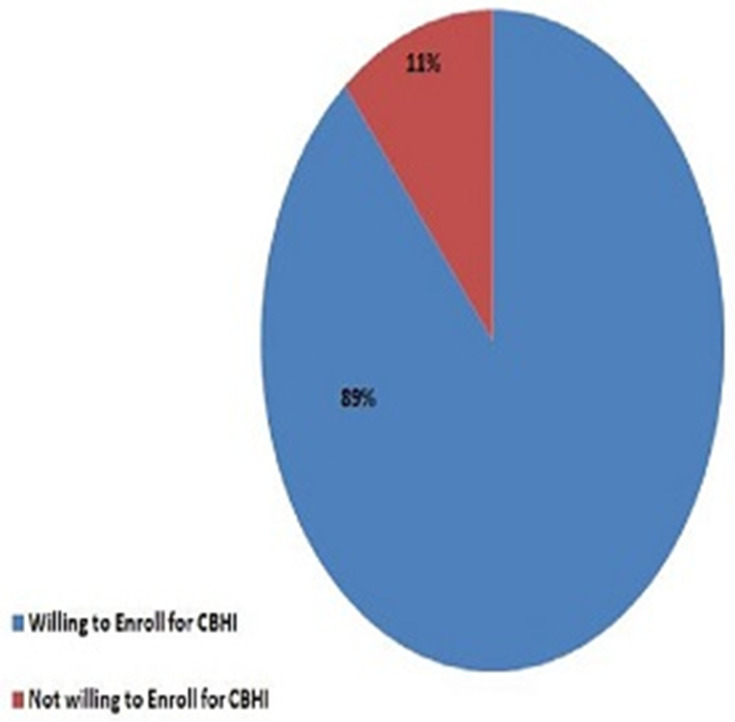
Among 510 study participants, 454 (89%) [CI: (86.5%-91.6%)] were willing to enroll for community-based health insurance. Members of social capital [AOR: 7.6 (3.78-15.5)], distance from health facilities [AOR: 10.8 (4.9-23.5)], the experience of chronic illness in the family [AOR: 4.6 (1.88-11.4)], medium family wealth status [AOR: 3.1 (1.3-7.5)], and the number of family members [AOR: 2.25 (1.11-4.6)] were significantly associated with willingness to enroll for community-based health insurance.
Willingness to enroll in community-based health insurance in the study area is high. Members of social capital, the experience of chronic illness in the family, distance from a health facility, the number of family members, and medium family wealth status were factors found to be associated with willingness to enroll for the scheme. Therefore, emphasizing redesigning and planning strategies for better expanding the scheme accordingly.
社区医疗保险是一种非营利性医疗保险,穷人用它来保护自己免受寻求医疗护理和疾病治疗的高昂费用的影响。本研究旨在评估埃塞俄比亚西北部西马达地区社区参与社区医疗保险(CBHI)的意愿及其相关因素。
采用基于社区的混合横断面研究设计。多阶段简单随机抽样和目的抽样技术分别用于定量和定性研究。数据进行编码并录入Epi info 7.2.0.1版本,然后导出到SPSS 20.0进行数据分析。进行推断统计以确定结果与自变量之间的关联。二元逻辑回归分析中p值<0.2的具有统计学意义的变量被纳入多变量二元逻辑回归分析,p值≤0.05被视为具有统计学意义。进行了Hosmer和Lemeshow拟合优度检验,并使用主题分析对定性数据进行了分析。
在510名研究参与者中,454人(89%)[置信区间:(86.5%-91.6%)]愿意参加社区医疗保险。社会资本成员[AOR:7.6(3.78-15.5)]、与医疗机构的距离[AOR:10.8(4.9-23.5)]、家庭慢性病经历[AOR:4.6(1.88-11.4)]、中等家庭财富状况[AOR:3.1(1.3-7.5)]以及家庭成员数量[AOR:2.25(1.11-4.6)]与参加社区医疗保险的意愿显著相关。
研究地区参加社区医疗保险的意愿很高。社会资本成员、家庭慢性病经历、与医疗机构的距离、家庭成员数量和中等家庭财富状况是与参加该计划的意愿相关的因素。因此,应强调重新设计和规划策略,以便更好地相应扩大该计划。