Zhang Zongyu, Huo Yongfeng, Zhou Zhijing, Zhang Peng, Hu Jun
Department of Orthopedics, Lianyungang Affiliated Hospital of Nanjing University of Chinese Medicine, Lianyungang Traditional Chinese Medicine Hospital, Lianyungang, Jiangsu 222004, P.R. China.
Department of Orthopedics, The First Affiliated Hospital of Kangda College of Nanjing Medical University, Xuzhou Medical University Affiliated Hospital of Lianyungang, Lianyungang, Jiangsu 222004, P.R. China.
Exp Ther Med. 2021 Feb;21(2):131. doi: 10.3892/etm.2020.9563. Epub 2020 Dec 10.
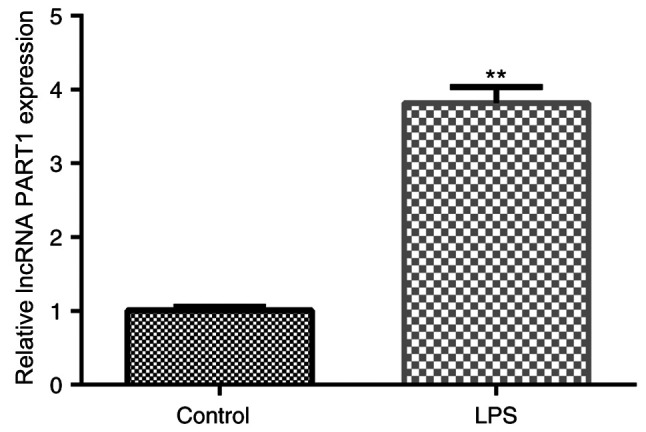
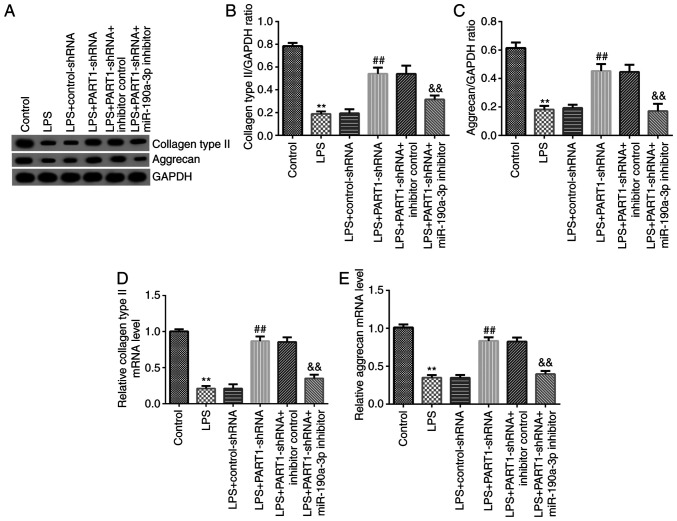
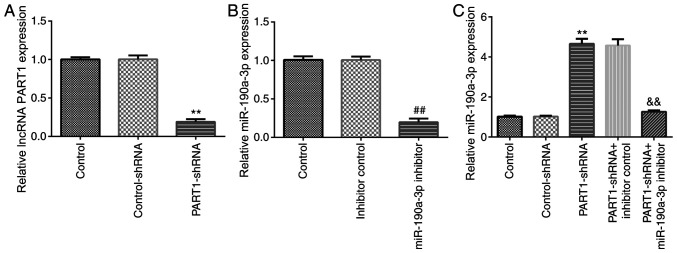
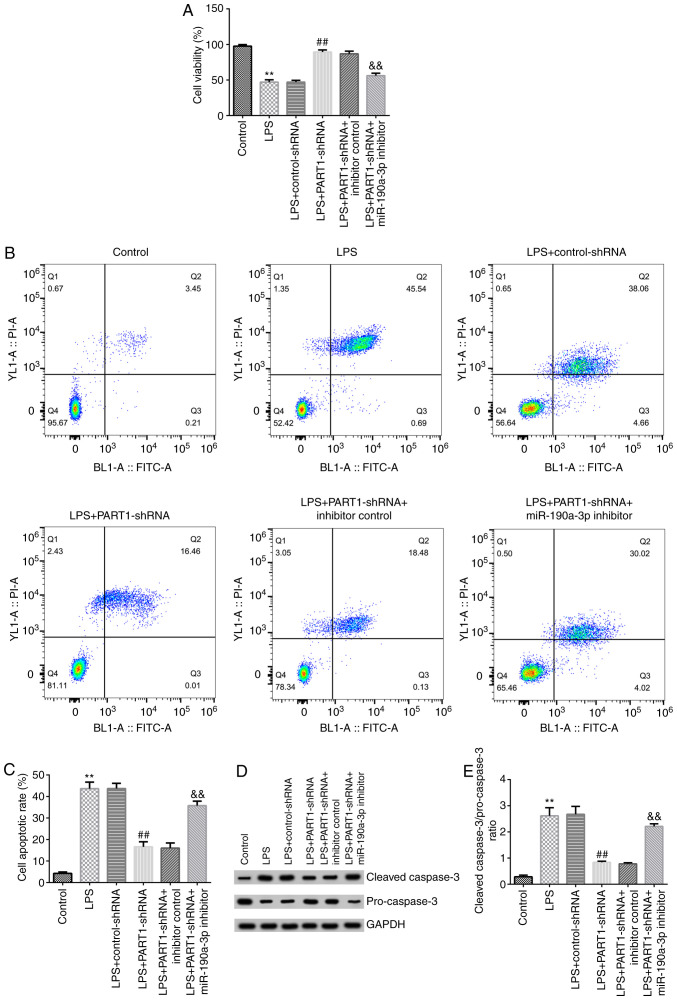
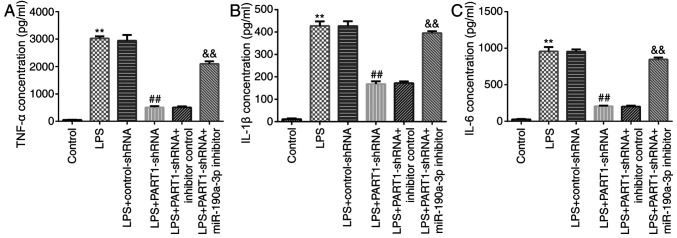
Intervertebral disc degeneration (IDD) is a chronic skeletal muscle degeneration disease. Previous studies have demonstrated that long non-coding RNAs (lncRNAs) exert significant roles in serious illnesses. Prostate androgen-regulated transcript 1 (PART1) is an identified lncRNA that has been reported to be a regulator in a number of diseases. However, the potential effects of PART1 in IDD have yet to be fully elucidated. The present study aimed to investigate the roles of lncRNA PART1 in IDD and identify a possible underlying mechanism. Human nucleus pulposus (NP) cells were first exposed to lipopolysaccharide (LPS) to construct IDD models. Reverse transcription-quantitative PCR (RT-qPCR) was performed to measure lncRNA PART1 expression levels in 10 ng/ml LPS-stimulated NP cells and normal cells (untreated cells). Dual-luciferase reporter assays were conducted to verify the possible binding sites of microRNA (miR)-190a-3p on lncRNA PART1. In addition, NP cell viability and apoptosis were measured by performing MTT and flow cytometry, respectively. Expression and secretion of inflammatory factors (TNF-α, IL-1β and IL-6) and extracellular matrix (ECM) degradation-related proteins (aggrecan and collagen type II) were measured using ELISA, RT-qPCR and western blotting. Expression levels of lncRNA PART1 in LPS-treated NP cells were found to be higher compared with those in the control groups. miR-190a-3p directly targeted lncRNA PART1. PART1 knockdown enhanced cell viability, reduced cell apoptosis, inhibited inflammatory factor secretion and promoted ECM degradation in LPS-stimulated NP cells. However, transfection with the miR-190a-3p inhibitor reversed the aforementioned PART1 knockdown-induced alterations in cell viability, apoptosis, inflammatory cytokine and ECM degradation. Collectively, these results suggest that PART1 accelerates the progression of IDD by directly targeting miR-190a-3p, which provides a novel target for IDD diagnosis and treatment.
椎间盘退变(IDD)是一种慢性骨骼肌退行性疾病。先前的研究表明,长链非编码RNA(lncRNAs)在严重疾病中发挥着重要作用。前列腺雄激素调节转录本1(PART1)是一种已被鉴定的lncRNA,据报道它在多种疾病中是一种调节因子。然而,PART1在IDD中的潜在作用尚未完全阐明。本研究旨在探讨lncRNA PART1在IDD中的作用,并确定可能的潜在机制。首先将人髓核(NP)细胞暴露于脂多糖(LPS)以构建IDD模型。进行逆转录定量PCR(RT-qPCR)以测量10 ng/ml LPS刺激的NP细胞和正常细胞(未处理细胞)中lncRNA PART1的表达水平。进行双荧光素酶报告基因测定以验证微小RNA(miR)-190a-3p在lncRNA PART1上的可能结合位点。此外,分别通过MTT和流式细胞术测量NP细胞活力和凋亡。使用酶联免疫吸附测定(ELISA)、RT-qPCR和蛋白质印迹法测量炎症因子(TNF-α、IL-1β和IL-6)的表达和分泌以及细胞外基质(ECM)降解相关蛋白(聚集蛋白聚糖和II型胶原)。发现LPS处理的NP细胞中lncRNA PART1的表达水平高于对照组。miR-190a-3p直接靶向lncRNA PART1。敲低PART1可增强LPS刺激的NP细胞的活力,减少细胞凋亡,抑制炎症因子分泌并促进ECM降解。然而,用miR-190a-3p抑制剂转染可逆转上述敲低PART1诱导的细胞活力、凋亡、炎性细胞因子和ECM降解的改变。总的来说,这些结果表明PART1通过直接靶向miR-190a-