Department of Pharmacology and Toxicology, Centre for Molecular Biosciences, University of Innsbruck , Austria.
Neurobiology Division, MRC Laboratory of Molecular Biology , Cambridge, UK.
Channels (Austin). 2021 Dec;15(1):38-52. doi: 10.1080/19336950.2020.1859260.
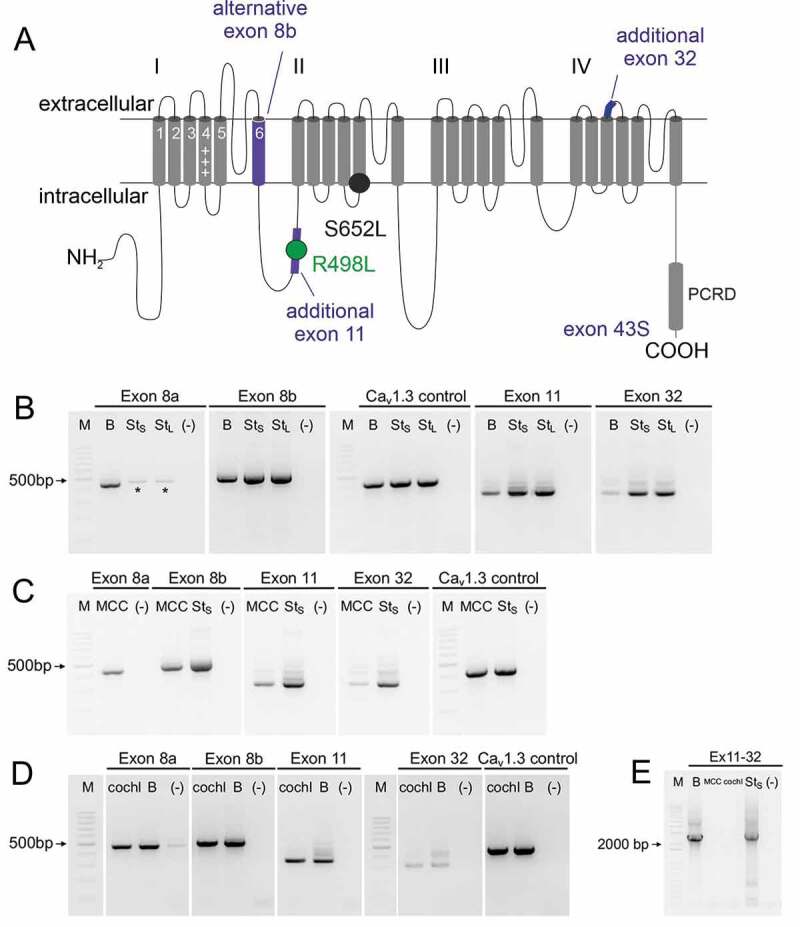
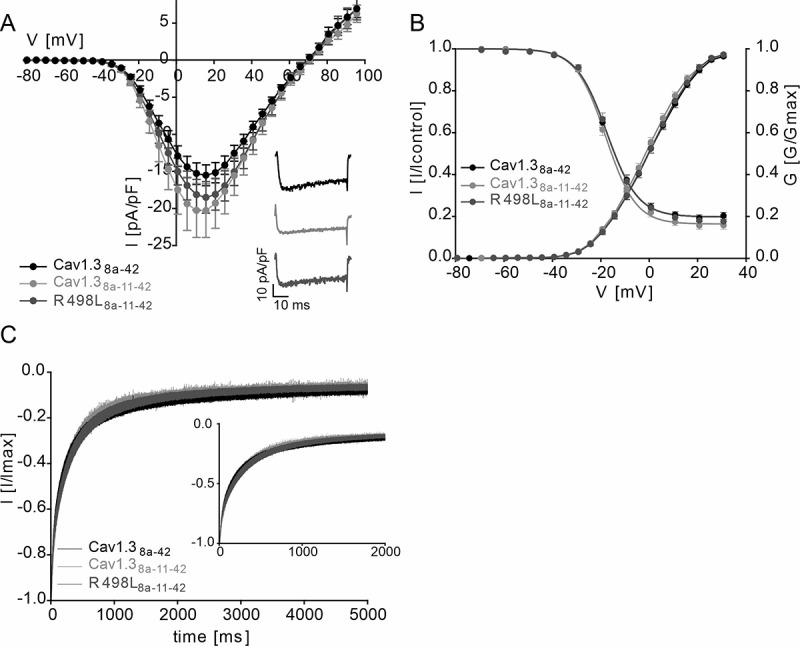
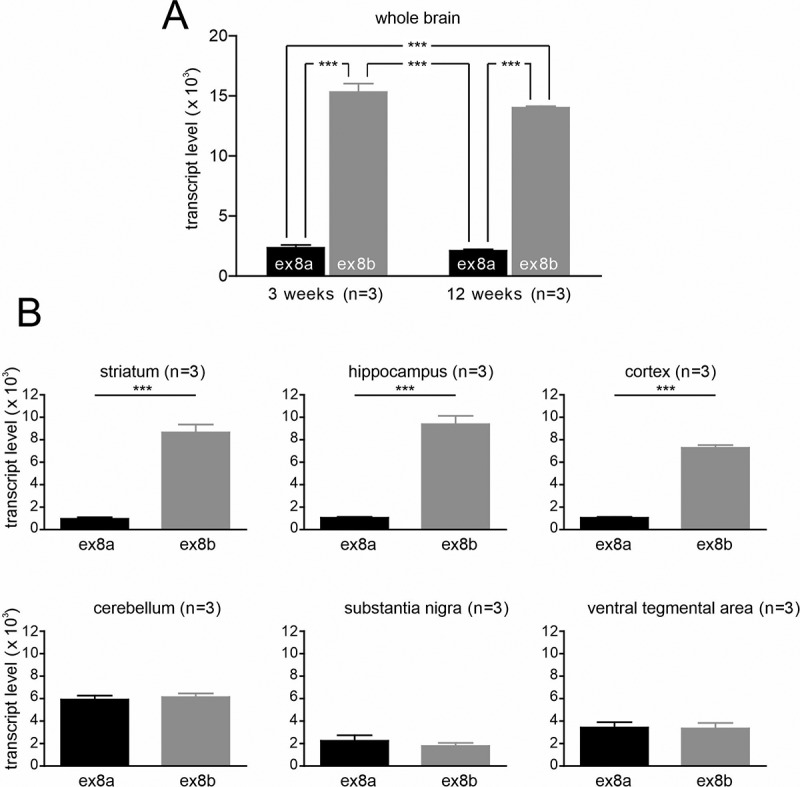
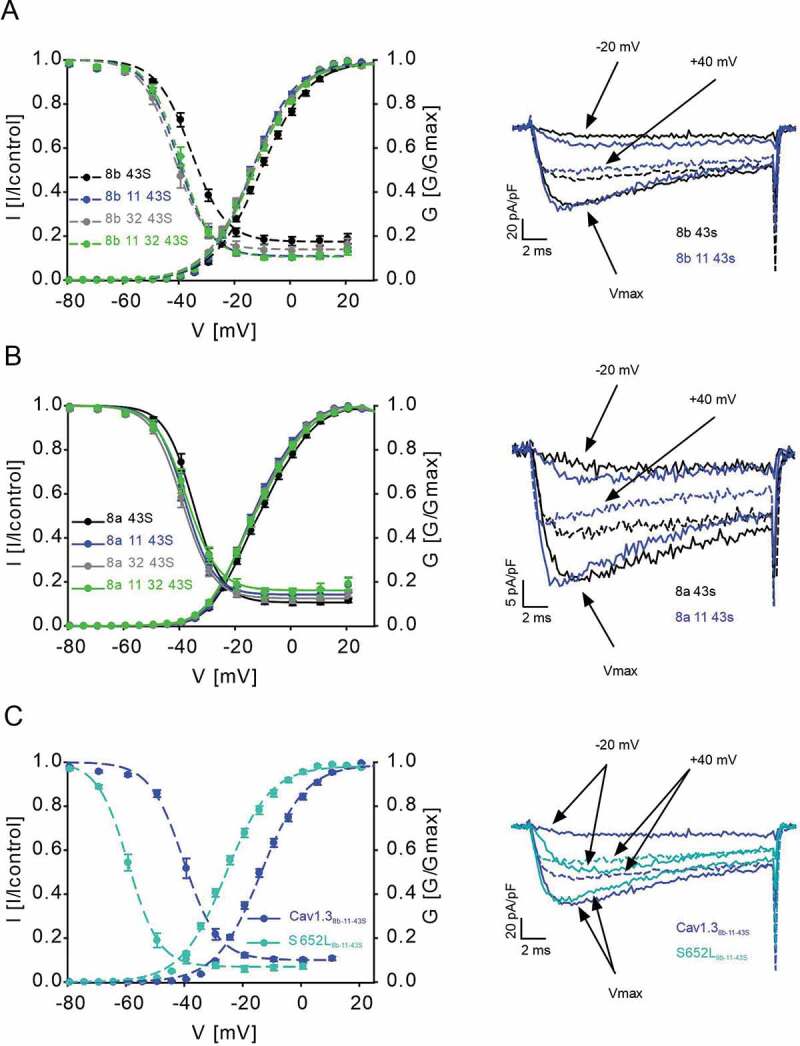
-->Low voltage-activated Cav1.3 L-type Ca-channels are key regulators of neuronal excitability controlling neuronal development and different types of learning and memory. Their physiological functions are enabled by their negative activation voltage-range, which allows Cav1.3 to be active at subthreshold voltages. Alternative splicing in the C-terminus of their pore-forming α1-subunits gives rise to C-terminal long (Cav1.3) and short (Cav1.3) splice variants allowing Cav1.3 to activate at even more negative voltages than Cav1.3. We discovered that inclusion of exons 8b, 11, and 32 in Cav1.3 further shifts activation (-3 to -4 mV) and inactivation (-4 to -6 mV) to more negative voltages as revealed by functional characterization in tsA-201 cells. We found transcripts of these exons in mouse chromaffin cells, the cochlea, and the brain. Our data further suggest that Cav1.3-containing exons 11 and 32 constitute a significant part of native channels in the brain. We therefore investigated the effect of these splice variants on human disease variants. Splicing did not prevent the gating defects of the previously reported human pathogenic variant S652L, which further shifted the voltage-dependence of activation of exon 11-containing channels by more than -12 mV. In contrast, we found no evidence for gating changes of the missense variant R498L, located in exon 11, which has recently been identified in a patient with an epileptic syndrome. Our data demonstrate that alternative splicing outside the C-terminus involving exons 11 and 32 contributes to channel fine-tuning by stabilizing negative activation and inactivation gating properties of wild-type and mutant Cav1.3 channels.
-->低电压激活的 Cav1.3 L 型钙通道是调节神经元兴奋性的关键调节因子,控制着神经元的发育以及不同类型的学习和记忆。它们的生理功能是通过其负激活电压范围实现的,该范围允许 Cav1.3 在亚阈值电压下激活。其孔形成 α1 亚基的 C 末端的选择性剪接产生 C 末端长(Cav1.3)和短(Cav1.3)剪接变体,使 Cav1.3 能够在比 Cav1.3 更负的电压下激活。我们发现,Cav1.3 中的外显子 8b、11 和 32 的包含进一步将激活(-3 至-4 mV)和失活(-4 至-6 mV)移至更负的电压,这是通过在 tsA-201 细胞中的功能特征揭示的。我们在小鼠嗜铬细胞、耳蜗和大脑中发现了这些外显子的转录本。我们的数据进一步表明,Cav1.3 包含的外显子 11 和 32 构成了大脑中天然通道的重要部分。因此,我们研究了这些剪接变体对人类疾病变体的影响。剪接并不能阻止先前报道的人类致病性变体 S652L 的门控缺陷,该变体进一步将包含外显子 11 的通道的激活电压依赖性移至超过-12 mV。相比之下,我们没有发现位于外显子 11 中的错义变体 R498L 的门控变化的证据,该变体最近在一名患有癫痫综合征的患者中被发现。我们的数据表明,涉及外显子 11 和 32 的 C 末端以外的选择性剪接通过稳定野生型和突变 Cav1.3 通道的负激活和失活门控特性,有助于通道微调。