Liu Yuxiang, Fang Jingai
Shanxi Medical University, No. 56, Xinjiannan Road, Taiyuan, 030001 Shanxi, China.
First Hospital of Shanxi Medical University, No. 85, Jiefangnan Road, Taiyuan, 030001 Shanxi, China.
Stem Cells Int. 2020 Dec 11;2020:8875554. doi: 10.1155/2020/8875554. eCollection 2020.
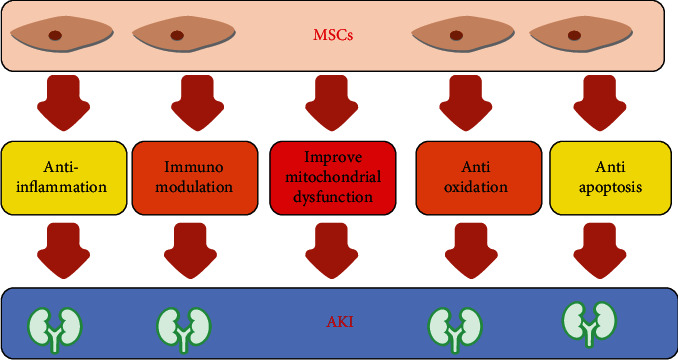
Acute kidney injury (AKI) is a heterogeneous syndrome characterized by a dramatic increase in serum creatinine. Mild AKI may merely be confined to kidney damage and resolve within days; however, severe AKI commonly involves extrarenal organ dysfunction and is associated with high mortality. There is no specific pharmaceutical treatment currently available that can reverse the course of this disease. Notably, mesenchymal stem cells (MSCs) show great promise for the management of AKI by targeting multiple pathophysiological pathways to facilitate tubular epithelial cell repair. It has been well established that the unique characteristics of MSCs make them ideal vectors for gene therapy. Thus, genetic modification has been attempted to achieve improved therapeutic outcomes in the management of AKI by overexpressing trophic cytokines or facilitating MSC delivery to renal tissues. The present article provides a comprehensive review of genetic modification strategies targeted at optimizing the therapeutic potential of MSCs in AKI.
急性肾损伤(AKI)是一种异质性综合征,其特征为血清肌酐急剧升高。轻度AKI可能仅局限于肾脏损伤,并在数天内恢复;然而,重度AKI通常涉及肾外器官功能障碍,且死亡率很高。目前尚无能够逆转该疾病病程的特效药物治疗方法。值得注意的是,间充质干细胞(MSC)通过靶向多种病理生理途径促进肾小管上皮细胞修复,在AKI的治疗中显示出巨大潜力。众所周知,MSC的独特特性使其成为基因治疗的理想载体。因此,人们尝试通过过表达营养细胞因子或促进MSC向肾组织递送,进行基因改造以在AKI的治疗中取得更好的治疗效果。本文全面综述了旨在优化MSC在AKI中治疗潜力的基因改造策略。