Verbenko Dmitry A, Karamova Arfenya E, Artamonova Olga G, Deryabin Dmitry G, Rakitko Alexander, Chernitsov Alexandr, Krasnenko Anna, Elmuratov Artem, Solomka Victoria S, Kubanov Alexey A
State Research Center of Dermatovenereology and Cosmetology, Korolenko St., 3, bldg 6, 107076 Moscow, Russia.
Genotek Ltd., Nastavnicheskiipereulok 17/1, 105120 Moscow, Russia.
J Pers Med. 2020 Dec 29;11(1):20. doi: 10.3390/jpm11010020.
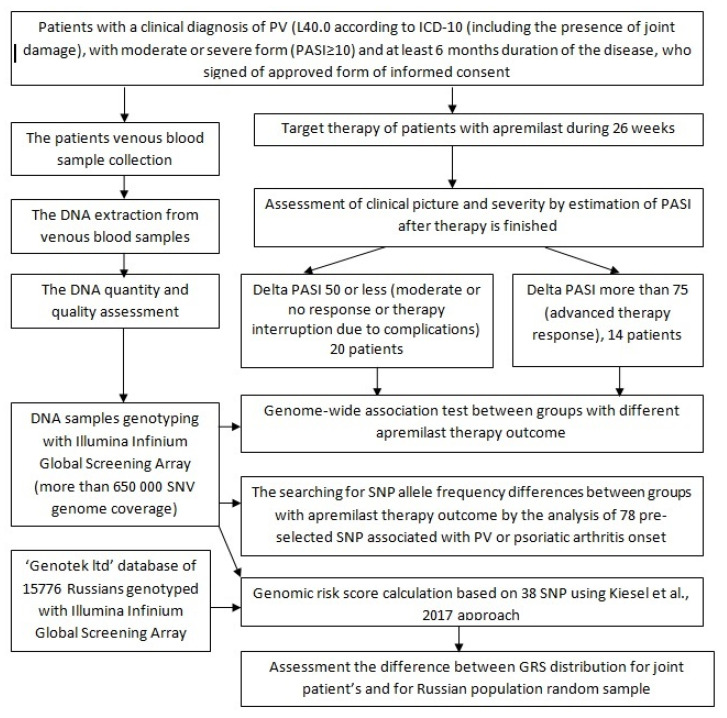
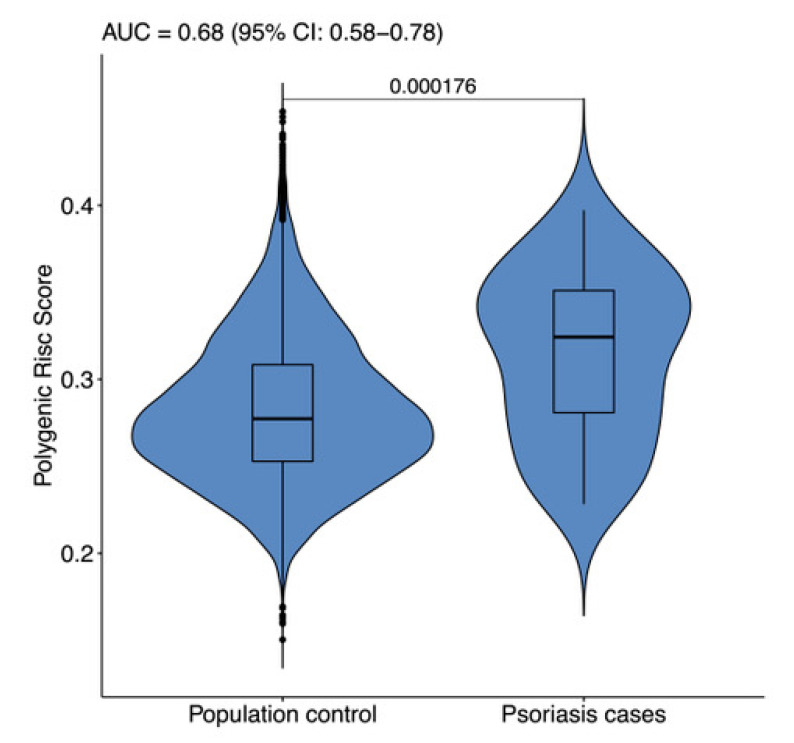
One of the target drugs for plaque psoriasis treatment is apremilast, which is a selective phosphodiesterase 4 (PDE4) inhibitor. In this study, 34 moderate-to-severe and severe plaque psoriasis patients from Russia were treated with apremilast for 26 weeks. This allowed us to observe the effectiveness of splitting patient cohorts based on clinical outcomes, which were assessed using the Psoriasis Area Severity Index (PASI). In total, 14 patients (41%) indicated having an advanced outcome with delta PASI 75 after treatment; 20 patients indicated having moderate or no effects. Genome variability was investigated using the Illumina Infinium Global Screening Array. Genome-wide analysis revealed apremilast therapy clinical outcome associations at three compact genome regions with undefined functions situated on chromosomes 2, 4, and 5, as well as on a single single-nucleotide polymorphism (SNP) on chromosome 23. Pre-selected SNP sets were associated with psoriasis vulgaris analysis, which was used to identify four SNP-associated targeted therapy efficiencies: (rs1143633), () (rs20541), (rs2201841), and (rs1800629) genes. Moreover, we showed that the use of the global polygenic risk score allowed for the prediction of onset psoriasis in Russians. Therefore, these results can serve as a starting point for creating a predictive model of apremilast therapy response in the targeted therapy of patients with psoriasis vulgaris.
斑块状银屑病治疗的目标药物之一是阿普斯特,它是一种选择性磷酸二酯酶4(PDE4)抑制剂。在本研究中,34名来自俄罗斯的中度至重度及重度斑块状银屑病患者接受了阿普斯特治疗26周。这使我们能够根据临床结果对患者队列进行划分,并观察其有效性,临床结果使用银屑病面积和严重程度指数(PASI)进行评估。总共有14名患者(41%)在治疗后显示达到PASI改善75%的良好效果;20名患者显示效果中等或无效果。使用Illumina Infinium全球筛查阵列研究基因组变异性。全基因组分析揭示了阿普斯特治疗的临床结果与位于2号、4号和5号染色体上功能未明的三个紧密基因组区域以及23号染色体上的一个单核苷酸多态性(SNP)相关。预先选择的SNP集与寻常型银屑病分析相关,用于确定四种SNP相关的靶向治疗效率:(rs1143633)、()(rs20541)、(rs2201841)和(rs1800629)基因。此外,我们表明使用全球多基因风险评分可以预测俄罗斯人患银屑病的风险。因此,这些结果可作为创建寻常型银屑病患者靶向治疗中阿普斯特治疗反应预测模型的起点。