Zhang Yuzhou, Ghiringhelli Borsa Nicolo, Shao Dingwu, Dopler Arthur, Jones Michael B, Meyer Nicole C, Pitcher Gabriella R, Taylor Amanda O, Nester Carla M, Schmidt Christoph Q, Smith Richard J H
Molecular Otolaryngology and Renal Research Laboratories, University of Iowa, Iowa City, IA, United States.
Institute of Pharmacology of Natural Products & Clinical Pharmacology, Ulm University, Ulm, Germany.
Front Immunol. 2020 Dec 15;11:607211. doi: 10.3389/fimmu.2020.607211. eCollection 2020.
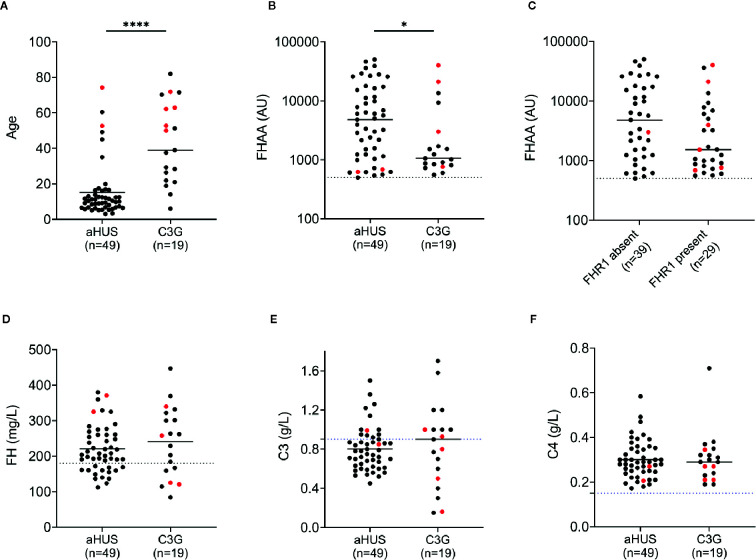
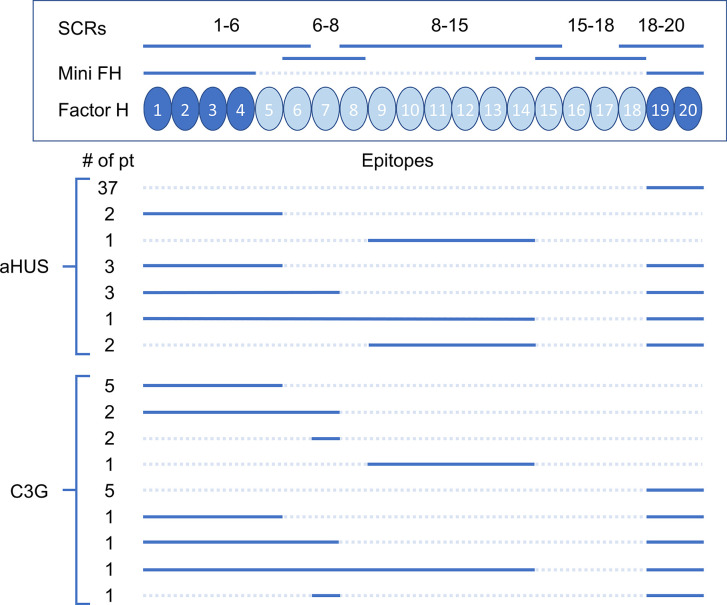
Factor H (FH), a member of the regulators-of-complement-activation (RCA) family of proteins, circulates in human plasma at concentrations of 180-420 mg/L where it controls the alternative pathway (AP) of complement in the fluid phase and on cell surfaces. When the regulatory function of FH is impaired, complement-mediated tissue injury and inflammation occur, leading to diseases such as atypical hemolytic uremic syndrome (a thrombotic microangiopathy or TMA), C3 glomerulopathy (C3G) and monoclonal gammopathy of renal significance (MGRS). A pathophysiological cause of compromised FH function is the development of autoantibodies to various domains of the FH protein. FH autoantibodies (FHAAs) are identified in 10.9% of patients with aHUS, 3.2% of patients with C3G, and rarely in patients with MGRS. The phenotypic variability of FHAA-mediated disease reflects both the complexity of FH and the epitope specificity of FHAA for select regions of the native protein. In this paper, we have characterized FHAA epitopes in a large cohort of patients diagnosed with TMA, C3G or MGRS. We explore the epitopes recognized by FHAAs in these diseases and the association of FHAAs with the genetic deletion of both copies of the gene to show how these disease phenotypes are associated with this diverse spectrum of autoantibodies.
补体激活调节因子(RCA)家族蛋白成员之一的补体因子H(FH),在人血浆中的浓度为180 - 420 mg/L,在液相和细胞表面控制补体的替代途径(AP)。当FH的调节功能受损时,补体介导的组织损伤和炎症就会发生,导致诸如非典型溶血性尿毒症综合征(一种血栓性微血管病或TMA)、C3肾小球病(C3G)和具有肾意义的单克隆丙种球蛋白病(MGRS)等疾病。FH功能受损的病理生理原因是针对FH蛋白各个结构域产生自身抗体。在10.9%的非典型溶血性尿毒症综合征患者、3.2%的C3G患者中可检测到FH自身抗体(FHAA),而在MGRS患者中则很少见。FHAA介导的疾病的表型变异性既反映了FH的复杂性,也反映了FHAA对天然蛋白特定区域的表位特异性。在本文中,我们对一大群被诊断为TMA、C3G或MGRS的患者中的FHAA表位进行了表征。我们探究了这些疾病中FHAA识别的表位以及FHAA与 基因两个拷贝的基因缺失之间的关联,以展示这些疾病表型如何与这种多样的自身抗体谱相关联。 (注:原文中“ gene”表述不完整,可能存在信息缺失)