Department for Cardiovascular Surgery, University Heart Center Freiburg-Bad Krozingen, Freiburg, Germany.
Faculty of Medicine, Albert-Ludwigs-University Freiburg, Freiburg, Germany.
Eur J Cardiothorac Surg. 2021 May 8;59(5):1096-1102. doi: 10.1093/ejcts/ezaa452.
To evaluate the impact of the coronavirus disease 2019 (COVID-19) pandemic on acute and elective thoracic and abdominal aortic procedures.
Forty departments shared their data on acute and elective thoracic and abdominal aortic procedures between January and May 2020 and January and May 2019 in Europe, Asia and the USA. Admission rates as well as delay from onset of symptoms to referral were compared.
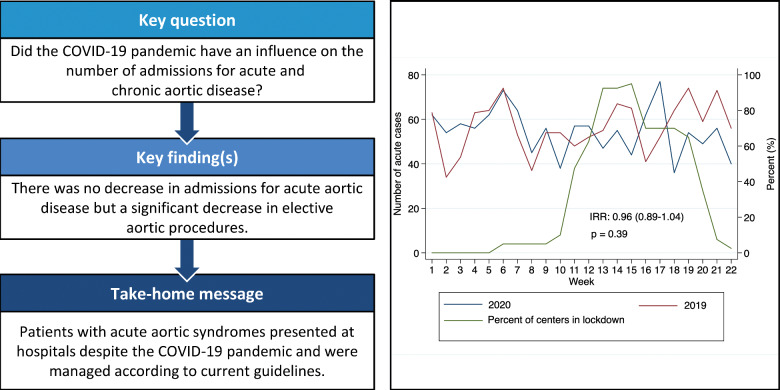
No differences in the number of acute thoracic and abdominal aortic procedures were observed between 2020 and the reference period in 2019 [incidence rates ratio (IRR): 0.96, confidence interval (CI) 0.89-1.04; P = 0.39]. Also, no difference in the time interval from acute onset of symptoms to referral was recorded (<12 h 32% vs > 12 h 68% in 2020, < 12 h 34% vs > 12 h 66% in 2019 P = 0.29). Conversely, a decline of 35% in elective procedures was seen (IRR: 0.81, CI 0.76-0.87; P < 0.001) with substantial differences between countries and the most pronounced decline in Italy (-40%, P < 0.001). Interestingly, in Switzerland, an increase in the number of elective cases was observed (+35%, P = 0.02).
There was no change in the number of acute thoracic and abdominal aortic cases and procedures during the initial wave of the COVID-19 pandemic, whereas the case load of elective operations and procedures decreased significantly. Patients with acute aortic syndromes presented despite COVID-19 and were managed according to current guidelines. Further analysis is required to prove that deferral of elective cases had no impact on premature mortality.
评估 2019 年冠状病毒病(COVID-19)大流行对急性和择期胸腹部主动脉手术的影响。
欧洲、亚洲和美国的 40 个科室在 2020 年 1 月至 5 月和 2019 年 1 月至 5 月期间分享了他们的急性和择期胸腹部主动脉手术的数据。比较了入院率和从症状发作到转诊的延迟时间。
2020 年与 2019 年参考期相比,急性胸腹部主动脉手术数量无差异[发病率比(IRR):0.96,置信区间(CI)0.89-1.04;P=0.39]。此外,从急性症状发作到转诊的时间间隔也无差异(2020 年<12 小时占 32%,>12 小时占 68%;2019 年<12 小时占 34%,>12 小时占 66%,P=0.29)。相反,择期手术减少了 35%(IRR:0.81,CI 0.76-0.87;P<0.001),且各国之间存在显著差异,意大利降幅最大(-40%,P<0.001)。有趣的是,在瑞士,择期病例数有所增加(+35%,P=0.02)。
在 COVID-19 大流行的初始阶段,急性和胸腹部主动脉手术的数量没有变化,而择期手术和手术量明显减少。尽管有 COVID-19 存在,急性主动脉综合征患者仍接受了治疗,并根据现行指南进行了管理。需要进一步分析以证明择期手术的推迟对过早死亡率没有影响。