Okada Motohiro, Oka Tomoka, Nakamoto Misaki, Fukuyama Kouji, Shiroyama Takashi
Department of Neuropsychiatry, Division of Neuroscience, Graduate School of Medicine, Mie University, Tsu 514-8507, Japan.
Int J Mol Sci. 2020 Dec 30;22(1):339. doi: 10.3390/ijms22010339.
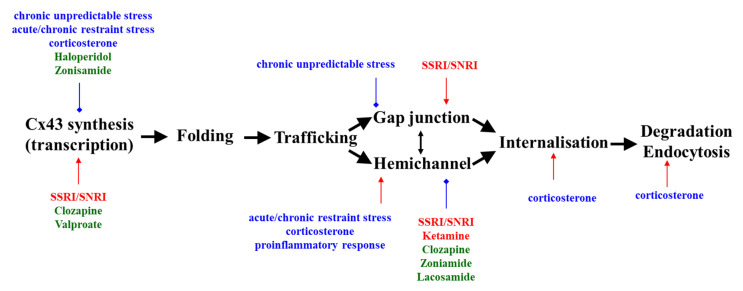
Mood disorders remain a major public health concern worldwide. Monoaminergic hypotheses of pathophysiology of bipolar and major depressive disorders have led to the development of monoamine transporter-inhibiting antidepressants for the treatment of major depression and have contributed to the expanded indications of atypical antipsychotics for the treatment of bipolar disorders. In spite of psychopharmacological progress, current pharmacotherapy according to the monoaminergic hypothesis alone is insufficient to improve or prevent mood disorders. Recent approval of esketamine for treatment of treatment-resistant depression has attracted attention in psychopharmacology as a glutamatergic hypothesis of the pathophysiology of mood disorders. On the other hand, in the last decade, accumulated findings regarding the pathomechanisms of mood disorders emphasised that functional abnormalities of tripartite synaptic transmission play important roles in the pathophysiology of mood disorders. At first glance, the enhancement of astroglial connexin seems to contribute to antidepressant and mood-stabilising effects, but in reality, antidepressive and mood-stabilising actions are mediated by more complicated interactions associated with the astroglial gap junction and hemichannel. Indeed, several depressive mood-inducing stress stimulations suppress connexin43 expression and astroglial gap junction function, but enhance astroglial hemichannel activity. On the other hand, monoamine transporter-inhibiting antidepressants suppress astroglial hemichannel activity and enhance astroglial gap junction function, whereas several non-antidepressant mood stabilisers activate astroglial hemichannel activity. Based on preclinical findings, in this review, we summarise the effects of antidepressants, mood-stabilising antipsychotics, and anticonvulsants on astroglial connexin, and then, to establish a novel strategy for treatment of mood disorders, we reveal the current progress in psychopharmacology, changing the question from "what has been revealed?" to "what should be clarified?".
情绪障碍仍然是全球主要的公共卫生问题。双相情感障碍和重度抑郁症病理生理学的单胺能假说促使了用于治疗重度抑郁症的单胺转运体抑制性抗抑郁药的研发,也推动了非典型抗精神病药物治疗双相情感障碍适应证的扩展。尽管在精神药理学方面取得了进展,但仅依据单胺能假说的当前药物治疗不足以改善或预防情绪障碍。艾氯胺酮近期被批准用于治疗难治性抑郁症,这在精神药理学领域引起了关注,因为它基于情绪障碍病理生理学的谷氨酸能假说。另一方面,在过去十年中,关于情绪障碍发病机制的累积研究结果强调,三方突触传递的功能异常在情绪障碍的病理生理学中起重要作用。乍一看,星形胶质细胞连接蛋白的增强似乎有助于产生抗抑郁和情绪稳定作用,但实际上,抗抑郁和情绪稳定作用是由与星形胶质细胞缝隙连接和半通道相关的更复杂相互作用介导的。的确,几种诱发抑郁情绪的应激刺激会抑制连接蛋白43的表达和星形胶质细胞缝隙连接功能,但会增强星形胶质细胞半通道活性。另一方面,单胺转运体抑制性抗抑郁药会抑制星形胶质细胞半通道活性并增强星形胶质细胞缝隙连接功能,而几种非抗抑郁情绪稳定剂会激活星形胶质细胞半通道活性。基于临床前研究结果,在本综述中,我们总结了抗抑郁药、情绪稳定型抗精神病药和抗惊厥药对星形胶质细胞连接蛋白的影响,然后,为了建立治疗情绪障碍的新策略,我们揭示了精神药理学的当前进展,将问题从“已经揭示了什么?”转变为“应该阐明什么?”。