
通向虚弱的门户?数据驱动的分析检测早期虚弱特征。
Portals to frailty? Data-driven analyses detect early frailty profiles.
机构信息
Department of Psychology, University of Alberta, P217 Biological Sciences Building, Edmonton, AB, T6G 2E9, Canada.
Neuroscience and Mental Health Institute, University of Alberta, 2-132 Li Ka Shing Center for Health Research Innovation, Edmonton, AB, T6G 2E1, Canada.
出版信息
Alzheimers Res Ther. 2021 Jan 4;13(1):1. doi: 10.1186/s13195-020-00736-w.
BACKGROUND
Frailty is an aging condition that reflects multisystem decline and an increased risk for adverse outcomes, including differential cognitive decline and impairment. Two prominent approaches for measuring frailty are the frailty phenotype and the frailty index. We explored a complementary data-driven approach for frailty assessment that could detect early frailty profiles (or subtypes) in relatively healthy older adults. Specifically, we tested whether (1) modalities of early frailty profiles could be empirically determined, (2) the extracted profiles were differentially related to longitudinal cognitive decline, and (3) the profile and prediction patterns were robust for males and females.
METHODS
Participants (n = 649; M age = 70.61, range 53-95) were community-dwelling older adults from the Victoria Longitudinal Study who contributed data for baseline multi-morbidity assessment and longitudinal cognitive trajectory analyses. An exploratory factor analysis on 50 multi-morbidity items produced 7 separable health domains. The proportion of deficits in each domain was calculated and used as continuous indicators in a data-driven latent profile analysis (LPA). We subsequently examined how frailty profiles related to the level and rate of change in a latent neurocognitive speed variable.
RESULTS
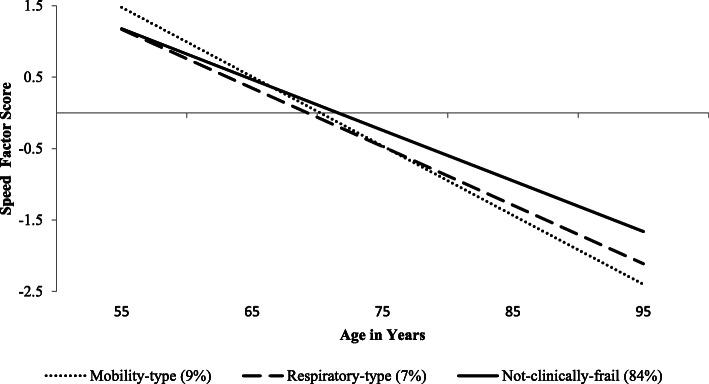
LPA results distinguished three profiles: not-clinically-frail (NCF; characterized by limited impairment across indicators; 84%), mobility-type frailty (MTF; characterized by impaired mobility function; 9%), and respiratory-type frailty (RTF; characterized by impaired respiratory function; 7%). These profiles showed differential neurocognitive slowing, such that MTF was associated with the steepest decline, followed by RTF, and then NCF. The baseline frailty index scores were the highest for MTF and RTF and increased over time. All observations were robust across sex.
CONCLUSIONS
A data-driven approach to early frailty assessment detected differentiable profiles that may be characterized as morbidity-intensive portals into broader and chronic frailty. Early inventions targeting mobility or respiratory deficits may have positive downstream effects on frailty progression and cognitive decline.
背景
虚弱是一种衰老状态,反映了多系统衰退和不良后果的风险增加,包括认知能力下降和功能障碍的差异。衡量虚弱的两种突出方法是虚弱表型和虚弱指数。我们探索了一种补充的数据驱动方法来评估虚弱,以便在相对健康的老年人中早期检测到虚弱特征(或亚型)。具体来说,我们测试了以下几点:(1)是否可以通过实证确定早期虚弱特征的模式;(2)提取的特征是否与纵向认知能力下降存在差异;(3)该特征和预测模式对男性和女性是否具有稳健性。
方法
参与者(n=649;平均年龄 70.61 岁,范围 53-95 岁)是来自维多利亚纵向研究的社区居住的老年人,他们提供了基线多病种评估和纵向认知轨迹分析的数据。对 50 种多病种项目进行的探索性因子分析产生了 7 个可分离的健康领域。每个领域的缺陷比例均计算在内,并用作数据驱动的潜在剖面分析(LPA)的连续指标。随后,我们检查了虚弱特征与潜在神经认知速度变量的水平和变化率之间的关系。
结果
LPA 结果区分了三种特征:非临床虚弱(NCF;特征为指标受限的损伤;84%)、移动型虚弱(MTF;特征为移动功能受损;9%)和呼吸型虚弱(RTF;特征为呼吸功能受损;7%)。这些特征表现出不同的神经认知减速,例如 MTF 与最陡峭的下降相关,其次是 RTF,然后是 NCF。MTF 和 RTF 的基线虚弱指数得分最高,并且随着时间的推移而增加。所有观察结果在性别上均稳健。
结论
一种用于早期虚弱评估的数据驱动方法检测到了可区分的特征,这些特征可能是更广泛和慢性虚弱的病态密集门户。针对移动或呼吸缺陷的早期干预措施可能对虚弱进展和认知能力下降产生积极的下游影响。


 Zotero 插件