Kawabori Masahito, Weintraub Alan H, Imai Hideaki, Zinkevych Iaroslav, McAllister Peter, Steinberg Gary K, Frishberg Benjamin M, Yasuhara Takao, Chen Jefferson W, Cramer Steven C, Achrol Achal S, Schwartz Neil E, Suenaga Jun, Lu Daniel C, Semeniv Ihor, Nakamura Hajime, Kondziolka Douglas, Chida Dai, Kaneko Takehiko, Karasawa Yasuaki, Paadre Susan, Nejadnik Bijan, Bates Damien, Stonehouse Anthony H, Richardson R Mark, Okonkwo David O
From the Department of Neurosurgery (M.K.), Hokkaido University Hospital, Sapporo, Japan; Rocky Mountain Regional Brain Injury System and University of Colorado School of Medicine (A.H.W.), Englewood; JCHO Tokyo Shinjuku Medical Center (H.I.), Japan; Ukraine Presidential Hospital (I.Z.), Kiev; New England Institute for Neurology and Headache (P.M.); New England Institute for Clinical Research (P.M.), Stamford; Department of Neurology (P.M.), Yale University, New Haven; Frank Netter School of Medicine (P.M.), Quinnipiac University, Hamden, CT; Department of Neurosurgery (G.K.S.), Department of Neurology and Neurological Sciences (N.E.S.), and Stanford Stroke Center (G.K.S., N.E.S.), Stanford University School of Medicine and Stanford Health Care, CA; The Neurology Center of Southern California (B.M.F.), Carlsbad; Department of Neurological Surgery (T.Y.), Okayama University Graduate School of Medicine, Okayama University Hospital, Japan; Department of Neurological Surgery (J.W.C.), University of California, Irvine, School of Medicine; Department of Neurology (S.C.C.), University of California, Los Angeles; California Rehabilitation Institute (S.C.C.); Los Angeles; Department of Neurosurgery (A.S.A.), Loma Linda University Medical Center; Department of Neurosurgery (J.S.), Yokohama City University School of Medicine, Kanagawa, Japan; Department of Neurosurgery (D.C.L.), Ronald Reagan UCLA Medical Center, Los Angeles, CA; Clinical Hospital Feofaniya (I.S.), Kiev, Ukraine; Department of Neurosurgery (H.N.), Osaka University Graduate School of Medicine, Suita, Japan; Department of Neurosurgery (D.K.), New York University and NYU Langone Medical Center, NY; SanBio, Inc (D.C., T.K., B.N., D.B.), Mountain View, CA; Department of Neurosurgery (Y.K.), University of Tokyo Hospital, Japan; Biostatistical Consulting Inc (S.P.), Lexington, MA; Watson & Stonehouse Enterprises LLC (A.H.S.), Pacific Grove, CA; Massachusetts General Hospital and Harvard Medical School (R.M.R.), Boston; and Department of Neurological Surgery (D.O.O.), University of Pittsburgh Medical Center, PA.
Neurology. 2021 Feb 22;96(8):e1202-e1214. doi: 10.1212/WNL.0000000000011450.
To determine whether chronic motor deficits secondary to traumatic brain injury (TBI) can be improved by implantation of allogeneic modified bone marrow-derived mesenchymal stromal/stem cells (SB623).
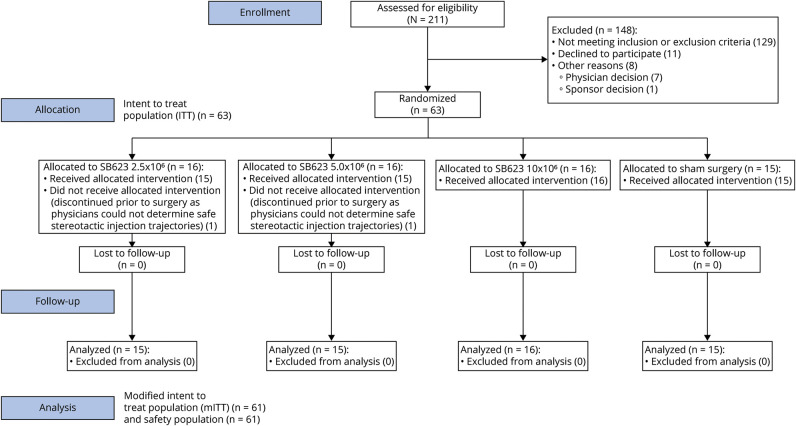
This 6-month interim analysis of the 1-year double-blind, randomized, surgical sham-controlled, phase 2 Stem Cell Therapy for Traumatic Brain Injury (STEMTRA) trial (NCT02416492) evaluated safety and efficacy of the stereotactic intracranial implantation of SB623 in patients with stable chronic motor deficits secondary to TBI. Patients in this multicenter trial (n = 63) underwent randomization in a 1:1:1:1 ratio to 2.5 × 10, 5.0 × 10, or 10 × 10 SB623 cells or control. Safety was assessed in patients who underwent surgery (n = 61), and efficacy was assessed in the modified intent-to-treat population of randomized patients who underwent surgery (n = 61; SB623 = 46, control = 15).
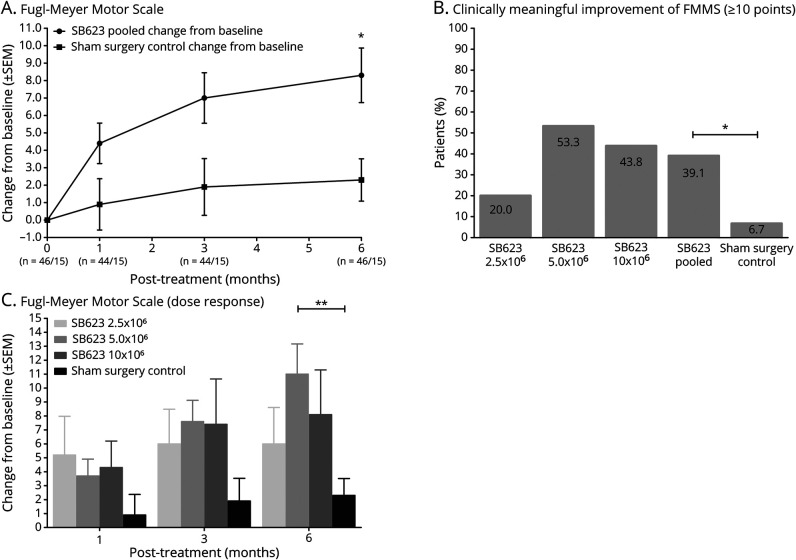
The primary efficacy endpoint of significant improvement from baseline of Fugl-Meyer Motor Scale score at 6 months for SB623-treated patients was achieved. SB623-treated patients improved by (least square [LS] mean) 8.3 (standard error 1.4) vs 2.3 (standard error 2.5) for control at 6 months, the LS mean difference was 6.0 (95% confidence interval 0.3-11.8, = 0.040). Secondary efficacy endpoints improved from baseline but were not statistically significant vs control at 6 months. There were no dose-limiting toxicities or deaths, and 100% of SB623-treated patients experienced treatment-emergent adverse events vs 93.3% of control patients ( = 0.25).
SB623 cell implantation appeared to be safe and well tolerated, and patients implanted with SB623 experienced significant improvement from baseline motor status at 6 months compared to controls.
NCT02416492.
This study provides Class I evidence that implantation of SB623 was well tolerated and associated with improvement in motor status.
确定创伤性脑损伤(TBI)继发的慢性运动功能障碍能否通过植入同种异体修饰的骨髓间充质基质/干细胞(SB623)得到改善。
这项针对为期1年的双盲、随机、手术假对照2期创伤性脑损伤干细胞治疗(STEMTRA)试验(NCT02416492)的6个月中期分析,评估了立体定向颅内植入SB623对TBI继发稳定慢性运动功能障碍患者的安全性和有效性。该多中心试验中的患者(n = 63)按1:1:1:1的比例随机分为接受2.5×10、5.0×10或10×10个SB623细胞治疗组或对照组。对接受手术的患者(n = 61)进行安全性评估,对接受手术的随机分组患者的改良意向性治疗人群(n = 61;SB623组 = 46,对照组 = 15)进行疗效评估。
达到了SB623治疗患者在6个月时Fugl-Meyer运动量表评分较基线有显著改善的主要疗效终点。SB623治疗患者在6个月时改善了(最小二乘[LS]均值)8.3(标准误1.4),而对照组为2.3(标准误2.5),LS均值差异为6.0(95%置信区间0.3 - 11.8,P = 0.040)。次要疗效终点较基线有所改善,但在6个月时与对照组相比无统计学意义。没有剂量限制性毒性或死亡事件,100%接受SB623治疗的患者出现治疗中出现的不良事件,而对照组患者为93.3%(P = 0.25)。
SB623细胞植入似乎安全且耐受性良好,与对照组相比,植入SB623的患者在6个月时运动状态较基线有显著改善。
NCT02416492。
本研究提供了I类证据,表明SB623植入耐受性良好且与运动状态改善相关。