DeltaQuest Foundation, Inc., 31 Mitchell Road, Concord, MA, 01742, USA.
Departments of Medicine and Orthopaedic Surgery, Tufts University Medical School, Boston, MA, USA.
Qual Life Res. 2021 May;30(5):1283-1292. doi: 10.1007/s11136-020-02727-8. Epub 2021 Jan 5.
In our companion paper, random intercept models (RIMs) investigated response-shift effects in a clinical trial comparing Eculizumab to Placebo for people with neuromyelitis optica spectrum disorder (NMOSD). RIMs predicted Global Health using the EQ-5D Visual Analogue Scale item (VAS) to encompass broad criteria that people might consider. The SF36™v2 mental and physical component scores (MCS and PCS) helped us detect response shift in VAS. Here, we sought to "back-translate" the VAS into the MCS/PCS scores that would have been observed if response shift had not been present.
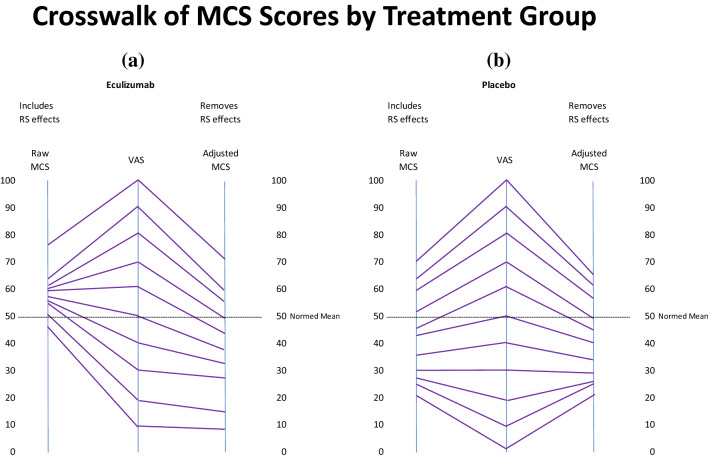
This secondary analysis utilized NMOSD clinical trial data evaluating the impact of Eculizumab in preventing relapses (n = 143). Analyses began by equating raw scores from the VAS, MCS, and PCS, and computing scores that removed response-shift effects. Correlation analysis and descriptive displays provided a more comprehensive examination of response-shift effects.
MCS and PCS crosswalks with VAS equated the scores that include and exclude response-shift effects. These two sets of scores had low shared variance for MCS for both groups, suggesting that corresponding mental health constructs were substantially different. The shared variance contrast for physical health was distinct only for the Placebo group. The larger MCS response-shift effects were found at end of study for Placebo only and were more prominent at extremes of the MCS score distribution.
Our results reveal notable treatment group differences in MCS but not PCS response shifts, which can explain null results detected in previous work. The method introduced herein provides a way to provide further information about response-shift effects in clinical trial data.
在我们的相关论文中,随机截距模型(RIM)研究了比较依库珠单抗和安慰剂治疗视神经脊髓炎谱系疾病(NMOSD)患者的临床试验中的反应转移效应。RIM 使用 EQ-5D 视觉模拟量表(VAS)项目预测全球健康,涵盖了人们可能考虑的广泛标准。SF36™v2 心理和生理成分评分(MCS 和 PCS)帮助我们检测 VAS 中的反应转移。在这里,我们试图“反向翻译” VAS 成如果没有反应转移就会观察到的 MCS/PCS 评分。
这项二次分析利用 NMOSD 临床试验数据评估了依库珠单抗对预防复发的影响(n=143)。分析首先通过平衡 VAS、MCS 和 PCS 的原始分数,并计算去除反应转移效应的分数。相关性分析和描述性显示提供了对反应转移效应更全面的检查。
VAS 与 MCS 和 PCS 的交叉点使包含和排除反应转移效应的分数相等。对于两个组,这两组分数的 MCS 之间的共享方差较低,这表明相应的心理健康结构有很大的不同。只有安慰剂组的身体健康共享方差对比具有明显的区别。仅在安慰剂组的研究结束时发现更大的 MCS 反应转移效应,并且在 MCS 评分分布的极端处更为明显。
我们的结果揭示了 MCS 中显著的治疗组差异,但 PCS 反应转移没有差异,这可以解释以前工作中检测到的无效结果。本文介绍的方法提供了一种在临床试验数据中提供有关反应转移效应的进一步信息的方法。