Medical Oncology and Breast Unit, University Hospital of Parma, Parma, Italy; Italian Oncology Group for Clinical Research (GOIRC), Parma, Italy; Department of Medicine and Surgery, University of Parma, Parma, Italy.
Hospital of Piacenza, Piacenza, Italy.
ESMO Open. 2021 Feb;6(1):100019. doi: 10.1016/j.esmoop.2020.100019. Epub 2020 Dec 31.
The combination of a microtubule inhibitor (eribulin) with a nucleoside analog (gemcitabine) may synergistically induce tumor cell death, particularly in triple negative breast cancer (TNBC) characterized by high cell proliferation, aggressive behavior, and chemo-resistance.
This is an open-label, multicenter phase II study evaluating the combination of eribulin (0.88 mg/m) plus gemcitabine (1000 mg/m) on days 1 and 8 of a 21-day cycle as either first- or second-line treatment of locally advanced or metastatic TNBC. The primary endpoint was the objective response for evaluable patients. A prospective, molecular correlative study was carried out to assess the role of germinal BRCA pathogenic variants and single nucleotide polymorphisms (SNPs) in predicting efficacy and toxicity of the combination regimen.
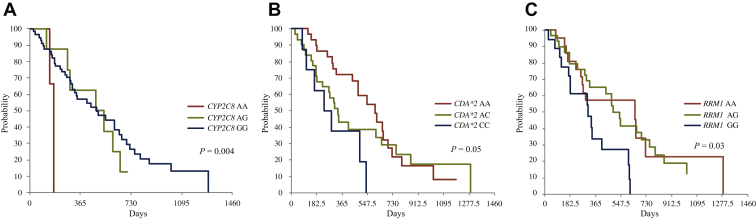
From July 2013 to September 2016, 83 evaluable patients were enrolled. They received a median number of six cycles of treatment. An overall response rate (ORR) of 37.3% (31 patients) was observed, with a complete response rate of 2.4% and a partial response rate of 34.9%; the clinical benefit rate was 48.8%. With a median follow-up of 28.8 months, the median response duration was 6.6 months, the median progression-free survival (PFS) was 5.1 months, and the median overall survival (OS) was 14.5 months. The most common grade 3-4 adverse events were aminotransferase elevation (in 25% of the patients) and neutropenia (in 23.8%). Women with BRCA1/2 pathogenic variants were associated with worse ORR, PFS, and OS than BRCA1/2 wild-type carriers. CYP3A4 and FGD4 SNPs were associated with increased risk of liver toxicity. Three different SNPs in CDA∗2, RRM1, and CYP2C8 genes were significantly associated with poorer OS.
The combination of eribulin and gemcitabine showed promising activity and a moderate toxicity profile in metastatic TNBC. BRCA status and pharmacogenetics tests may help identify patients with high probability of response with negligible toxicity.
2012-003505-10.
微管抑制剂(艾立布林)与核苷类似物(吉西他滨)联合使用可能会协同诱导肿瘤细胞死亡,尤其是在三阴性乳腺癌(TNBC)中,这种癌症具有高细胞增殖、侵袭性行为和化疗耐药性等特征。
这是一项开放标签、多中心的 II 期研究,评估了艾立布林(0.88mg/m2)加吉西他滨(1000mg/m2)在 21 天周期的第 1 天和第 8 天联合应用于局部晚期或转移性 TNBC 的一线或二线治疗。主要终点是可评估患者的客观缓解率。前瞻性的分子相关性研究旨在评估生殖系 BRCA 致病性变异和单核苷酸多态性(SNP)在预测联合治疗方案疗效和毒性中的作用。
从 2013 年 7 月至 2016 年 9 月,共纳入 83 例可评估患者。他们接受了中位数为 6 个周期的治疗。观察到总缓解率(ORR)为 37.3%(31 例),完全缓解率为 2.4%,部分缓解率为 34.9%;临床获益率为 48.8%。中位随访 28.8 个月时,中位缓解持续时间为 6.6 个月,中位无进展生存期(PFS)为 5.1 个月,中位总生存期(OS)为 14.5 个月。最常见的 3-4 级不良事件为氨基转移酶升高(25%的患者)和中性粒细胞减少(23.8%)。BRCA1/2 致病性变异携带者的 ORR、PFS 和 OS 较 BRCA1/2 野生型携带者更差。CYP3A4 和 FGD4SNP 与肝毒性风险增加相关。CDA∗2、RRM1 和 CYP2C8 基因中的 3 个不同 SNP 与较差的 OS 显著相关。
艾立布林联合吉西他滨在转移性 TNBC 中显示出有希望的疗效和中等毒性特征。BRCA 状态和药物遗传学检测可能有助于识别具有高反应概率和最小毒性的患者。
EudraCT 编号:2012-003505-10。