
二苯甲酮-3对乳腺肿瘤发生的促进作用取决于饮食。
Benzophenone-3 promotion of mammary tumorigenesis is diet-dependent.
作者信息
Kariagina Anastasia, Morozova Elena, Hoshyar Reyhane, Aupperlee Mark D, Borin Mitchell A, Haslam Sandra Z, Schwartz Richard C
机构信息
Breast Cancer and the Environment Research Program, Department of Microbiology and Molecular Genetics, Michigan State University, East Lansing, MI, USA.
Breast Cancer and the Environment Research Program, Department of Physiology, Michigan State University, East Lansing, MI, USA.
出版信息
Oncotarget. 2020 Dec 1;11(48):4465-4478. doi: 10.18632/oncotarget.27831.
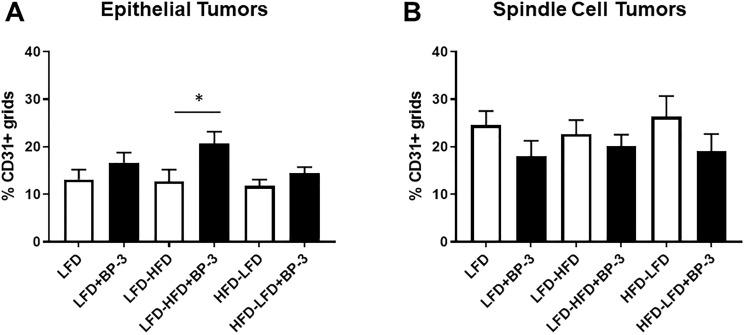
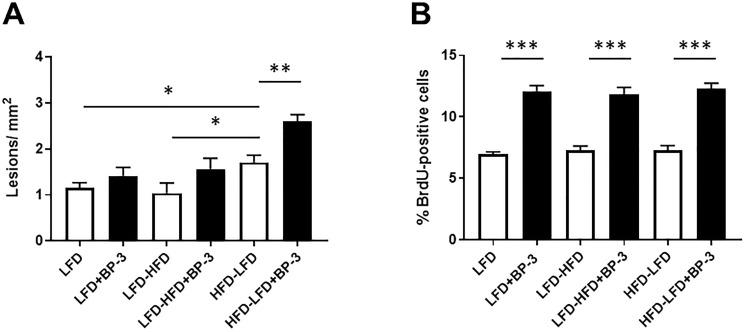
Benzophenone-3 is a putative endocrine disrupting chemical and common ingredient in sunscreens. The potential of endocrine disrupting chemicals to act as agonists or antagonists in critical hormonally regulated processes, such as mammary gland development and mammary tumorigenesis, demands evaluation of its potential in promoting breast cancer. This study identifies the effects of BP-3 on mammary tumorigenesis with high-fat diet during puberty versus adulthood in - transplant BALB/c mice. Benzophenone-3 exposure yielded levels in urine similar to humans subjected to heavy topical sunscreen exposure. Benzophenone-3 was protective for epithelial tumorigenesis in mice fed lifelong low-fat diet, while promotional for epithelial tumorigenesis in mice fed adult high-fat diet. Benzophenone-3 increased tumor cell proliferation, decreased tumor cell apoptosis, and increased tumor vascularity dependent on specific dietary regimen and tumor histopathology. Even in instances of an ostensibly protective effect, other parameters suggest greater risk. Although benzophenone-3 seemed protective on low-fat diet, spindle cell tumors arising in these mice showed increased proliferation and decreased apoptosis. This points to a need for further studies of benzophenone-3 in both animal models and humans as a potential breast cancer risk factor, as well as a more general need to evaluate endocrine disrupting chemicals in varying dietary contexts.
二苯甲酮-3是一种公认的内分泌干扰化学物质,也是防晒霜中的常见成分。内分泌干扰化学物质在关键的激素调节过程(如乳腺发育和乳腺肿瘤发生)中充当激动剂或拮抗剂的可能性,要求对其促进乳腺癌的潜力进行评估。本研究确定了在移植的BALB/c小鼠中,青春期与成年期高脂饮食情况下二苯甲酮-3对乳腺肿瘤发生的影响。二苯甲酮-3暴露后尿液中的含量与大量局部涂抹防晒霜的人类相似。二苯甲酮-3对终生喂食低脂饮食的小鼠的上皮肿瘤发生具有保护作用,而对喂食成年高脂饮食的小鼠的上皮肿瘤发生具有促进作用。二苯甲酮-3会增加肿瘤细胞增殖,减少肿瘤细胞凋亡,并根据特定的饮食方案和肿瘤组织病理学增加肿瘤血管生成。即使在表面上有保护作用的情况下,其他参数也表明风险更大。尽管二苯甲酮-3在低脂饮食中似乎具有保护作用,但这些小鼠中出现的梭形细胞瘤显示增殖增加且凋亡减少。这表明有必要在动物模型和人类中进一步研究二苯甲酮-3作为潜在的乳腺癌风险因素,以及更普遍地需要在不同饮食背景下评估内分泌干扰化学物质。


 Zotero 插件