Boikos Constantina, Fischer Lauren, O'Brien Dan, Vasey Joe, Sylvester Gregg C, Mansi James A
Seqirus Inc., Kirkland, Quebec, Canada.
Veradigm, San Francisco, California, USA.
Clin Infect Dis. 2021 Aug 2;73(3):e692-e698. doi: 10.1093/cid/ciaa1944.
The cell-propagated inactivated quadrivalent influenza vaccine (ccIIV4) may offer improved protection in seasons where egg-derived influenza viruses undergo mutations that affect antigenicity. This study estimated the relative vaccine effectiveness (rVE) of ccIIV4 versus egg-derived inactivated quadrivalent influenza vaccine (eIIV4) in preventing influenza-related medical encounters in the 2018-2019 US season.
A dataset linking primary care electronic medical records with medical claims data was used to conduct a retrospective cohort study among individuals ≥ 4 years old vaccinated with ccIIV4 or eIIV4 during the 2018-2019 season. Adjusted odds ratios (ORs) were derived from a doubly robust inverse probability of treatment-weighted approach adjusting for age, sex, race, ethnicity, geographic region, vaccination week, and health status. rVE was estimated by (1 - OR) × 100 and presented with 95% confidence intervals (CI).
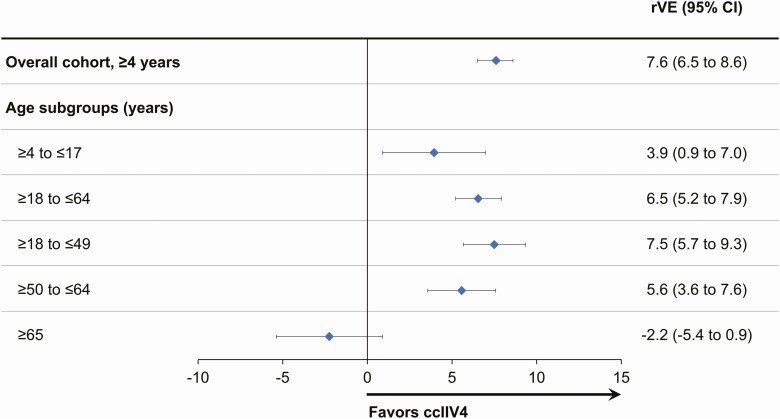
Following the application of inclusion/exclusion criteria, the study cohort included 2 125 430 ccIIV4 and 8 000 903 eIIV4 recipients. Adjusted analyses demonstrated a greater reduction in influenza-related medical encounters with ccIIV4 versus eIIV4, with the following rVE: overall, 7.6% (95% CI, 6.5-8.6); age 4-17 years, 3.9% (95% CI, .9-7.0); 18-64 years, 6.5% (95% CI, 5.2-7.9); 18-49 years, 7.5% (95% CI, 5.7-9.3); 50-64 years, 5.6% (95% CI, 3.6-7.6); and ≥65 years, -2.2% (95% CI, -5.4 to .9).
Adjusted analyses demonstrated statistically significantly greater reduction in influenza-related medical encounters in individuals vaccinated with ccIIV4 versus eIIV4 in the 2018-2019 US influenza season. These results support ccIIV4 as a potentially more effective public health measure against influenza than an egg-based equivalent.
细胞培养的四价流感灭活疫苗(ccIIV4)在鸡蛋来源的流感病毒发生影响抗原性的突变的季节可能提供更好的保护。本研究估计了2018 - 2019年美国流感季ccIIV4相对于鸡蛋来源的四价流感灭活疫苗(eIIV4)预防流感相关医疗就诊的相对疫苗效力(rVE)。
使用一个将初级保健电子病历与医疗理赔数据相链接的数据集,对2018 - 2019年流感季接种ccIIV4或eIIV4的4岁及以上个体进行回顾性队列研究。调整后的比值比(OR)来自双稳健逆概率治疗加权法,对年龄、性别、种族、民族、地理区域、接种周和健康状况进行了调整。rVE通过(1 - OR)×100进行估计,并给出95%置信区间(CI)。
应用纳入/排除标准后,研究队列包括2125430名ccIIV4接种者和8000903名eIIV4接种者。调整分析表明,与eIIV4相比,ccIIV4在减少流感相关医疗就诊方面效果更显著,rVE如下:总体为7.6%(95%CI,6.5 - 8.6);4 - 17岁为3.9%(95%CI,0.9 - 7.0);18 - 64岁为6.5%(95%CI,5.2 - 7.9);18 - 49岁为7.5%(95%CI,5.7 - 9.3);50 - 64岁为5.6%(95%CI,3.6 - 7.6);≥65岁为 - 2.2%(95%CI, - 5.4至0.9)。
调整分析表明,在2018 - 2019年美国流感季,接种ccIIV4的个体与接种eIIV4的个体相比,在减少流感相关医疗就诊方面有统计学上显著更大的效果。这些结果支持ccIIV4作为一种可能比基于鸡蛋的同类疫苗更有效的预防流感的公共卫生措施。