Department of Medicine, Hospital for Special Surgery, New York, NY, United States.
Department of Medicine, The George Washington School of Medicine and Health Sciences, Washington, DC, United States.
J Med Internet Res. 2021 Jan 14;23(1):e21408. doi: 10.2196/21408.
The use of social media assists in the distribution of COVID-19 information to the general public and health professionals. Alternative-level metrics (ie, altmetrics) and PlumX metrics are new bibliometrics that can assess how many times a scientific article has been shared and how much a scientific article has spread within social media platforms.
Our objective was to characterize and compare the traditional bibliometrics (ie, citation count and impact factors) and new bibliometrics (ie, Altmetric Attention Score [AAS] and PlumX score) of the top 100 COVID-19 articles with the highest AASs.
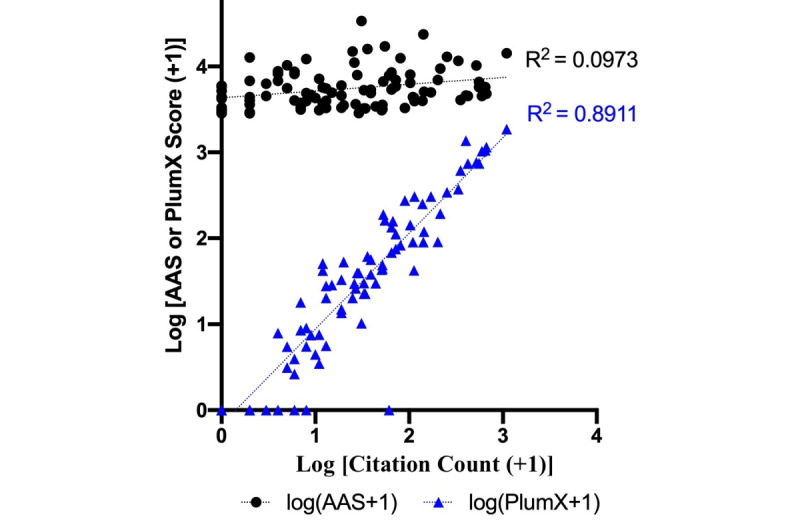
The top 100 articles with highest AASs were identified with Altmetric Explorer in May 2020. The AASs, journal names, and the number of mentions in various social media databases of each article were collected. Citation counts and PlumX Field-Weighted Citation Impact scores were collected from the Scopus database. Additionally, AASs, PlumX scores, and citation counts were log-transformed and adjusted by +1 for linear regression, and Spearman correlation coefficients were used to determine correlations.
The median AAS, PlumX score, and citation count were 4922.50, 37.92, and 24.00, respectively. The New England Journal of Medicine published the most articles (18/100, 18%). The highest number of mentions (985,429/1,022,975, 96.3%) were found on Twitter, making it the most frequently used social media platform. A positive correlation was observed between AAS and citation count (r=0.0973; P=.002), and between PlumX score and citation count (r=0.8911; P<.001).
Our study demonstrated that citation count weakly correlated with AASs and strongly correlated with PlumX scores, with regard to COVID-19 articles at this point in time. Altmetric and PlumX metrics should be used to complement traditional citation counts when assessing the dissemination and impact of a COVID-19 article.
社交媒体的使用有助于向公众和卫生专业人员传播 COVID-19 信息。替代水平指标(即 altmetrics)和 PlumX 指标是新的文献计量学,可以评估一篇科学文章被分享的次数以及该文章在社交媒体平台上的传播程度。
我们的目的是描述和比较前 100 篇具有最高 altmetrics 得分的 COVID-19 文章的传统文献计量学(即引文数和影响因子)和新文献计量学(即 Altmetric Attention Score [AAS] 和 PlumX 得分)。
2020 年 5 月,使用 Altmetric Explorer 确定了前 100 篇具有最高 AAS 的文章。收集了每个文章的 AAS、期刊名称以及在各种社交媒体数据库中的提及次数。从 Scopus 数据库中收集了引文数和 PlumX 领域加权引文影响得分。此外,将 AAS、PlumX 得分和引文数进行对数转换并加 1 进行线性回归,使用 Spearman 相关系数确定相关性。
中位数 AAS、PlumX 得分和引文数分别为 4922.50、37.92 和 24.00。《新英格兰医学杂志》(New England Journal of Medicine)发表的文章最多(18/100,18%)。在 Twitter 上发现的提及次数最多(985429/1022975,96.3%),使其成为最常用的社交媒体平台。AAS 与引文数之间存在正相关关系(r=0.0973;P=.002),PlumX 得分与引文数之间存在强相关关系(r=0.8911;P<.001)。
本研究表明,就此时的 COVID-19 文章而言,引文数与 AAS 呈弱相关,与 PlumX 得分呈强相关。在评估 COVID-19 文章的传播和影响时,应使用替代计量和 PlumX 指标来补充传统的引文计数。