Anastasilakis Athanasios D, Makras Polyzois, Yavropoulou Maria P, Tabacco Gaia, Naciu Anda Mihaela, Palermo Andrea
Department of Endocrinology, 424 General Military Hospital, 564 29 Thessaloniki, Greece.
Department of Endocrinology and Diabetes and Department of Medical Research, 251 Hellenic Air Force & VA General Hospital, 115 25 Athens, Greece.
J Clin Med. 2021 Jan 4;10(1):152. doi: 10.3390/jcm10010152.
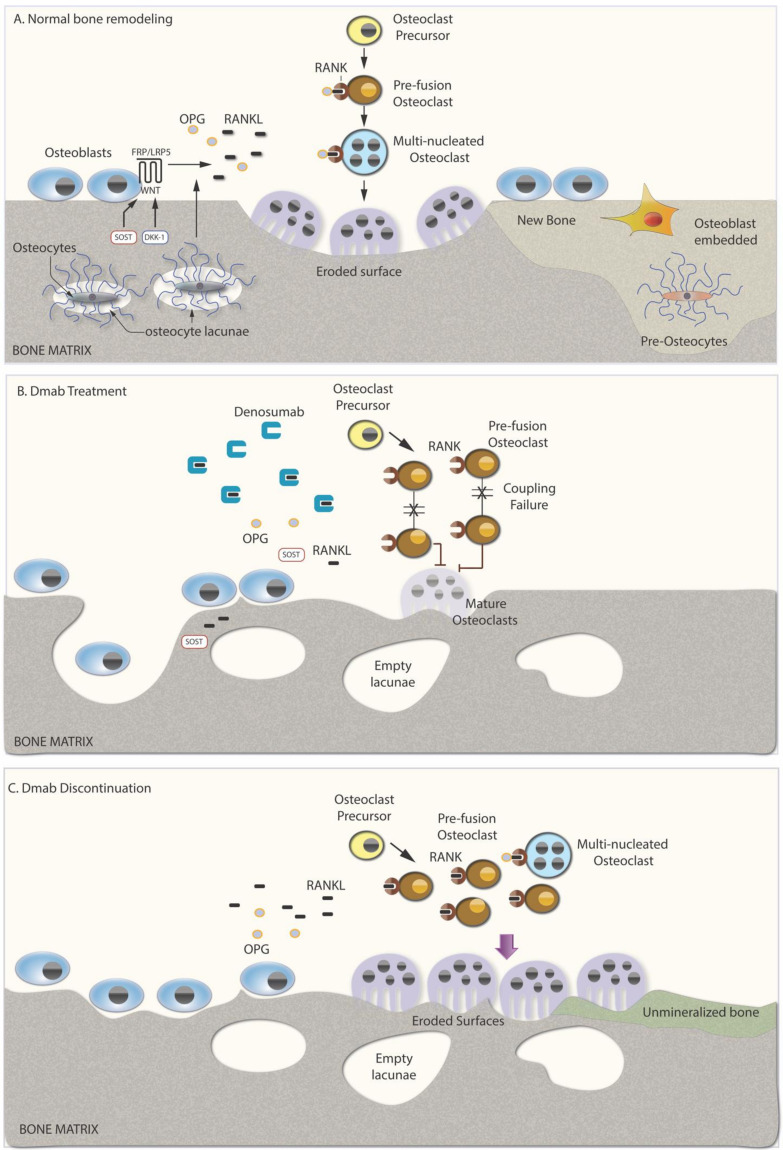
Denosumab is a potent antiresorptive agent that substantially increases bone mineral density and reduces fracture rates at all skeletal sites for as long as it is administered. However, its favorable skeletal effects reverse quickly upon its discontinuation, because of a vast increase of osteoclast number and activity, which leads to a subsequent profound increase of bone turnover above pre-treatment values, a phenomenon commonly described as "rebound phenomenon". More importantly, most patients experience rapid, profound bone loss due to this burst of bone resorption that may lead in a minority of these patients to occurrence of fractures, especially multiple vertebral fractures. Therefore, subsequent antiresorptive treatment is mandatory, although the optimal regimen is yet to be clarified. In the present review, we outline what is currently known regarding the negative effects of denosumab discontinuation on different aspects of bone status, the factors that may affect them, and strategies to prevent them.
地诺单抗是一种强效抗骨吸收药物,在给药期间可显著提高骨矿物质密度并降低所有骨骼部位的骨折发生率。然而,停药后其有益的骨骼效应会迅速逆转,这是因为破骨细胞数量和活性大幅增加,导致骨转换随后显著高于治疗前水平,这种现象通常被称为“反跳现象”。更重要的是,大多数患者会因这种骨吸收激增而经历快速、严重的骨质流失,少数患者可能会因此发生骨折,尤其是多发性椎体骨折。因此,后续的抗骨吸收治疗是必要的,尽管最佳治疗方案尚未明确。在本综述中,我们概述了目前已知的关于停用 地诺单抗对骨骼状态不同方面的负面影响、可能影响这些影响的因素以及预防这些影响的策略。