Department of Psychological Sciences, Purdue University, West Lafayette, IN, USA.
Department of Speech, Language, and Hearing Sciences, Purdue University, West Lafayette, IN, USA.
J Neurodev Disord. 2021 Jan 6;13(1):5. doi: 10.1186/s11689-020-09351-0.
Autism spectrum disorder (ASD) is associated with hyper- and/or hypo-sensitivity to sensory input. Spontaneous alpha power, which plays an important role in shaping responsivity to sensory information, is reduced across the lifespan in individuals with ASD. Furthermore, an excitatory/inhibitory imbalance has also been linked to sensory dysfunction in ASD and has been hypothesized to underlie atypical patterns of spontaneous brain activity. The present study examined whether resting-state alpha power differed in children with ASD as compared to TD children, and investigated the relationships between alpha levels, concentrations of excitatory and inhibitory neurotransmitters, and atypical sensory processing in ASD.
Participants included thirty-one children and adolescents with ASD and thirty-one age- and IQ-matched typically developing (TD) participants. Resting-state electroencephalography (EEG) was used to obtain measures of alpha power. A subset of participants (ASD = 16; TD = 16) also completed a magnetic resonance spectroscopy (MRS) protocol in order to measure concentrations of excitatory (glutamate + glutamine; Glx) and inhibitory (GABA) neurotransmitters.
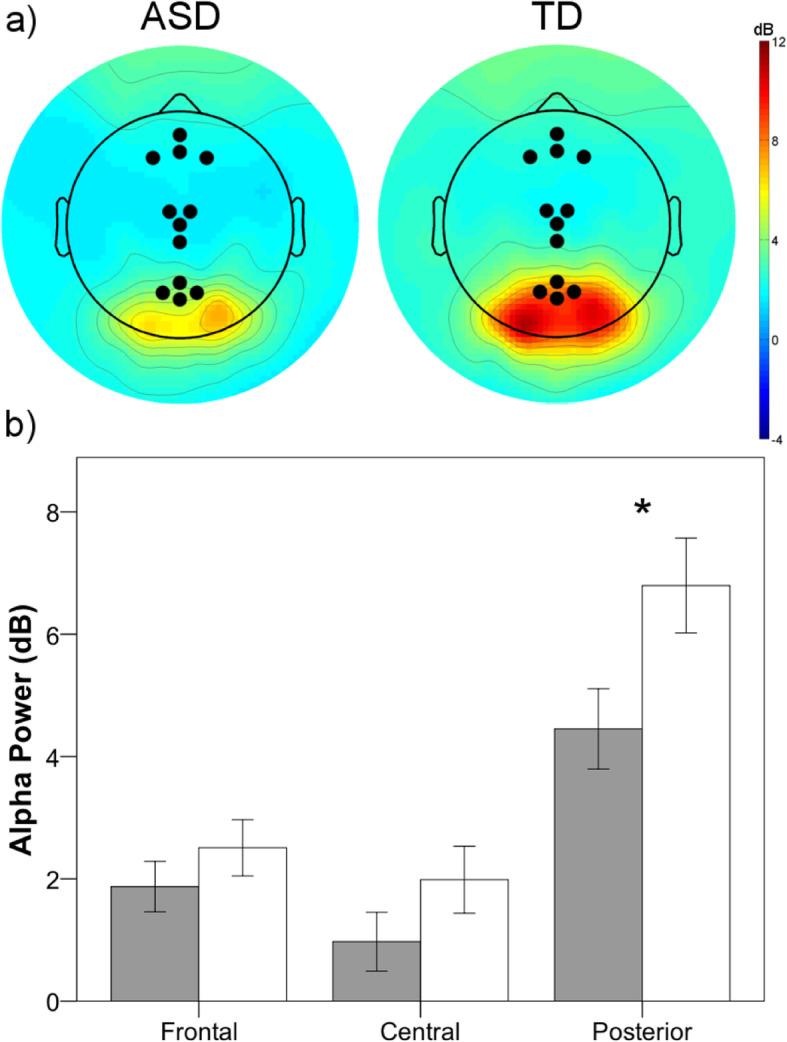
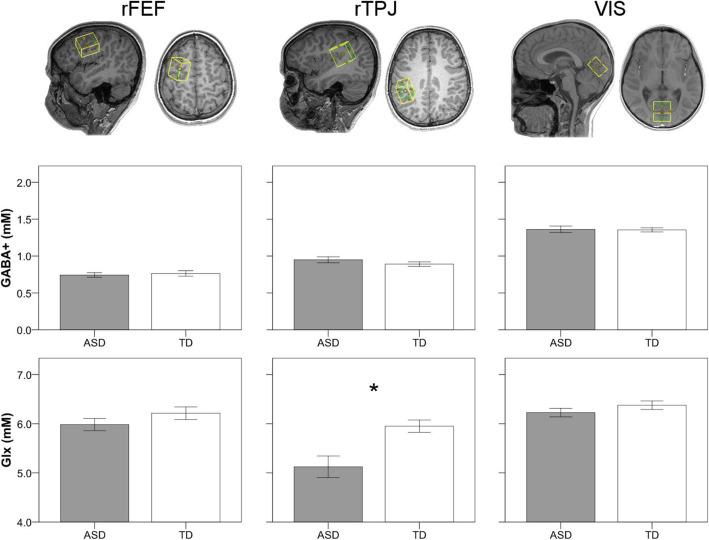
Children with ASD evidenced significantly decreased resting alpha power compared to their TD peers. MRS estimates of GABA and Glx did not differ between groups with the exception of Glx in the temporal-parietal junction. Inter-individual differences in alpha power within the ASD group were not associated with region-specific concentrations of GABA or Glx, nor were they associated with sensory processing differences. However, atypically decreased Glx was associated with increased sensory impairment in children with ASD.
Although we replicated prior reports of decreased alpha power in ASD, atypically reduced alpha was not related to neurochemical differences or sensory symptoms in ASD. Instead, reduced Glx in the temporal-parietal cortex was associated with greater hyper-sensitivity in ASD. Together, these findings may provide insight into the neural underpinnings of sensory processing differences present in ASD.
自闭症谱系障碍(ASD)与对感觉输入的超敏和/或低敏有关。自发阿尔法功率在塑造对感觉信息的反应能力方面起着重要作用,在 ASD 患者的整个生命周期中都会降低。此外,兴奋性/抑制性失衡也与 ASD 中的感觉功能障碍有关,并被假设为异常自发脑活动模式的基础。本研究比较了 ASD 儿童与 TD 儿童的静息状态阿尔法功率是否存在差异,并探讨了阿尔法水平、兴奋性和抑制性神经递质浓度与 ASD 中异常感觉处理之间的关系。
参与者包括 31 名 ASD 儿童和青少年以及 31 名年龄和智商匹配的典型发育(TD)参与者。使用静息态脑电图(EEG)获取阿尔法功率测量值。一小部分参与者(ASD=16;TD=16)还完成了磁共振波谱(MRS)方案,以测量兴奋性(谷氨酸+谷氨酰胺;Glx)和抑制性(GABA)神经递质的浓度。
与 TD 同龄人相比,ASD 儿童的静息阿尔法功率明显降低。除颞顶联合区的 Glx 外,两组间的 MRS 估计的 GABA 和 Glx 浓度没有差异。ASD 组内个体间的阿尔法功率差异与 GABA 或 Glx 的区域特异性浓度无关,也与感觉处理差异无关。然而,异常降低的 Glx 与 ASD 儿童的感觉障碍增加有关。
虽然我们复制了先前关于 ASD 中阿尔法功率降低的报告,但异常降低的阿尔法与 ASD 中的神经化学差异或感觉症状无关。相反,颞顶叶皮质中的 Glx 减少与 ASD 中的超敏反应增加有关。这些发现可能为 ASD 中存在的感觉处理差异的神经基础提供了一些见解。