Molecular and Cellular Biology Program, Ohio University, Athens, OH, 45701-2979, USA.
Department of Environmental & Plant Biology, Ohio University, Athens, OH, 45701-2979, USA.
BMC Plant Biol. 2021 Jan 6;21(1):16. doi: 10.1186/s12870-020-02791-9.
Arabinogalactan-proteins (AGPs) are a class of hydroxyproline-rich proteins (HRGPs) that are heavily glycosylated (> 90%) with type II arabinogalactans (AGs). AGPs are implicated in various plant growth and development processes including cell expansion, somatic embryogenesis, root and stem growth, salt tolerance, hormone signaling, male and female gametophyte development, and defense. To date, eight Hyp-O-galactosyltransferases (GALT2-6, HPGT1-3) have been identified; these enzymes are responsible for adding the first sugar, galactose, onto AGPs. Due to gene redundancy among the GALTs, single or double galt genetic knockout mutants are often not sufficient to fully reveal their biological functions.
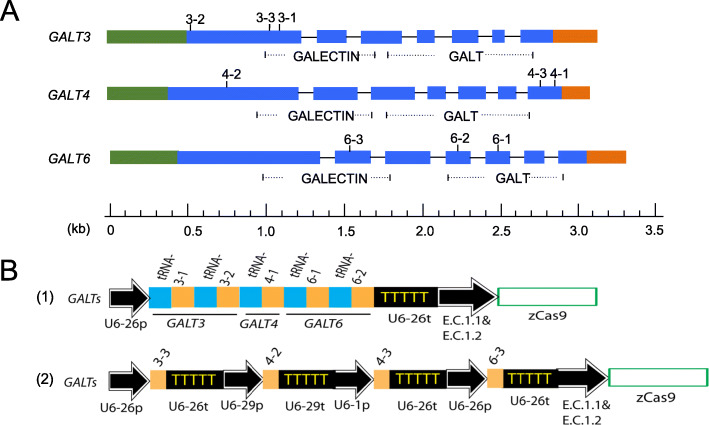
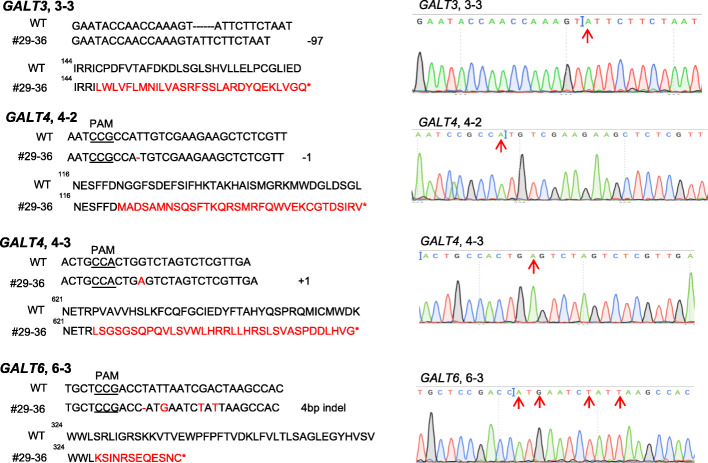
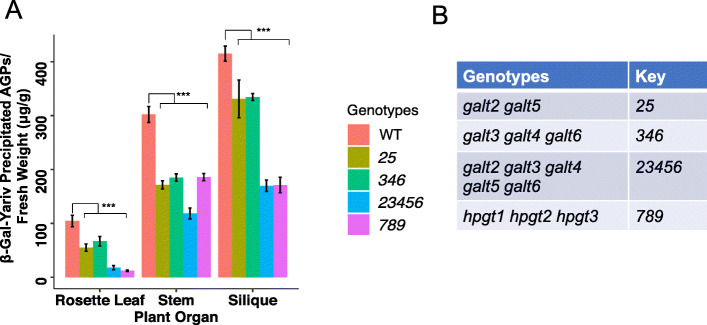
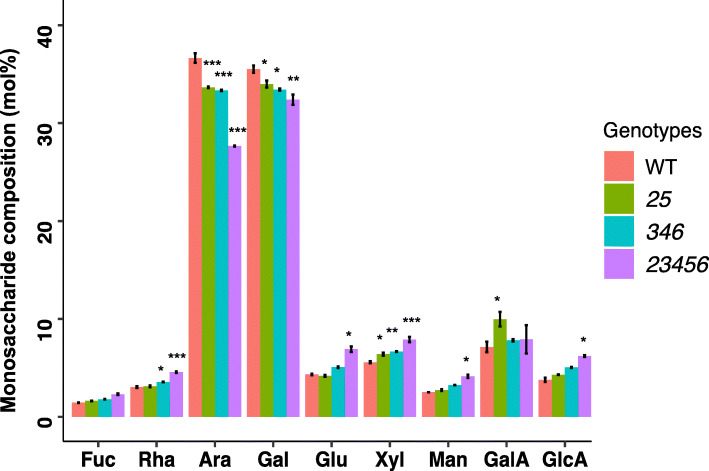
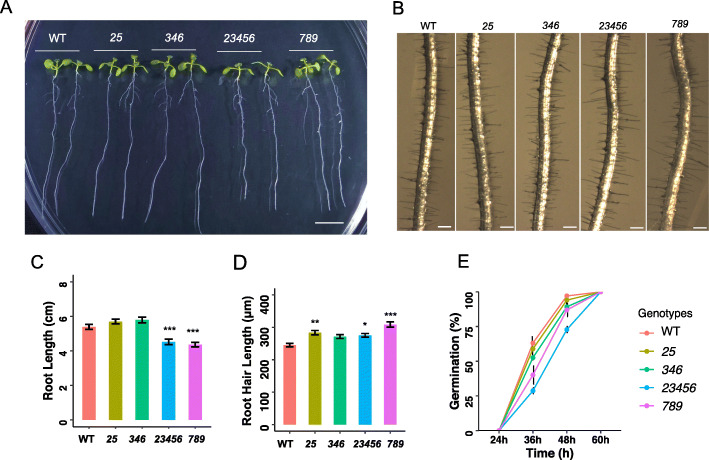
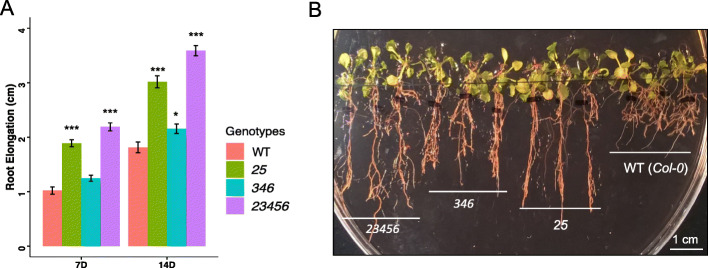
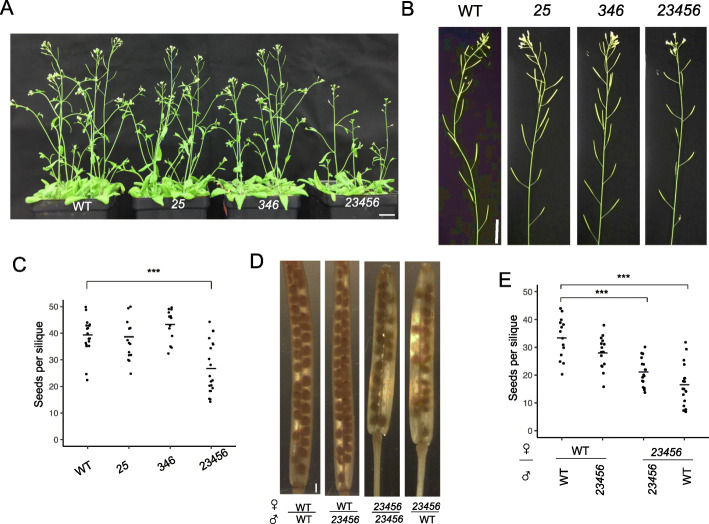
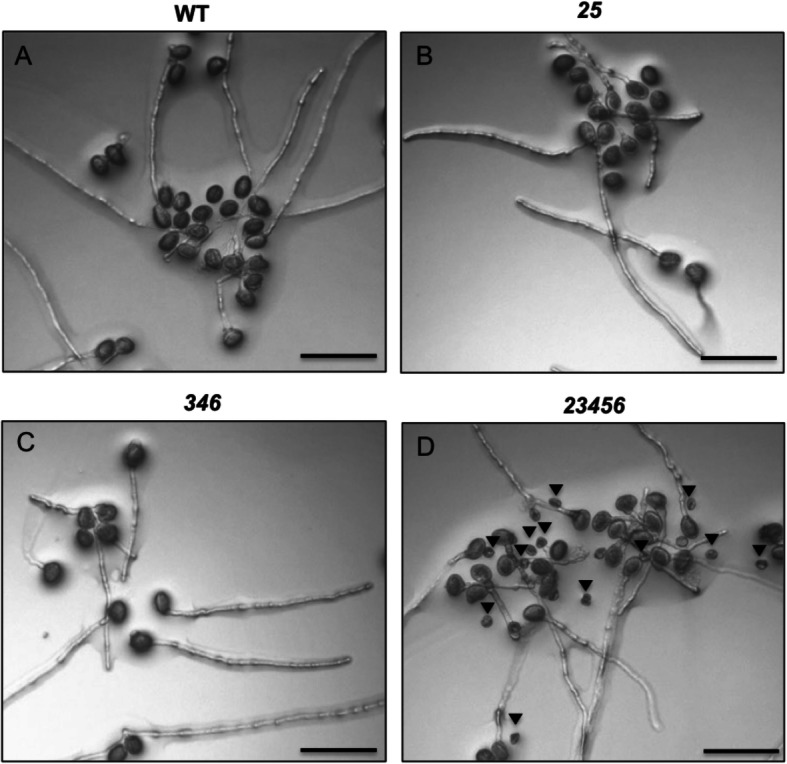
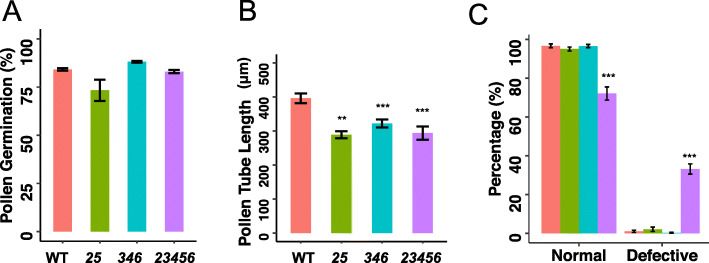
Here, we report the successful application of CRISPR-Cas9 gene editing/multiplexing technology to generate higher-order knockout mutants of five members of the GALT gene family (GALT2-6). AGPs analysis of higher-order galt mutants (galt2 galt5, galt3 galt4 galt6, and galt2 galt3 galt4 galt5 gal6) demonstrated significantly less glycosylated AGPs in rosette leaves, stems, and siliques compared to the corresponding wild-type organs. Monosaccharide composition analysis of AGPs isolated from rosette leaves revealed significant decreases in arabinose and galactose in all the higher-order galt mutants. Phenotypic analyses revealed that mutation of two or more GALT genes was able to overcome the growth inhibitory effect of β-D-Gal-Yariv reagent, which specifically binds to β-1,3-galactan backbones on AGPs. In addition, the galt2 galt3 galt4 galt5 gal6 mutant exhibited reduced overall growth, impaired root growth, abnormal pollen, shorter siliques, and reduced seed set. Reciprocal crossing experiments demonstrated that galt2 galt3 galt4 galt5 gal6 mutants had defects in the female gametophyte which were responsible for reduced seed set.
Our CRISPR/Cas9 gene editing/multiplexing approach provides a simpler and faster way to generate higher-order mutants for functional characterization compared to conventional genetic crossing of T-DNA mutant lines. Higher-order galt mutants produced and characterized in this study provide insight into the relationship between sugar decorations and the various biological functions attributed to AGPs in plants.
阿拉伯半乳聚糖蛋白(AGPs)是富含羟脯氨酸的蛋白(HRGPs)的一类,其高度糖基化(>90%),带有 II 型阿拉伯半乳糖(AGs)。AGPs 参与各种植物生长和发育过程,包括细胞扩张、体细胞胚胎发生、根和茎生长、耐盐性、激素信号转导、雌雄配子体发育和防御。迄今为止,已经鉴定出 8 种 Hyp-O-半乳糖基转移酶(GALT2-6、HPGT1-3);这些酶负责将第一个糖,半乳糖,添加到 AGPs 上。由于 GALT 之间存在基因冗余,单个或双 galt 基因敲除突变体通常不足以充分揭示其生物学功能。
在这里,我们报告了 CRISPR-Cas9 基因编辑/多重技术成功应用于产生五个 GALT 基因家族成员(GALT2-6)的更高阶敲除突变体。对更高阶 galt 突变体(galt2 galt5、galt3 galt4 galt6 和 galt2 galt3 galt4 galt5 gal6)的 AGPs 分析表明,与相应的野生型器官相比,在罗勒叶、茎和蒴果中的糖基化 AGPs 明显减少。从罗勒叶中分离的 AGPs 的单糖组成分析显示,所有更高阶的 galt 突变体中的阿拉伯糖和半乳糖都显著减少。表型分析表明,两个或更多 GALT 基因的突变能够克服β-D-Gal-Yariv 试剂的生长抑制作用,该试剂特异性结合 AGPs 上的β-1,3-半乳糖骨架。此外,galt2 galt3 galt4 galt5 gal6 突变体表现出整体生长减少、根生长受损、花粉异常、蒴果变短和种子产量降低。正反交实验表明,galt2 galt3 galt4 galt5 gal6 突变体在雌性配子体中存在缺陷,这是导致种子产量降低的原因。
与传统的 T-DNA 突变株遗传杂交相比,我们的 CRISPR/Cas9 基因编辑/多重技术提供了一种更简单、更快的方法来生成用于功能表征的更高阶突变体。本研究中产生和表征的更高阶 galt 突变体为糖基化与 AGPs 在植物中归因于各种生物学功能之间的关系提供了深入了解。