Merck &Co., Inc., Kenilworth, NJ, USA.
Center for Observational and Real-world Evidence (CORE), Merck & Co., Inc., WP37A-150, PO Box 1000, West Point, PA, 19486, USA.
BMC Infect Dis. 2021 Jan 6;21(1):11. doi: 10.1186/s12879-020-05632-0.
Combined with cancer screening programs, vaccination against human papillomavirus (HPV) can significantly reduce the high health and economic burden of HPV-related disease in Japan. The objective of this study was to assess the health impact and cost effectiveness of routine and catch-up vaccination of girls and women aged 11-26 years with a 4-valent (4vHPV) or 9-valent HPV (9vHPV) vaccine in Japan compared with no vaccination.
We used a mathematical model adapted to the population and healthcare settings in Japan. We compared no vaccination and routine vaccination of 12-16-year old girls with 1) 4vHPV vaccine, 2) 9vHPV vaccine, and 3) 9vHPV vaccine in addition to a temporary catch-up vaccination of 17-26 years old girls and women with 9vHPV. We estimated the expected number of disease cases and deaths, discounted (at 2% per year) future costs (in 2020 ¥) and discounted quality-adjusted life years (QALY), and incremental cost effectiveness ratios (ICER) of each strategy over a time horizon of 100 years. To test the robustness of the conclusions, we conducted scenario and sensitivity analyses.
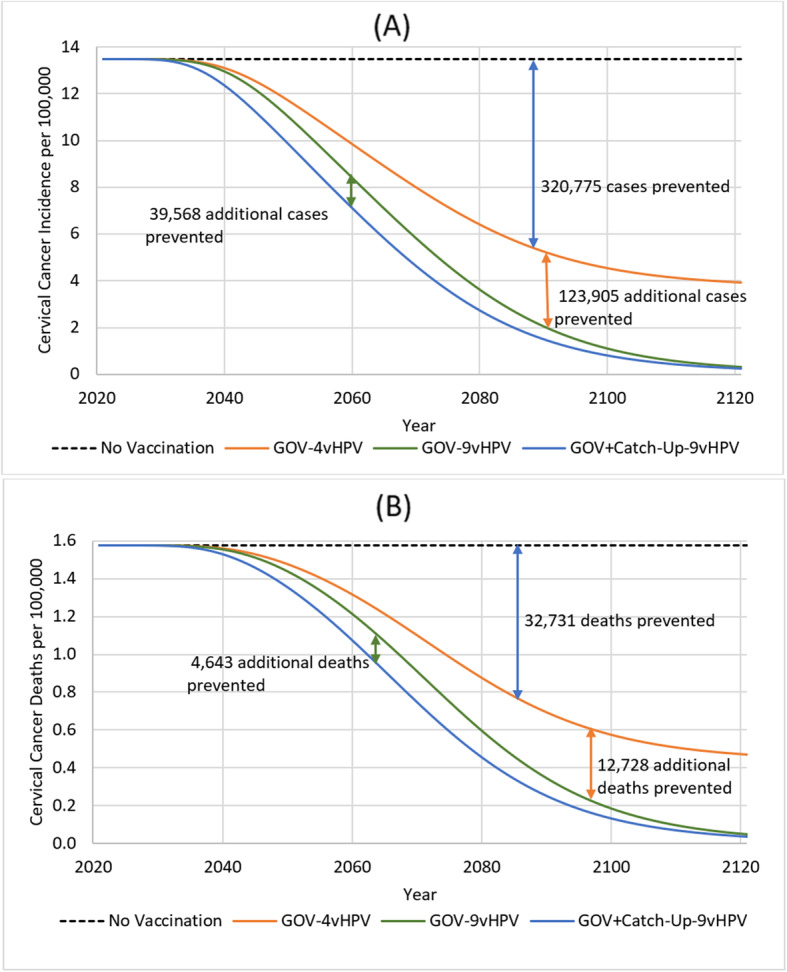
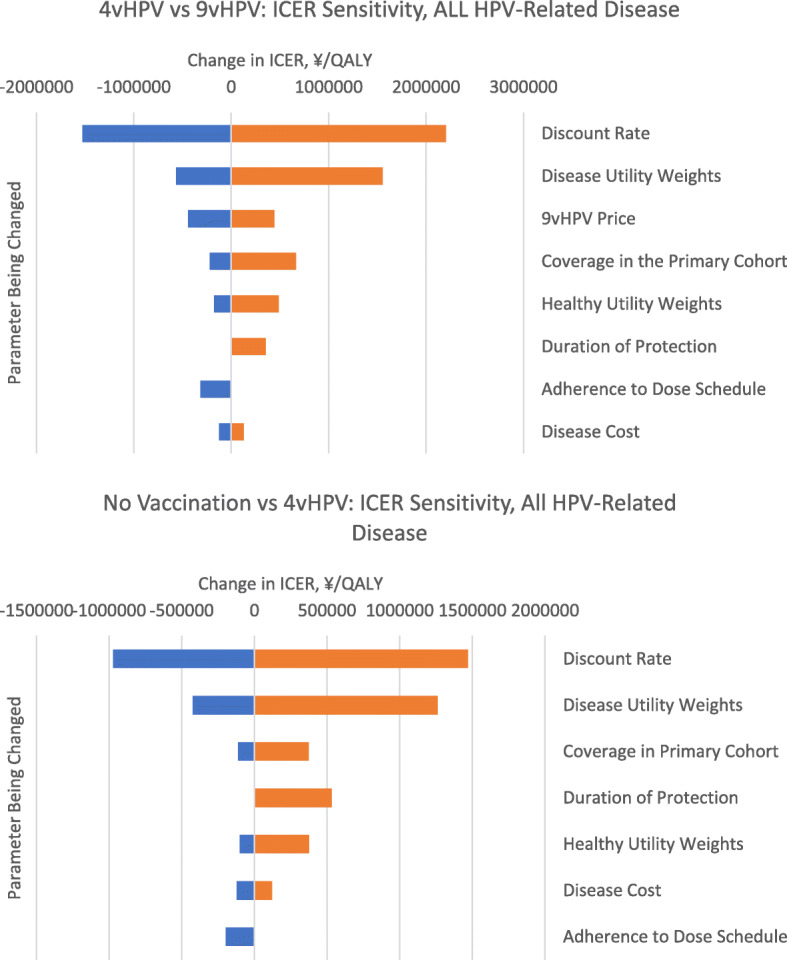
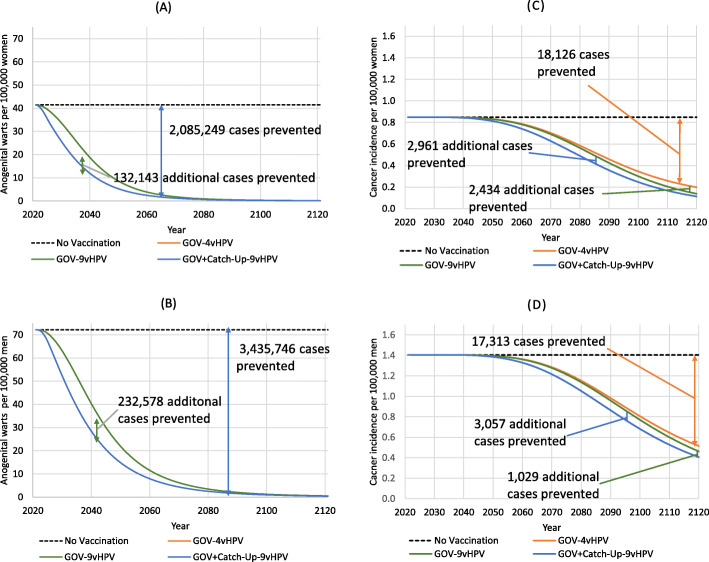
Over 100 years, compared with no vaccination, 9vHPV vaccination was projected to reduce the incidence of 9vHPV-related cervical cancer by 86% (from 15.24 new cases per 100,000 women in 2021 to 2.02 in 2121). A greater number of cervical cancer cases (484,248) and cancer-related deaths (50,102) were avoided through the described catch-up vaccination program. Routine HPV vaccination with 4vHPV or 9vHPV vaccine prevented 5,521,000 cases of anogenital warts among women and men. Around 23,520 and 21,400 diagnosed non-cervical cancers are prevented by catch-up vaccination among women and men, respectively. Compared with no vaccination, the ICER of 4vHPV vaccination was ¥975,364/QALY. Compared to 4vHPV, 9vHPV + Catch-up had an ICER of ¥1,534,493/QALY.
A vaccination program with a 9-valent vaccine targeting 12 to 16 year-old girls together with a temporary catchup program will avert significant numbers of cases of HPV-related diseases among both men and women. Furthermore, such a program was the most cost effective among the vaccination strategies we considered, with an ICER well below a threshold of ¥5000,000/QALY.
结合癌症筛查计划,接种人乳头瘤病毒(HPV)疫苗可以显著降低日本 HPV 相关疾病的高健康和经济负担。本研究的目的是评估在日本对 11-26 岁女孩常规接种和补种 4 价(4vHPV)或 9 价 HPV(9vHPV)疫苗与不接种疫苗相比的健康影响和成本效益。
我们使用了一种适用于日本人口和医疗保健环境的数学模型。我们将不接种疫苗与常规接种 12-16 岁女孩进行了比较:1)4vHPV 疫苗,2)9vHPV 疫苗,3)9vHPV 疫苗,外加 17-26 岁女孩和妇女的临时补种疫苗。我们估计了疾病病例和死亡人数,贴现(贴现率为每年 2%)未来成本(2020 年的日元)和贴现质量调整生命年(QALY),以及每种策略在 100 年时间范围内的增量成本效益比(ICER)。为了检验结论的稳健性,我们进行了情景和敏感性分析。
在 100 年内,与不接种疫苗相比,9vHPV 疫苗接种预计将使与 9vHPV 相关的宫颈癌发病率降低 86%(从 2021 年每 100,000 名妇女中 15.24 例新病例降至 2121 年的 2.02 例)。通过描述的补种疫苗计划,避免了 484,248 例宫颈癌病例和 50,102 例癌症相关死亡。常规接种 4vHPV 或 9vHPV 疫苗可预防妇女和男性 552.1 万例肛门生殖器疣。女性和男性分别通过补种疫苗预防约 23520 例和 21400 例非宫颈癌病例。与不接种疫苗相比,4vHPV 疫苗的 ICER 为 975,364 日元/QALY。与 4vHPV 相比,9vHPV+Catch-up 的 ICER 为 1534493 日元/QALY。
针对 12 至 16 岁女孩的 9 价疫苗接种计划加上临时补种计划将避免男性和女性中大量 HPV 相关疾病的发生。此外,与我们考虑的疫苗接种策略相比,该方案是最具成本效益的,其 ICER 远低于 500 万日元/QALY 的阈值。