RCSI & UCD Malaysia Campus, 4 Jalan Sepoy Lines, George Town, Penang, Malaysia.
Int Breastfeed J. 2021 Jan 6;16(1):4. doi: 10.1186/s13006-020-00353-1.
Ethnic Chinese mothers in Malaysia adhere to 30 days of traditional postpartum practices (the "confinement period") aimed at recuperation after delivery. Recently there has been an emergence of confinement centres (CCs) where mothers stay and receive traditional confinement care. Ethnic Chinese mothers have low breastfeeding rates. There are concerns that practices in CCs could contribute to this but no data exists. We described mothers' breastfeeding experiences at CCs and identified areas for potential improvement in breastfeeding support.
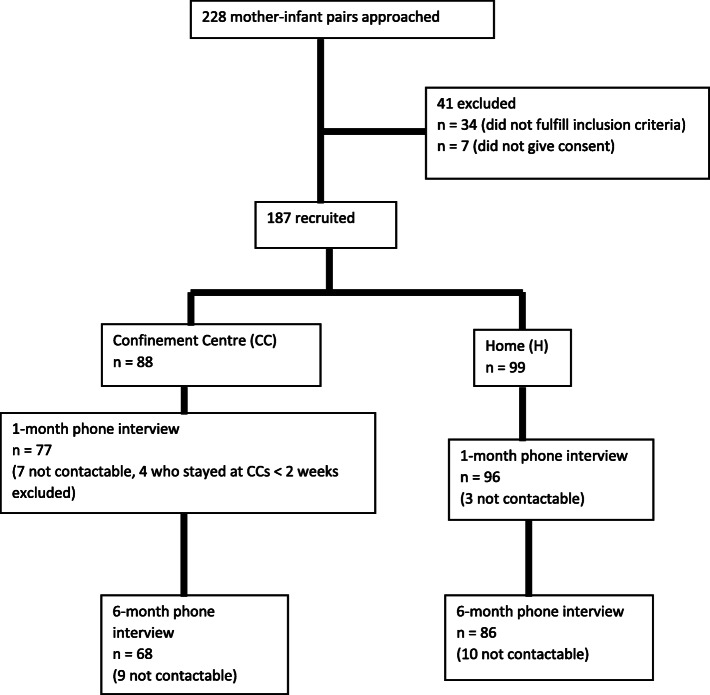
Ethnic Chinese mothers intending to breastfeed their healthy infants were recruited post-delivery between August and October 2017 then, at 1 and 6 months, they were telephone interviewed about their experience. For every participant going to a CC after the birth, another mother going home ("home") for her confinement was recruited. Chi-square test was used to compare groups and multiple logistic regression was used to assess the effect of confinement place on exclusive breastfeeding.
Of 187 mothers, 88 (47%) went to CCs. Significantly more were primipara and fewer had previous breastfeeding experience. Response rates for the 1- and 6- month interviews were 88% (CC) versus 97% (home); and 77% (CC) versus 87% (home) respectively. Exclusive breastfeeding rates were similar between the groups: 62% (CC) versus 56% (home) at 1 month (p = 0.4); and 37% (CC) versus 42% (home) at 6 months (p = 0.5). Multiple logistic regression did not show that CCs were a factor affecting exclusive breastfeeding rates at 1 month, (adjusted odds ratio [aOR] 1.7, 95% confidence interval [CI] 0.9, 3.3), or 6 months (aOR 0.9, 95% CI 0.4, 1.7). However, significantly more CC participants only fed expressed breast milk. Despite 66% of CC participants reporting that their centre supported breastfeeding, only 6 (8%) CC participants compared to 66 (69%) of home participants roomed-in with their baby (p < 0.001). The proportion encountering breastfeeding difficulties were similar between groups. CC participants sought help for breastfeeding problems mainly from CC staff and support groups while home participants obtained help from friends and healthcare professionals.
Breastfeeding rates appeared to be similar at CCs and at home during the confinement period, but there were gaps in how CCs supported breastfeeding. Targeted training to CC staff to support breastfeeding may result in better outcomes for mothers staying in CCs.
马来西亚的华裔母亲遵循传统的产后 30 天习俗(“坐月子”),旨在分娩后进行康复。最近出现了一些产后护理中心(CCs),母亲们可以在那里入住并接受传统的产后护理。华裔母亲母乳喂养率较低。有人担心 CC 中的做法可能对此有所影响,但目前尚无相关数据。我们描述了母亲在 CC 中的母乳喂养经历,并确定了在母乳喂养支持方面可能需要改进的领域。
2017 年 8 月至 10 月,我们招募了打算用母乳喂养健康婴儿的华裔母亲,并在产后 1 个月和 6 个月时通过电话对她们的母乳喂养经历进行了访谈。对于每一位去 CC 分娩的母亲,我们都会招募一位选择在家(“家庭”)分娩的母亲。使用卡方检验比较组间差异,使用多因素逻辑回归评估产后护理场所对纯母乳喂养的影响。
在 187 位母亲中,88 位(47%)选择入住 CC。初产妇的比例显著更高,而有母乳喂养经验的母亲比例更低。1 个月和 6 个月访谈的应答率分别为 88%(CC)和 97%(家庭);77%(CC)和 87%(家庭)。两组的纯母乳喂养率相似:1 个月时为 62%(CC)和 56%(家庭)(p=0.4);6 个月时为 37%(CC)和 42%(家庭)(p=0.5)。多因素逻辑回归显示,CC 不是影响 1 个月时纯母乳喂养率的因素(调整后的优势比[aOR]1.7,95%置信区间[CI]0.9,3.3)或 6 个月时的纯母乳喂养率(aOR 0.9,95%CI 0.4,1.7)。然而,CC 组中只有更多的母亲只喂哺挤出的母乳。尽管 66%的 CC 参与者表示他们的中心支持母乳喂养,但只有 6 名(8%)CC 参与者与 66 名(69%)家庭参与者与婴儿同室(p<0.001)。两组报告遇到母乳喂养困难的比例相似。CC 参与者主要向 CC 工作人员和支持小组寻求母乳喂养问题的帮助,而家庭参与者则向朋友和医疗保健专业人员寻求帮助。
在“坐月子”期间,CC 和家庭的母乳喂养率似乎相似,但 CC 支持母乳喂养的方式存在差距。对 CC 工作人员进行母乳喂养方面的针对性培训可能会改善留在 CC 中的母亲的母乳喂养结局。