Department of Environmental Medicine and Public Health, Icahn School of Medicine at Mount Sinai, New York, NY, USA.
Department of Pediatrics, Kravis Children's Hospital, Icahn School of Medicine at Mount Sinai, New York, NY, USA.
Biol Sex Differ. 2021 Jan 6;12(1):6. doi: 10.1186/s13293-020-00348-x.
Fetal sex is known to modify the course and complications of pregnancy, with recent evidence of sex-differential fetal influences on the maternal immune and endocrine systems. In turn, heightened inflammation and surges in reproductive hormone levels associated with pregnancy and parturition have been linked with the development of perinatal depression. Here, we examined whether there is an association between fetal sex and maternal depression assessed during the prenatal and postnatal periods.
The study included two multi-ethnic, prospective pregnancy cohorts that enrolled women from prenatal clinics in the Northeastern United States between 2001 and 2018. Maternal depressive symptoms were measured during the prenatal and postnatal periods using the Edinburgh Postpartum Depression Scale (EPDS), and newborn sex was reported by the mother following delivery. We used logistic regression to examine associations between fetal sex and maternal depressive symptoms (EPDS > 10) during the prenatal period only, postnatal period only, or both periods versus no depressive symptoms during either period. We considered both unadjusted models and models adjusted for a core set of sociodemographic and lifestyle variables.
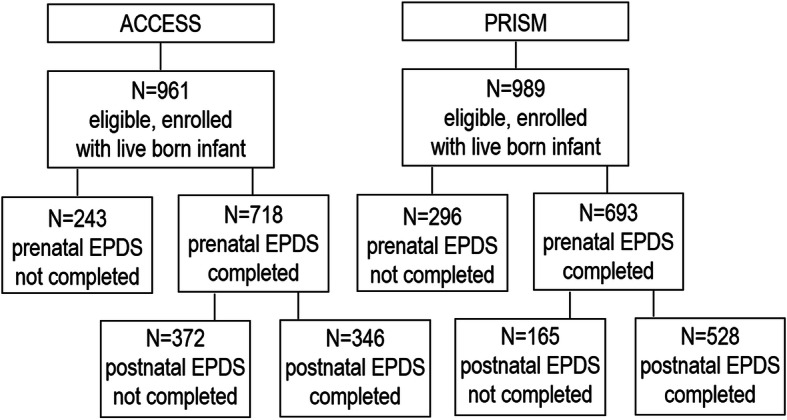
In adjusted models using PRISM data (N = 528), women pregnant with a male versus female fetus had significantly greater odds of depressive symptoms during the postnatal period compared to women without depressive symptoms during either period (odds ratio [OR] = 5.24, 95% confidence interval [CI] = 1.93, 14.21). The direction of results was consistent in the ACCESS cohort, although the findings did not reach statistical significance (OR = 2.05, 95% CI = 0.86, 4.93). Significant associations were not observed in either cohort among women with prenatal symptoms only or women with prenatal and postnatal symptoms.
Male fetal sex was associated with the onset of depressive symptoms during the postnatal period.
已知胎儿性别会影响妊娠的过程和并发症,最近有证据表明胎儿性别会对母体的免疫和内分泌系统产生差异影响。反过来,与妊娠和分娩相关的炎症加剧和生殖激素水平激增与围产期抑郁症的发展有关。在这里,我们研究了在产前和产后期间评估的胎儿性别与产妇抑郁之间是否存在关联。
这项研究包括两个多民族前瞻性妊娠队列,它们在 2001 年至 2018 年期间从美国东北部的产前诊所招募了女性。在产前和产后期间,使用爱丁堡产后抑郁量表(EPDS)评估产妇的抑郁症状,并且新生儿性别由母亲在分娩后报告。我们使用逻辑回归来检查胎儿性别与产前、产后或两个时期的产妇抑郁症状(EPDS > 10)之间的关联,而不是两个时期中任何一个时期都没有抑郁症状。我们考虑了未调整模型和调整了核心组社会人口统计学和生活方式变量的模型。
在使用 PRISM 数据(N = 528)的调整模型中,与产前两个时期都没有抑郁症状的女性相比,怀有男性胎儿的女性在产后期间出现抑郁症状的可能性显著更高(比值比 [OR] = 5.24,95%置信区间 [CI] = 1.93,14.21)。在 ACCESS 队列中,结果的方向是一致的,尽管结果没有达到统计学意义(OR = 2.05,95% CI = 0.86,4.93)。在仅产前有症状或产前和产后都有症状的女性中,两个队列中均未观察到显著关联。
男性胎儿性别与产后期间抑郁症状的发生有关。